
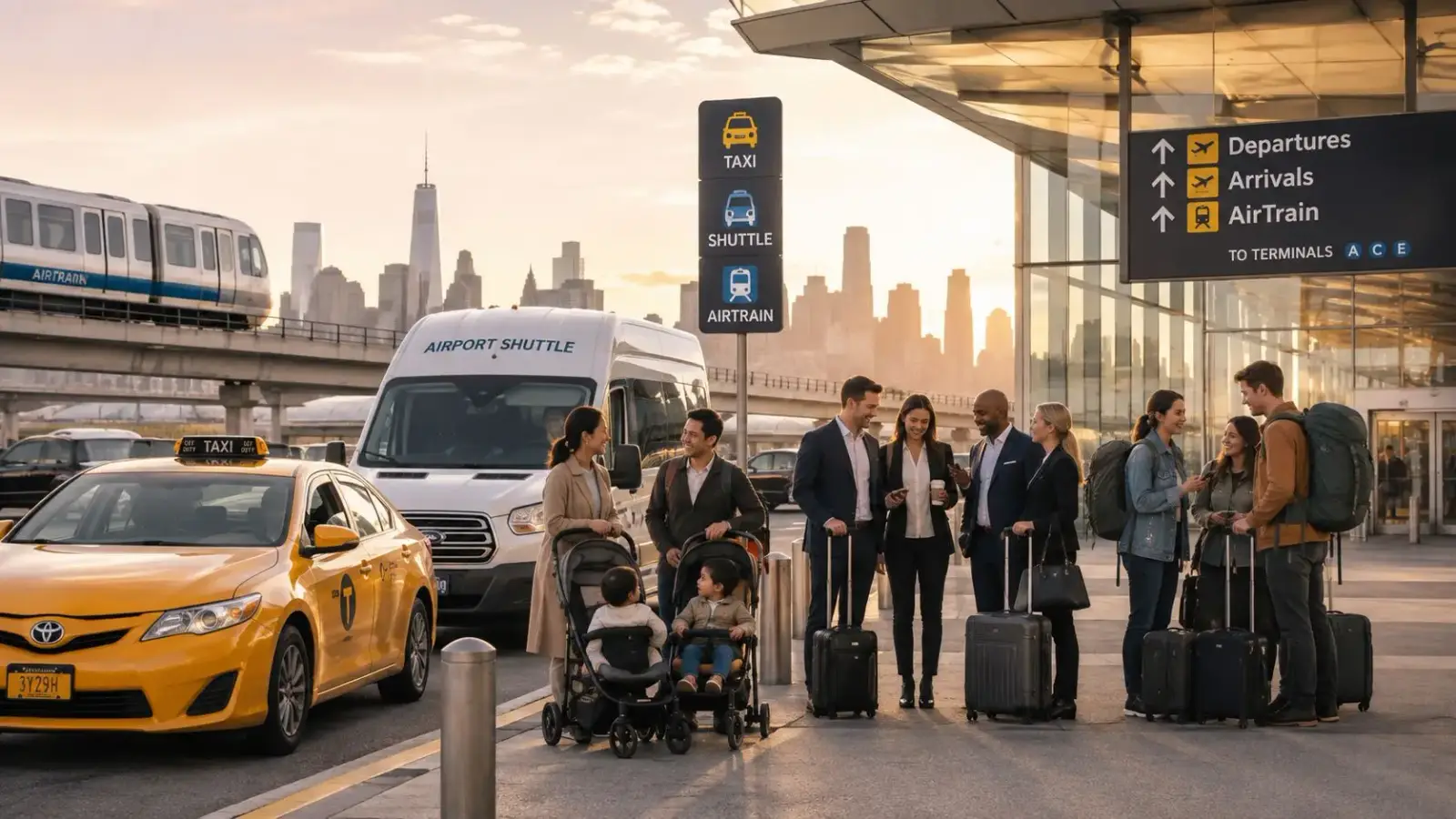
You've just landed with a group that's bigger than the curb can casually absorb. There are eight people, a stack of checked bags, one stroller, a couple of carry-ons that somehow multiplied in the terminal, and a line of yellow cabs, app-based pickups, and shuttle vans all competing for the same strip of pavement. At that point, transportation from airport stops being a vague travel question and turns into a logistics decision.
For groups moving through JFK, LGA, or EWR, the primary issue is rarely the fare. It's whether the vehicle can hold the people, the bags, and the timing without forcing a split pickup or a second ride across the curb. That's why the best choice depends on how the party moves as one unit, not just on which option looks simplest on paper.
| Mode | Best for | Where it tends to work | Main limitation |
|---|---|---|---|
| Public transit | Solo travelers or very light groups | JFK to Manhattan or Brooklyn via rail connections | Multiple transfers and limited comfort with luggage |
| Taxi | Small parties with moderate bags | Direct curb-to-door trips inside the core NYC area | Space runs out fast for larger groups |
| Rideshare | Small to mid-size parties that can split | Flexible curb pickups across NYC and New Jersey | Vehicle availability and group separation |
| Shared shuttle | Budget-focused travelers with flexible timing | Hotel-linked or scheduled airport runs | Waiting, extra stops, and slower door-to-door time |
| Private van | Groups that need one vehicle and coordinated luggage space | JFK, LGA, EWR, Manhattan, Brooklyn, Westchester, New Jersey, and selected inter-airport routes | Needs advance coordination and the right vehicle configuration |
Table of Contents
- Why Airport Transportation Is a Group Decision First
- The Main Modes of Transportation from Airport in NYC
- Comparing NYC Airport Options Side by Side
- Where Each Mode Breaks Down for a Group
- Matching the Option to the Traveler
- How a Quote-First Private Airport Van Works in NYC
- A Simple Rule of Thumb for NYC Airport Transfers
- Common Questions About Transportation from Airport in NYC
Why Airport Transportation Is a Group Decision First
A family of eight lands at JFK after a long haul. There are eight checked bags, a stroller, two kids half-asleep, and a pickup point that still has to work even if baggage takes longer than expected. The curb is busy, the group is tired, and the first bad decision usually happens when someone assumes the ride can be figured out after the bags appear.

The practical question is simple. Can everyone leave together, with the luggage they brought, without forcing the group into two vehicles or a messy curbside negotiation? For airport access at major U.S. hubs, that matters because demand is huge, curb activity is dense, and the airport leg is a real piece of the trip, not a minor add-on. TSA screened about 904 million passengers in 2023 and checkpoint volumes stayed strong in 2024, while U.S. international passenger traffic still runs in the hundreds of millions annually, so airport ground transport sits inside a very large, high-frequency system, not a niche one (TSA passenger volumes).
The curb decides more than the fare
At JFK, LGA, and EWR, the curb is where most plans are won or lost. A taxi may be easy for two people with carry-ons. The same setup can fall apart fast when a party of eight arrives with multiple suitcases, strollers, and a tight connection to Manhattan, Brooklyn, Westchester, or New Jersey.
Practical rule: if the vehicle was not configured for the group before arrival, the group probably will not stay together after arrival.
That is why a private van, a taxi, a train connection, or an app-based pickup should be treated as different operational tools. The right one depends on passenger count, bag count, and how much slack the schedule really has. A curb that looks manageable for one traveler can become chaotic for a family or corporate team that needs one clean departure from the airport.
The Main Modes of Transportation from Airport in NYC
A group lands at JFK with four suitcases, a stroller, and two people who want to stay together. The mode choice stops being about price and starts being about curb geometry, bag count, and whether the ride can leave the airport as one unit.
Public transit works when the group is light and flexible
For JFK, the rail path means subway service to Jamaica or Howard Beach, then the AirTrain to the terminals. That makes the airport access a transfer chain, not a single curbside stop, and it works best for travelers with small bags, clear wayfinding, and enough patience for stairs, platform changes, and waiting.
For EWR, rail-based access can make sense for people headed into Manhattan or New Jersey when the destination sits near a station and the group is small. For LGA, transit is more often a bus-plus-subway combination than one direct line, so it fits light travelers better than families carrying full luggage sets. Once bags multiply, the walk, the stairs, and the transfer points start to matter more than the fare.
Taxis and rideshare solve the direct-door problem
A taxi is simple at the curb. A rideshare pickup can be simple too, if the group is small enough and the pickup area is clear before the app car arrives. Payment is straightforward, the route is direct, and the handoff to a hotel, apartment, office, or residence is usually easy.
The catch is space. Once a group gets bigger, one car starts forcing decisions about who rides first, who waits, and which bags fit without turning the back seat into a storage bench. That is where the mode starts to break down for parties that need to stay together.
Shared shuttles trade speed for structure
Shared shuttles run on schedules and multiple stops. They can work for solo travelers or very small parties, but they rarely feel efficient for a group with luggage and children. The curb process usually means waiting, loading, and then circling through extra stops before anyone gets to the final address.
That extra routing changes the whole trip. A shuttle may look orderly on paper, but for an airport departure it often adds friction at the exact moment when the group wants the fewest handoffs.
Private vans fit the group as a group
A private Sprinter van is different because the whole vehicle is reserved for one party. That keeps the pickup simple, cuts down the moving parts at the curb, and lets the luggage plan happen before the airport pickup instead of during it.
For group airport transfers, that distinction matters. A party of eight can board one vehicle together, keep bags in one place, and move directly to a destination in Manhattan, Brooklyn, Westchester, or New Jersey without splitting across multiple cars. For many family, corporate, and event pickups, that is the key operational win.
Comparing NYC Airport Options Side by Side
| Mode | Best Party Size | Luggage Fit | Curb Time | Predictability |
|---|---|---|---|---|
| Public transit | 1 to 2 travelers, sometimes a small family with light bags | Limited by stairs, platforms, and carrying load | Longer, with transfers | Moderate if the route is familiar |
| Taxi | 1 to 3 travelers | Good for standard bags, tight for larger loads | Usually quick if a cab is available | Good, but dependent on curb availability |
| Rideshare | 1 to 4 travelers in one car, more if split | Variable by vehicle type | Moderate, with app-based pickup steps | Mixed, because vehicle type and wait can change |
| Shared shuttle | 1 to 4 travelers | Enough for typical luggage, less flexible for oversized loads | Often the slowest of the curb options | Lower, because of stops and shared routing |
| Private van | 6 to 14 passengers, depending on luggage requirements | Strong for group bags, strollers, and coordinated loading | Efficient when booked correctly | High, because the vehicle is planned for the party |
The row that surprises many travelers is luggage fit. A rideshare SUV may look like it can solve the whole problem, but group luggage changes the equation quickly. A standard taxi can also look sufficient until checked bags, car seats, and carry-ons all show up together at the curb.
Another surprise is the time cost of transit. Public transportation can be the right answer for a light traveler headed to the city, but it is rarely the cleanest answer for a family arriving late with multiple pieces of luggage. The airport is not just a station, it's the start of a door-to-door chain.
Key takeaway: for groups, the right comparison is not just ride time. It is whether the mode can carry the party, the bags, and the schedule as one system.
Private vans also sit in the airport market, not a theoretical one. Large-airport mode splits show that prearranged and for-hire vehicle services can represent meaningful shares of airport ground trips, including limousine and taxi use at Denver and San Francisco in the cited data (ACRP Appendix E mode split data). That doesn't tell any traveler what to book by itself, but it does show that the airport curb routinely serves arranged vehicles, not only spontaneous hails.
Where Each Mode Breaks Down for a Group
The failure point is usually configuration
A group of six can sometimes fit into two vehicles and still make the trip work. A group of eight to fourteen starts exposing the limits of any mode that was not set up for the party from the start. The issue is not just seats. It is whether the luggage, passenger distribution, and curb loading can all happen in one move.

A rideshare SUV can split the group fast. One car takes part of the party and leaves the rest waiting for another pickup, or the bags force a second vehicle even when the passenger count looks manageable on paper. That is how a simple arrival turns into two drivers, two ETAs, and two sets of curbside instructions.
Why the curb gets messy
A standard yellow cab can be the right tool for a small party with light luggage, but it is not built for a full family arrival with oversized bags and a stroller. Public transit adds another layer of complexity because bags, platforms, and transfers all have to move together. At JFK, the rail and AirTrain connection has to be part of the plan from the start, because the terminal connection affects how the whole group gets out of the airport.
Shared shuttles break down for a different reason. They are built to wait, load, circulate, and drop multiple parties, which works for a solo traveler but gets awkward for a group that wants one direct trip. The service still works, just not cleanly when time, bags, and passenger count all matter at once.
A group travels together only if the vehicle was originally configured for the group.
That single point changes the booking logic. A vehicle that is close enough on paper can fail at the curb once bags appear, and airport staff will not reorganize the loading sequence around a party's improvised plan. For groups that want one departure, the reservation has to match the actual baggage picture before anyone leaves baggage claim.
For families that want one vehicle and predictable loading, Airport Vans NYC's family airport van service is the kind of setup that avoids last-minute splitting at the curb.
Matching the Option to the Traveler
Families with children and strollers
For families arriving into JFK or EWR, the first choice is usually a private van. It keeps children, stroller gear, and checked bags together, which avoids the need to split across two cabs or a ride-hail fallback. The second-best option is a taxi or rideshare only when the family is small enough that the luggage and stroller still fit without forcing a second vehicle. The internal family transfer page at Airport Vans NYC's family airport van service is useful when the family wants one vehicle and predictable loading.
Corporate teams with rolling luggage
For a business group landing at LGA or JFK and heading to Manhattan or New Jersey, a private van is usually the cleanest operational choice. It keeps the team together, gives the coordinator one pickup point, and avoids the drain of explaining the curb plan to multiple drivers. A taxi can work as the second-best option if the group is small, but once bags and time pressure increase, one vehicle is easier to manage than two or three scattered arrivals.
Hotel concierges and guest arrivals
Concierges arranging a guest pickup usually need the simplest possible handoff. For a solo traveler or couple, a taxi or rideshare can be enough. For guest parties arriving with more than a normal luggage load, a private van is the more controlled option because pickup instructions, vehicle size, and curbside timing can be settled before the guest lands.
Event planners and wedding groups
Wedding guest transfers from EWR, JFK, or LGA work best when the vehicle plan is built around blocks of people, not individual seat counts. A private van fits the first wave of arrivals well, especially when the group needs to move to a hotel or venue in one pass. The second-best option is a shuttle only when timing is loose and the group is small enough to accept circulation and waiting.
Inter-airport connections
For travelers moving between JFK and LGA or JFK and EWR, a private van is often the most controlled option because the route is specific, the luggage stays together, and the transfer can be timed around the next flight. The airport-to-airport page of Airport Vans NYC is relevant when the trip is really a coordinated ground transfer rather than a standard arrival ride.
How a Quote-First Private Airport Van Works in NYC
The quote has to match the trip, not just the headcount
A quote-first process starts with the actual trip details, passenger count, bags, airports, and destination. That matters because up to 14 passengers is only useful when the luggage plan still fits the vehicle configuration. A group of ten with oversized suitcases can need a different setup than a group of twelve with lighter carry-on loads.
The quote form should collect enough detail to avoid guessing at the curb. Passenger numbers, baggage volume, child seats if relevant, terminal information, and the destination all shape the pickup plan. A vehicle that is properly matched before dispatch is the difference between a clean transfer and a last-minute scramble.
Pickup instructions should be terminal-specific
At JFK, LGA, and EWR, the pickup point matters as much as the vehicle. Terminal-level instructions, door details, and curbside meeting points remove uncertainty when the group exits baggage claim. That is especially important for parties arriving on staggered flights or with complex baggage handling.
Supported routes include JFK to LGA and JFK to EWR, along with trips across Manhattan, Brooklyn, Westchester, and New Jersey. The service is built around one dedicated vehicle for the party, so the group doesn't have to self-manage multiple cars or coordinate separate curb arrivals.
Confirmation makes the reservation real
A quote request is not the same thing as a confirmed booking. The reservation becomes real only after operator confirmation, usually by phone or email, once the trip details and vehicle fit are reviewed. That follow-up step is what keeps the transfer aligned with the actual luggage and pickup needs.
For travelers who want to see the vehicle style before they ask for a quote, the gallery page shows trip and fleet photos, and the quote page is the place to send the route details. Airport Vans NYC is the private Sprinter van quote and reservation service operated by IONASprinter for airport group transfers in the greater NYC area.
A Simple Rule of Thumb for NYC Airport Transfers
Ask three things before booking. How many passengers are traveling, how many bags are coming off the plane, and how tightly the schedule has to hold at the curb. If any of those answers create friction, the ride needs to be planned as a group transfer, not treated as a casual airport pickup.
If the group wants to stay together, the vehicle has to be chosen before the bags land.
That's the cleanest way to think about transportation from airport in NYC. When the numbers, the luggage, and the timing all line up, a private van is often the simplest answer, and a quote request is the first step.
Common Questions About Transportation from Airport in NYC
What happens if a flight is delayed or changes arrival time?
Pickup planning can account for flight details when those details are provided in advance. The important part is to communicate the change as soon as it's known so the dispatch plan and curb timing can be adjusted.
What if the group shows up with more bags than expected?
That is the moment when vehicle fit matters most. If the luggage load grows beyond what was discussed at booking, the pickup may need a different configuration or a second vehicle, which is exactly why bag count belongs in the quote request.
Can private vans handle inter-airport transfers?
Yes, selected inter-airport routes such as JFK to LGA and JFK to EWR are part of the service scope. Those trips work best when the timing, passenger count, and luggage are shared before confirmation so the transfer can be dispatched correctly.
How is a quote request different from a reservation?
A quote request is the planning step. A reservation is the confirmed booking after the operator reviews the trip and responds by phone or email. That distinction matters because the vehicle isn't locked in until the provider confirms the details.
Airport Vans NYC handles private Sprinter van transfers for groups moving through JFK, LGA, and EWR and heading across the greater NYC area. For families, corporate teams, and event planners who need one vehicle, the quote-first process keeps the trip tied to the passenger and luggage count. Visit Airport Vans NYC to request a quote when the airport ride needs to be planned as a proper group transfer.