
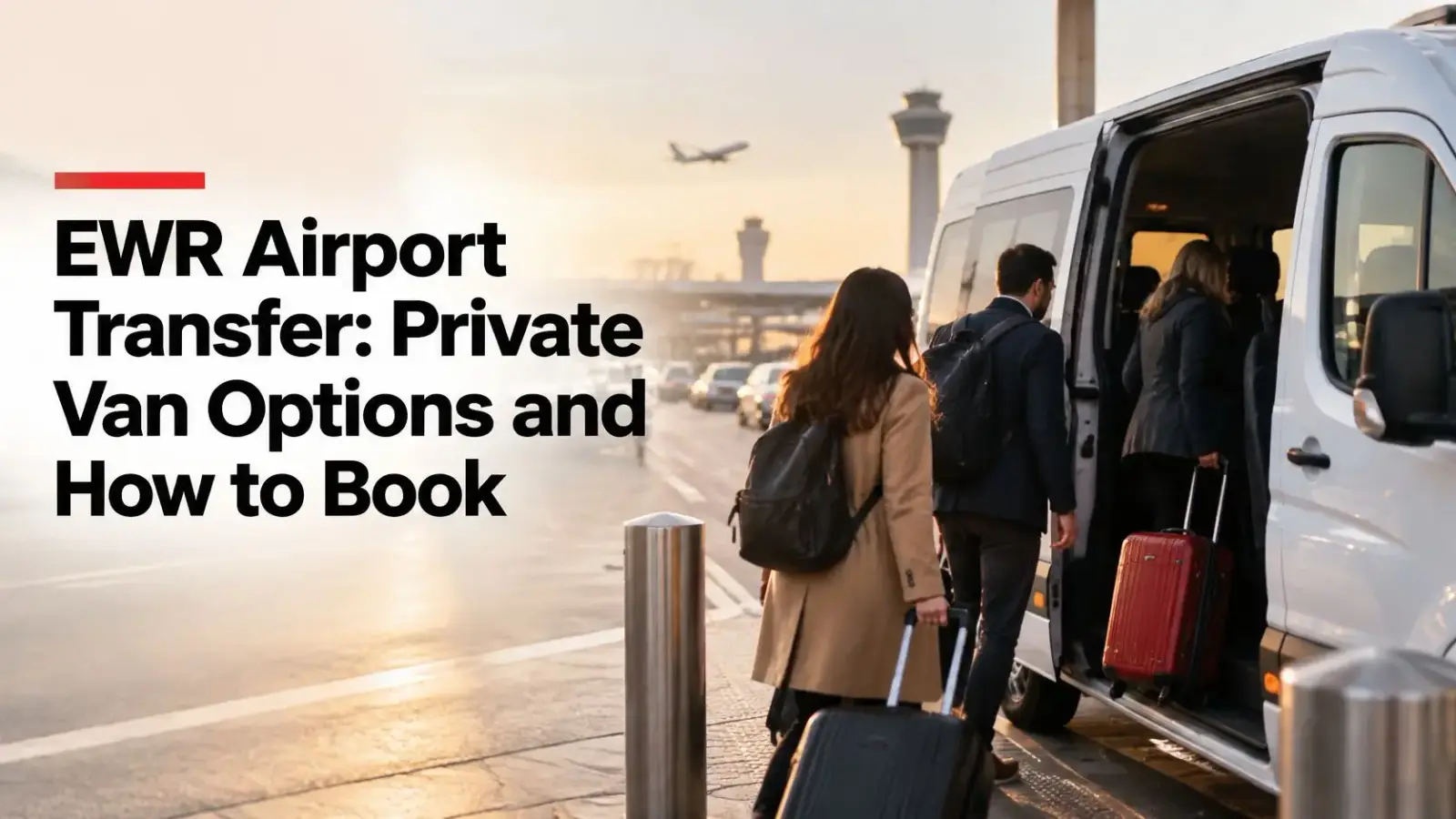
Six people, nine checked bags, a stroller and a 7:40 a.m. departure from Newark. Most groups arrive at that morning with a plan built on a rideshare app and optimism, and it comes apart somewhere between the hotel door and the terminal curb.
Newark Liberty is the airport that punishes loose planning hardest. It sits in New Jersey rather than inside New York City, it spreads passengers across three terminals, and its rail link ends at a station instead of a departure door. Get the sequence right and the morning is quiet. Get it wrong and the party splits across two cars, two terminals and two phone calls.
What follows is the working method: how to choose the option that fits the headcount and the luggage, where pickups happen at each terminal, how to time a departure backward from the flight, and what turns a quote into a confirmed reservation.
Table of Contents
- Newark Transfer Options Compared at a Glance
- Where Private Vans Pick Up at Newark
- Newark-to-JFK Trips and Group Scenarios
- Timing Newark Arrivals and Departures Realistically
- What Drives the Price of a Newark Transfer
- How to Book a Newark Transfer and Request a Quote
Newark Transfer Options Compared at a Glance
Match the party to the option before reading anything else. The table below is the decision itself, sorted by who each mode serves.
| Option | Best for | Planning limit |
|---|---|---|
| Private Sprinter van | Groups, families and heavy luggage | Quote and operator confirmation required before the trip is reserved |
| AirTrain and NJ Transit rail | Solo travelers with hand luggage | Station changes and stairs or elevators to manage with bags |
| Taxi or rideshare | One or two travelers with light bags | Vehicle size varies, so group and bag fit must be checked |
| Shared shuttle | Travelers with flexible schedules | Stops and departure times are set by the shuttle, not the traveler |
| Personal car | Local drivers familiar with the route | Parking, tolls and airport access charges apply |
Newark Liberty sits in Newark, New Jersey, which reshapes the timing question. A trip into Manhattan crosses a river, and the crossing used decides how the drive behaves on a given afternoon. Terminal assignment matters just as much as the route, because three terminals do three different jobs and a driver heading to the wrong one wastes the buffer that was supposed to protect the flight.
Rail deserves a fair hearing. AirTrain service runs every 3 to 5 minutes from 5 a.m. to 11 p.m. and about every 15 minutes overnight, according to Amtrak's Newark Liberty station information. That frequency serves a solo traveler with one carry-on and time to spare. It serves a family with four suitcases and a stroller far less well.
Private van service is quote-first, operated by IONASprinter for groups of up to 14 passengers subject to luggage requirements. Airport Vans NYC runs private van transfers to and from JFK, LaGuardia and Newark only, not general city rides, which keeps the planning conversation focused on airport logistics. Drive time between EWR and Midtown depends on traffic, time of day and route, and this guide publishes no fixed duration for it.
Working rule: count people, then count checked bags, carry-ons and strollers. The option that keeps that whole load in one vehicle with the fewest handoffs is the right one, and it's rarely the cheapest line in the table.
Where Private Vans Pick Up at Newark
Pickup at Newark is a three-part decision: the terminal, the designated loading area, and the last few hundred feet between the door and the vehicle. Miss any part and the party waits in the wrong place while the clock runs.
| Terminal | Pickup planning note |
|---|---|
| Terminal A | Not directly connected to AirTrain; walk about 15 minutes on a covered path or take a shuttle of about 5 minutes |
| Terminal B | Confirm airline, terminal and pickup area at booking |
| Terminal C | Confirm airline, terminal and pickup area at booking |
Confirm the terminal, not just the airport
The airline and the terminal decide where a driver is directed, so both belong in the booking details rather than in an assumption made on the plane. Airport Vans NYC makes drop-offs at all EWR terminals and asks customers to confirm their airline at booking so the driver heads to the correct one. Pickups cover Terminals A, B and C. Vehicles load and unload only in designated areas, which is why the exact pickup zone and a passenger contact method get settled before the flight instead of negotiated at the curb. The terminal logic behind Newark airport drop-off planning follows the same principle, with the airline check-in hall mattering more than the gate.
The Terminal A leg changes the clock
AirTrain is ADA-compliant, with elevators, escalators and designated wheelchair spaces, yet Terminal A is not directly connected to it. Passengers walk about 15 minutes on a covered path or take a shuttle of about five minutes, per Newark Airport's AirTrain guidance. For a wheelchair user the extra leg means an elevator sequence and a platform change. For an older traveler it means distance with bags. For a family with a stroller it means a shuttle loading and unloading routine. Newark also notes that modernization work can cause temporary AirTrain interruptions, with shuttle buses running when service is unavailable, so the backup matters as much as the plan.
Before pickup, confirm six things: terminal and airline, level and door, meeting point, walking distance from the curb, vehicle description, and what happens if AirTrain service is down. A group that knows all six moves as one party.
Newark-to-JFK Trips and Group Scenarios
The inter-airport run is decided long before anyone reaches an AirTrain platform. A traveler with one bag and four hours of slack is playing a different game than a family of six collecting four checked suitcases at 4 p.m. with a second flight that evening.
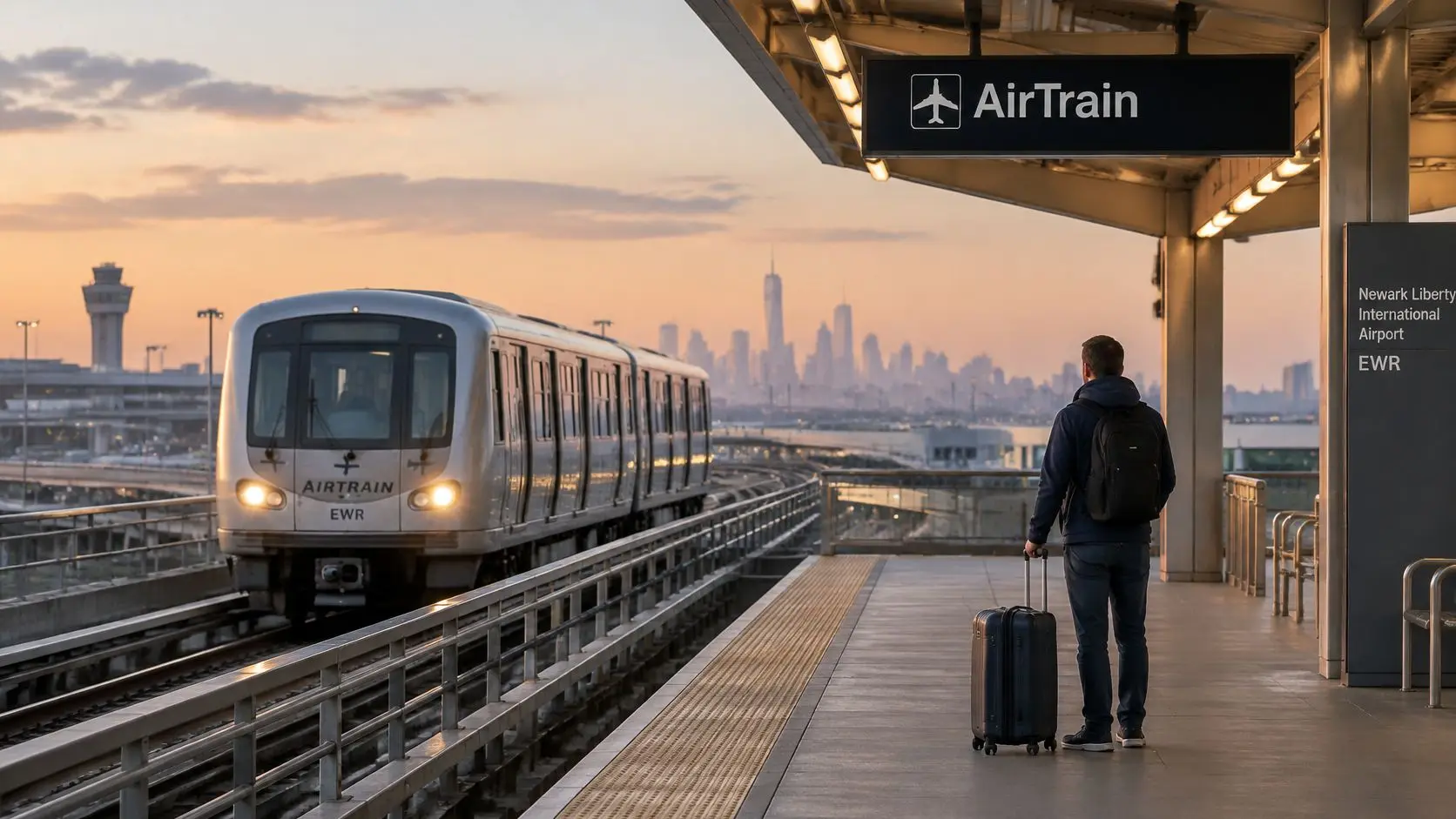
Newark's own connections guidance lays out the public-transit version of the trip: EWR AirTrain to NJ Transit, New York Penn Station, the LIRR, Jamaica Station, then the JFK AirTrain, with estimated travel times of roughly 60 to 90 minutes. It also notes that pre-arranged transportation may be preferable for groups or travelers carrying oversized or substantial luggage, per Newark Airport's guide to travel between airports. The burden that gets left out of most comparisons is operational: separate fare systems, station changes, elevators, terminal walking and the bag collection that has to happen before any of it starts.
Scenarios sort the decision quickly.
- Solo travelers with hand luggage can often take rail and keep the fare in their pocket, provided the itinerary leaves room for a missed connection.
- Families with a stroller and checked bags feel every station change. One vehicle removes the elevator sequence, the platform wait and the risk of a child and a suitcase going in different directions.
- Corporate teams and tour parties of six to 14 are better served by one vehicle than three or four cars arriving at different times, with one coordinator holding the flight details.
- Event planners receiving arrivals in waves need a single meeting point and one person to call, not a group chat that fragments the moment flights slip.
- International travelers with heavy bags need the pickup timed after customs and baggage claim, not at the moment the wheels touch down.
No published luggage threshold fixes the vehicle choice, so it gets set from the quote details: headcount, bag count, strollers and the space those take. The plain rule is that when a party has to move as one unit with substantial luggage, a dedicated van removes the handoffs that cause the delay. For the reverse direction, the JFK to Newark transfer route covers the same logistics from the Queens side.
Timing Newark Arrivals and Departures Realistically
Every time on this page is an estimate that depends on traffic, time of day and route. There's no fixed door-to-door duration worth publishing, because a quoted clock time is a promise nobody can keep on a Friday afternoon. What can be planned is the sequence, built backward from wheels up.
An EWR to Midtown trip often takes 45 to 75 minutes, which is a sensible planning range rather than a guarantee. Use the operator's route estimate for the actual hour of travel and let the clock shift with conditions.
Build the pickup time backward
- Set the airport deadline. Work from the moment the party needs to be inside the terminal, not the departure time. International departures out of EWR often require an earlier Manhattan pickup than domestic flights, so the window should be built from the customer's flight time.
- Estimate the drive for that specific hour. A route that moves cleanly at 5 a.m. behaves differently at 4 p.m., and the plan should reflect the hour being traveled rather than an average.
- Add the group buffer. Loading nine passengers and their luggage from a hotel lobby takes longer than loading one person from a stoop, and the buffer should cover the loading, the tunnel and the terminal approach.
- Confirm the window. The resulting pickup time goes back to the operator for confirmation, so both sides are working from the same number.
International arrivals need separate treatment. Customs and baggage collection add real time after landing, so the pickup gets timed for after the party has its bags rather than when the aircraft parks, and Airport Vans NYC coordinates that timing accordingly.
Plan for the slowest member of the party, which is usually the person with the stroller or the heaviest bags, and the schedule holds for everyone else.
A flight change, an early-morning departure or a tight same-day connection justifies a larger buffer. Sending updated flight details lets pickup planning follow the change instead of guessing at it.
What Drives the Price of a Newark Transfer
Airport access gets priced separately from the vehicle, and that separation explains most of the confusion in an EWR airport transfer quote. The Port Authority's published 2026 New Jersey airport schedule lists a $3.50 ground-transportation access fee for each for-hire-vehicle pickup and drop-off trip at the airport, with pooled trips listed at $1.75, according to the Port Authority schedule of charges for Newark Liberty. A private, non-pooled van doesn't fall under the pooled rate.
The fee attaches per airport event rather than per booking. An arrival from EWR into Manhattan generally involves one airport pickup, a Manhattan departure to EWR involves one airport drop-off, and an inter-airport itinerary can create events at both origin and destination. That's why a quote should state plainly whether the trip is a pickup, a drop-off or both.
| Factor | What it changes | Check before booking |
|---|---|---|
| Airport access fee for a pickup or drop-off | $3.50 per for-hire trip event in the 2026 Port Authority schedule | Confirm the schedule date the quote uses |
| Pooled for-hire trip | $1.75 listed for pooled trips | Does not apply to a non-pooled private van |
| Trip type | Airport pickup, airport drop-off, or both | The quote states which airport events are included |
| Passenger count | Sets the vehicle, up to 14 passengers | Confirmed against luggage requirements |
| Luggage and strollers | Sets the vehicle configuration | Confirmed in the quote form details |
| Tolls | Charged separately from the transport rate | Ask which crossings the route uses and see them itemized on the quote |
Because the published schedule is airport-specific and time-effective, the fee should be validated against the current schedule date rather than carried over from an older reservation. Tolls follow the same logic: they belong on the quote as their own line, apart from the transport rate, so the reader can see what the crossing costs and what the vehicle costs.
This article publishes no fixed price, because the variables above move with the itinerary. The written quote is the number to plan around, and three questions are worth asking of it: which airport events are included, what tolls apply, and which vehicle is being quoted for the actual luggage load.
How to Book a Newark Transfer and Request a Quote
Booking is a paperwork exercise, and the paperwork is what makes the curb work on the day.

Port Authority rules state that ground transportation services generally may be provided at an air terminal only pursuant to specific pre-arrangement, and vehicles may load or unload passengers only in designated locations, as set out in the Port Authority airport rules and regulations. Pre-arrangement is the operative word. A confirmed booking should carry the terminal, the designated pickup area, a passenger contact method, vehicle identification and contingency instructions, rather than a loose agreement to meet outside arrivals.
The steps run in a fixed order, and each one feeds the next.
- Gather the flight details. Airline, flight number, arrival or departure time and terminal. The terminal is the detail that sets the whole pickup plan, and it's the one travelers most often leave blank.
- Count the load. Passengers, checked bags, carry-ons and strollers. These set the vehicle configuration, and one quote for a Newark transfer covers the vehicle, the pickup plan and the timing together.
- Write the exact address. A Manhattan street address, a hotel lobby, a Brooklyn residence or a Westchester pickup point. "Midtown" isn't an address a driver can plan a route around.
- Send the request. Submit the flight details, the headcount and the address through the request form, and add anything that affects timing or space, such as an early departure or a wheelchair.
- Read the written quote. It should show the vehicle, the pickup plan and the timing, with airport charges and tolls itemized separately from the transport rate.
- Wait for confirmation before calling it booked. A quote request becomes a reservation only after operator confirmation, which sets the terminal, the designated pickup area, the contact method, the vehicle description and the backup plan.
Why the order matters more than the speed
A request that arrives without terminal details leaves the pickup plan incomplete and slows confirmation, which is the opposite of what a traveler under time pressure wants. Flight details also stay useful after booking, because a party can share them for operator follow-up as schedules shift.
Transportation services are operated by IONASprinter, a NYC-area provider with experience coordinating airport pickups, terminal instructions and group transfers, and the business is the dedicated channel for airport van quotes and bookings. The airport transfer quote process explains what happens between a request and a confirmed trip. For a party that prefers to talk it through, calling (718) 439-1650 gets a quote started for private airport van service.
Send the flight details, the luggage count and the pickup address now, review the written quote when it arrives, and treat the trip as reserved only once the operator has confirmed it.
Airport Vans NYC provides quote-first private Sprinter van transfers to and from Newark Liberty, JFK and LaGuardia, with door-to-door service across Manhattan, Brooklyn, Westchester, New Jersey and the greater NYC area, for groups of up to 14 passengers subject to luggage requirements. If the party is larger than a taxi can hold and the bags outnumber the seats, send the flight details and headcount for a written quote covering the vehicle, terminal pickup plan and timing. Visit Airport Vans NYC to request a quote and confirm the details before travel day.