

A group rolled up to the terminal with six people, four checked bags, two strollers, and one suitcase that should've been labeled “problem.” The driver had the right airport, the right curb, and the wrong amount of time. One passenger was still digging for a passport while the rest were already half out of the van, and the lane behind them was starting to stack up.
That's the reality of airport drop off for private van groups. At JFK, LGA, and EWR, the curb isn't a casual stopping point, it's a moving workspace where luggage, people, doors, and traffic all have to line up at once. For families, corporate teams, hotel concierges, and event planners, the difference between a smooth handoff and a messy one is usually planning, not luck.
Table of Contents
- Why Group Airport Drop Offs Require Real Planning
- Timing Your Arrival and Building Buffer Windows
- Curbside Versus Cell Phone Lot Staging Strategies
- Terminal Specific Drop Off Rules at JFK LGA and EWR
- Managing Luggage and Passenger Coordination for Groups
- Requesting a Quote and Confirming Your Private Van Transfer
Why Group Airport Drop Offs Require Real Planning
A van with 8 or 12 people on board doesn't behave like a solo rideshare. At a busy terminal, one person is trying to answer a text, another is hunting for a boarding pass, a child has a backpack underfoot, and the rear hatch is still open while bags come out one by one. That's how a simple curb stop turns into a clog.

Airport guidance makes the core rule clear, curbside zones are for active loading and unloading only, not waiting or parking. Narita's curbside passenger platform rules explicitly prohibit stopping, parking, or handover in that area, and U.S. airport guidance similarly pushes vehicles toward the correct departures level and lane so traffic doesn't get trapped by enforcement or confusion. In practice, that means the driver needs the party ready before the van reaches the edge, not after.
Practical rule: if the bags aren't staged and the passengers aren't ready to step out, the airport curb is already becoming a bottleneck.
For a group transfer, the hidden failure points are usually small. One passenger exits on the wrong side because the curb is crowded. A checked bag gets handed out last because it was buried behind a stroller. Someone assumes the others are still inside the van, so the group starts splitting before the terminal doors are even in sight.
That's why a private group airport transfer in the NYC area works best when it's treated as a coordinated logistics event. Airport Vans NYC, operated by IONASprinter, fits that model by keeping the whole party in one dedicated van and planning the vehicle around both passengers and luggage. For more on the broader transfer side of the process, see airport transportation from airport.
Timing Your Arrival and Building Buffer Windows
The most common timing mistake is aiming to “arrive at the airport” when the target is the curb handoff. Those are not the same thing. A van can be on airport property and still be late if it has to deal with terminal access roads, lane changes, and a crowded departures level before anyone can step out.
A workable method is to build a 60 to 90 minute buffer before the target curb arrival when the trip includes terminal access, lane-finding, and handoff tasks. In high-friction airport environments, a normal-day curb-to-terminal handoff can still take roughly 30 to 60 minutes, which is exactly why last-minute arrivals tend to unravel when the curb is backed up. That buffer helps absorb lane congestion, late passenger readiness, and the need to circle back instead of forcing a risky stop.
A curb delay rarely starts with the curb itself. It starts when the van has to make one more turn, one more lane change, or one more pass because the party wasn't ready.
Flight details matter too, especially when a family is traveling with children or a company group has staggered arrivals. A quote-first private van process can account for the flight schedule, then adjust the arrival plan when details are provided in advance. That matters because the van shouldn't be arriving blind, it should be arriving with enough margin to adapt if the trip gets tighter than expected.
A simple working formula helps:
- Set the target curb time first. Base it on when the group needs to be at the terminal door, not when the flight itself leaves.
- Add the handoff buffer. That includes lane-finding, baggage unloading, and the time it takes for everyone to gather at the curb.
- Protect the approach time. The drive to JFK, LGA, or EWR can be fine and still leave too little room if the terminal road is slow.
- Keep the van moving only when the group is ready. At a crowded airport, waiting in the wrong place is often worse than arriving slightly later with everyone prepared.
For group planners, the main lesson is simple. A private van should not be scheduled like a city ride. It should be timed like a terminal operation.
Curbside Versus Cell Phone Lot Staging Strategies
Not every group should go straight to the curb. If the terminal is jammed, staging in a holding area can be smarter than forcing the van into repeated passes. The point isn't to avoid the curb, it's to reach it at the moment when the party is fully ready to unload.
At busy airports, the curb is usually a live loading zone, not a waiting area. That's why the staged approach often works better for larger groups with luggage. The van can hold nearby, keep the party together, and then move in once the passengers are assembled, bags are organized, and the door plan is clear.
Best use case for staging: the group is large, the luggage count is high, or the terminal traffic makes a direct curb approach more likely to trigger a second loop.
A direct curb approach makes sense when the route is simple, the terminal is clear, and the passengers are already standing by. That's efficient for a small, tidy group. It's far less efficient when people are still split between the van, the sidewalk, and the luggage pile while other vehicles are trying to squeeze in behind them.
Airport guidance also shows that drop-off is not a single fixed pattern everywhere. Some airports direct vehicles to specific levels or alternative curbs depending on congestion. MSP notes that if the departures level is backed up, drivers can use the arrivals level instead, and curb design research found that 76% of surveyed airports designate the private-vehicle departure/ticketing curb as the primary drop-off point, while 19% use the baggage-claim curb instead. That gap matters for group travel because luggage-heavy passengers may do better with a less crowded curb strategy, especially when everyone needs to stay together.
For private van operators in the NYC area, the decision comes down to three things, terminal layout, time of day, and group readiness. A staged arrival works when the curb is unpredictable. A direct approach works when the group can exit fast and the lane is clear enough to support it.
Terminal Specific Drop Off Rules at JFK LGA and EWR
JFK, LGA, and EWR each create their own version of curbside pressure, and no driver should assume the same drop-off routine will work at all three. The basic task is the same, get the group to the correct terminal edge. The route there is what changes.
At Heathrow, the airport charges a £7 Terminal Drop-Off Charge every time a vehicle enters the terminal drop-off areas, which are the forecourts in front of the terminals, and the airport says payment can be made through published channels. That's not a NYC airport, but it's a useful reminder that terminal curb access is often managed as a controlled space, not a free-for-all. In the New York area, the rule is simpler but just as strict, the driver has to know the right lane, the right level, and the right handoff point before the van rolls in.
For JFK, the terminal layout and passenger volume make clear instructions essential. Airport Vans NYC keeps a dedicated JFK airport van service page for route planning and pickup coordination, which is helpful when a group needs the right terminal guidance before arrival. A private van operator should always confirm the terminal and airline information ahead of time so the curb stop doesn't become a last-second lane search.
For LGA and EWR, the operational issue is usually not just where to stop, but whether the departures-level curb is the right choice at that moment. Some airports allow alternate curbs or levels when the primary departures curb is congested, and that flexibility helps groups with bags because a few extra minutes at the wrong curb can create a much longer delay at the wrong door. Inter-airport runs, such as JFK to LGA or JFK to EWR, need the same discipline, because the group's terminal plan can change even when the vehicle plan does not.
A simple rule holds across all three airports:
- Confirm the terminal before departure. The wrong terminal creates more trouble than a slow road.
- Keep baggage details visible. Heavy luggage changes how quickly the group can unload.
- Treat the curb as a handoff point, not a waiting spot. The faster the party exits, the cleaner the drop-off.
- Expect terminal-specific lane selection. That's how the driver avoids conflicts and keeps the van moving.
The curb works best when the van arrives already knowing where everyone is going next.
Managing Luggage and Passenger Coordination for Groups
A private Sprinter van carrying up to 14 passengers can turn luggage into a planning item. One checked bag per person changes the whole curb operation. Add strollers, golf bags, trade-show materials, or sports equipment, and the unloading sequence matters as much as the route.
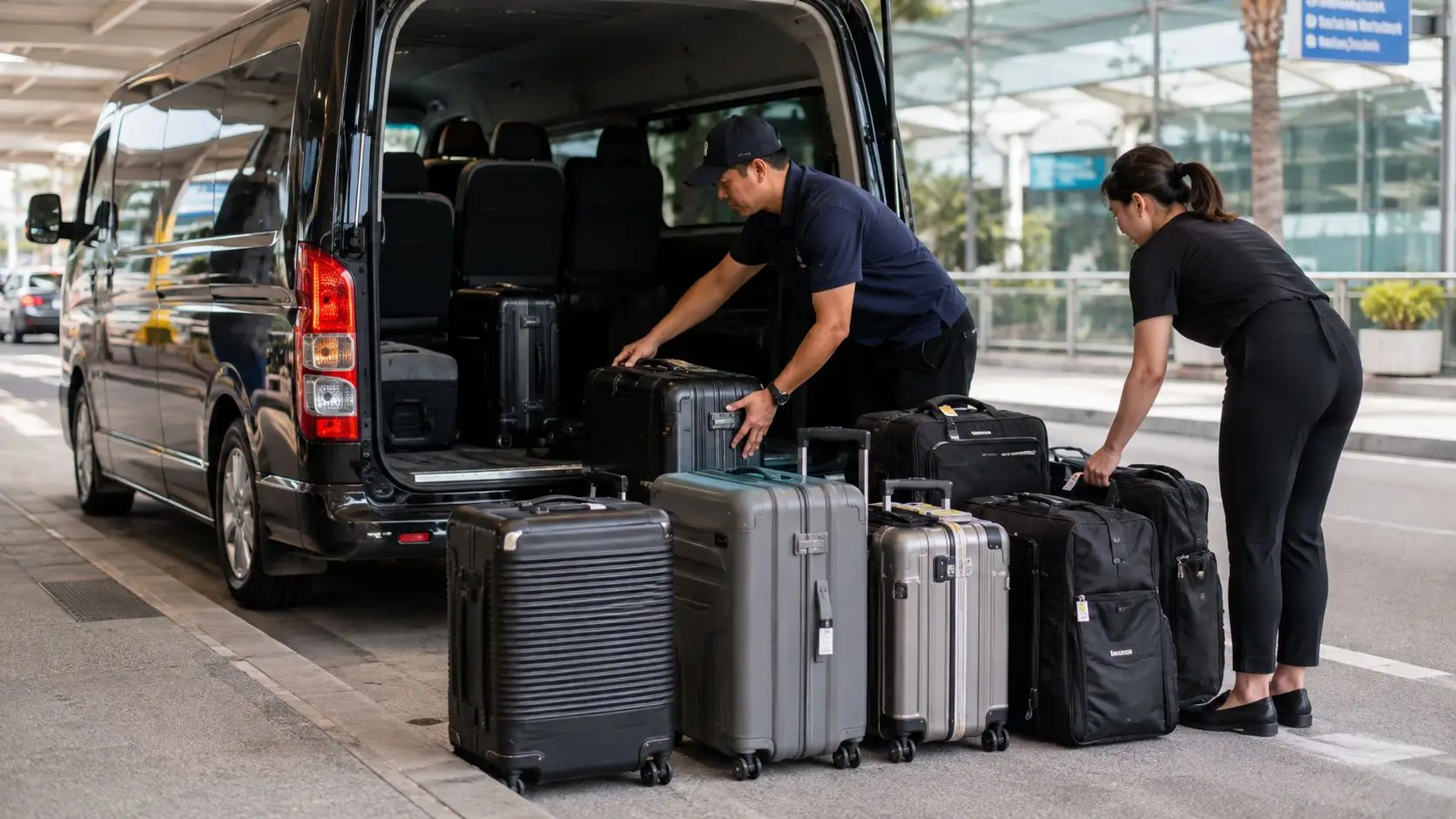
Vehicle configuration should be matched to both passenger count and luggage requirements. That's why splitting a group into multiple cars often creates more trouble than it solves. One vehicle may arrive early, another may get stuck behind terminal traffic, and the group ends up waiting on each other instead of moving together.
Families and travelers with mobility needs need even more curbside room. U.S. DOT guidance says passengers who need wheelchair help or guided assistance should request it in advance and confirm the need with the airline. That affects airport drop-off logistics directly, because a traveler who needs assistance may need extra time at the curb, a shorter walk, or a vehicle setup that keeps the whole party together while the handoff happens.
Operational truth: luggage planning and passenger coordination are the same job at the airport curb.
A good pre-trip checklist for group coordinators is straightforward:
- Count every bag, not just every person. A van can be technically large enough and still be badly configured for luggage.
- Separate fragile or special items early. Strollers, gear, and oversized pieces should not be discovered at the curb.
- Keep the loading order simple. Bags that will be needed first should be easiest to reach.
- Plan for the slowest traveler. If one person needs more help, the whole curbside handoff needs more room.
Airport Vans NYC keeps the process focused on private group transfers, and its quote-first structure lets the operator match the van to the load instead of forcing one standard setup onto every trip. That matters for airport drop off because a clean handoff is usually built long before the van reaches the terminal.
Requesting a Quote and Confirming Your Private Van Transfer
For group airport transportation, the smartest first step is a quote, not a rushed booking. A request should include passenger count, luggage details, flight information, and the destination so the vehicle can be matched to the actual trip. That's especially useful for groups of 6 to 14 passengers, where one extra suitcase can change the setup.
Airport Vans NYC, operated by IONASprinter, uses a quote-first process that includes follow-up by phone or email before a reservation is confirmed. That matters because the quote request is not the same thing as a final booking. The operator still has to confirm the vehicle configuration and trip details before the transfer becomes a reservation.
A solid request also gives the dispatcher what they need to coordinate the terminal side of the trip. If flight details are provided in advance, arrival timing can be adjusted around schedule changes instead of being guessed at on the day of travel. For families, hotel concierges, corporate travel managers, and event planners, that human check is often the difference between a tight curbside handoff and a scramble.
When preparing a request, have these details ready:
- Passenger count and luggage count.
- Pickup and drop-off points.
- Flight number or itinerary details.
- Any accessibility or child-seat related needs.
- Whether the trip is one-way, round trip, or inter-airport.
For a private group van, the goal isn't speed for its own sake. It's a reliable curb plan that keeps everyone together and gets the luggage off the vehicle without improvisation. To start that process, use the quote request page and provide the trip details up front so the reservation can be confirmed the right way.
Airport Vans NYC arranges private Sprinter van transfers for JFK, LGA, EWR, Manhattan, Brooklyn, Westchester, New Jersey, and selected inter-airport routes. If your group needs a coordinated airport drop off with luggage planning and terminal-aware timing, visit Airport Vans NYC and request a quote for the trip.