
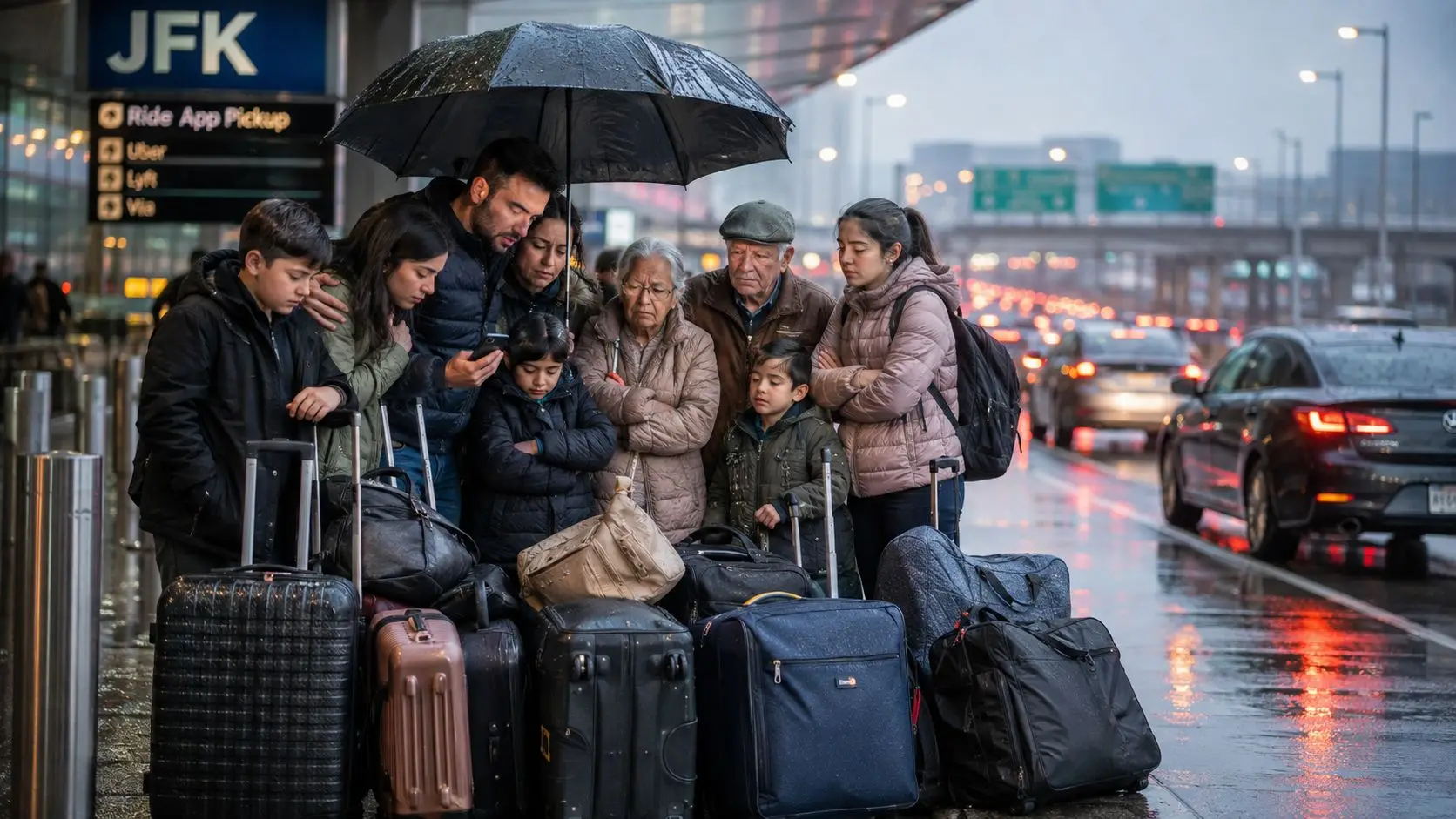
A family of nine arrives at JFK with eight checked bags during a rainstorm. Two rideshares seem practical until the cars leave different pickup areas, the drivers lose sight of one another on the Van Wyck, and half the group reaches the hotel while the rest is still trying to identify the correct curb. The problem isn't the road distance. It's coordination.
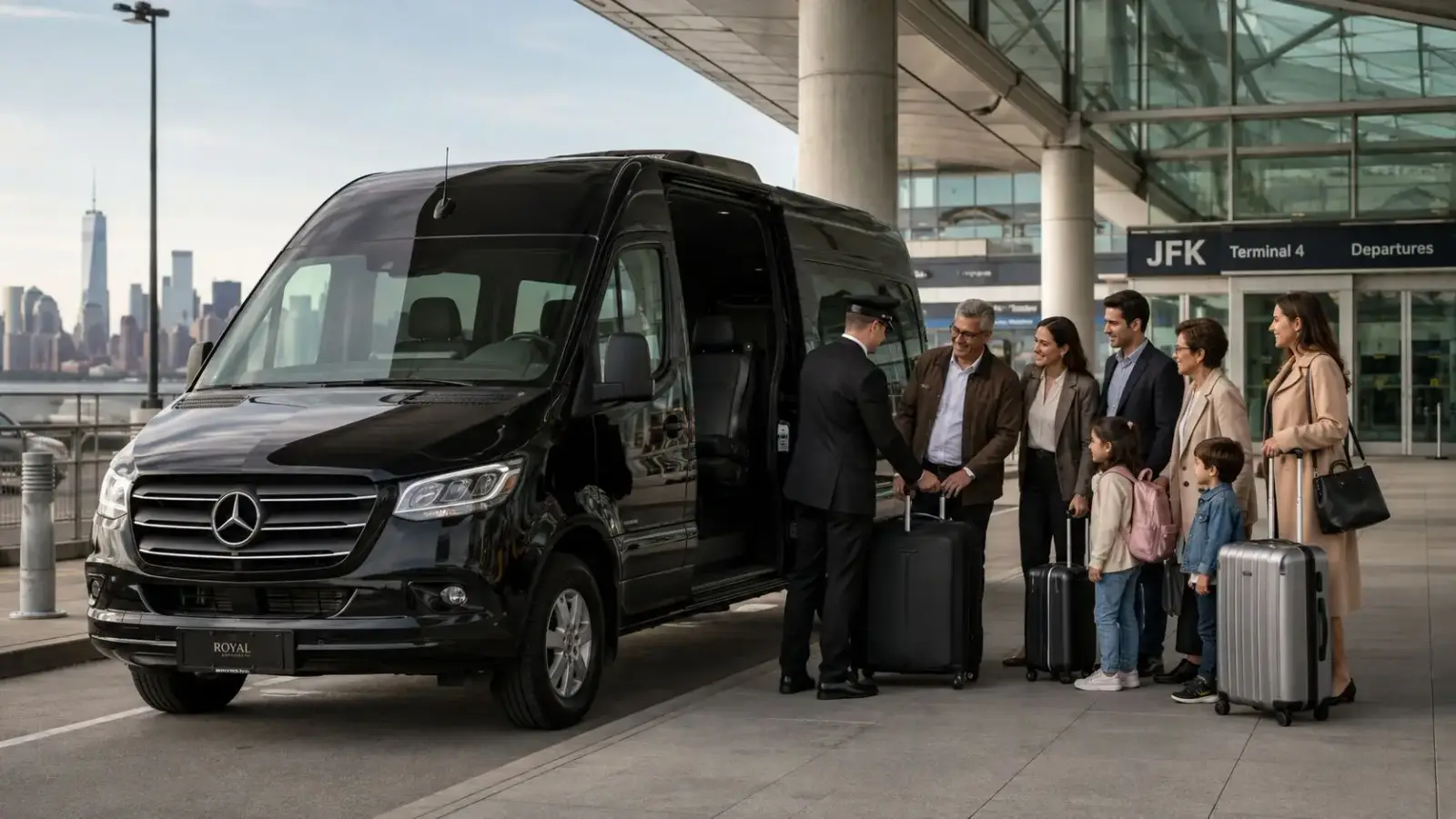
A private airport transfer treats that coordination as the main job. For groups traveling through JFK, LGA, or Newark Liberty, the vehicle, luggage plan, flight details, terminal instructions, and handoff all need to work together. Airport Vans NYC is a quote-first private Sprinter van service operated by IONASprinter for groups of up to 14 passengers, subject to luggage requirements.
The practical decisions are straightforward: which airport is involved, how many passengers and bags need space, and whether the group should pre-book instead of arranging vehicles after landing. The choice is operational, not necessarily luxurious. A dedicated van can keep the party together, but only when the operator has accurate information before confirming the trip.
Table of Contents
- Why Groups Choose a Private Airport Transfer in NYC
- How a Quote-First Private Transfer Service Works
- Capacity, Luggage, and Vehicle Configuration
- Routes Across JFK, LGA, EWR, and the Greater NYC Area
- Use Cases for Families, Corporate Teams, and Event Groups
- Pickup Logistics at JFK, LGA, and EWR
- Requesting a Quote and What Happens Next
Why Groups Choose a Private Airport Transfer in NYC
A group of six can sometimes fit across separate cars, but that doesn't mean the arrangement is simple. Each vehicle needs its own driver, pickup communication, luggage space, and destination instructions. If one car reaches the curb while another is still circling, the group has effectively created multiple airport problems instead of solving one.
A private van changes the math by giving the party one vehicle and one coordinated handoff. That matters even more for groups between 6 and 14 passengers, where several cars can create confusion at a terminal curb. The van still needs enough room for the bags, and the operator still needs the correct terminal and flight information, but the travelers aren't trying to reunite separate vehicles in active airport traffic.
The three decisions that shape the trip
Airport choice affects the pickup procedure and route. JFK, LaGuardia, and Newark Liberty each have different terminal layouts and commercial pickup rules. A trip to Manhattan isn't planned the same way as a transfer from JFK to LGA or a ride to Westchester, Brooklyn, or New Jersey.
Passenger and luggage count determines whether the requested vehicle configuration is suitable. Fourteen people with carry-ons create a different space problem from fourteen people with checked bags, strollers, car seats, or oversized equipment.
Pre-booking gives an operator time to review those details and provide a quote before the group reaches the terminal. It also creates a defined process for confirmation, rather than leaving every traveler to arrange separate transportation at the curb.
| Traveler Situation | Why a Private Van Fits | What to Confirm First |
|---|---|---|
| Family with children and strollers | One vehicle keeps adults, children, and bags together | Child seats, stroller size, checked baggage |
| Corporate team | One request can organize the group's airport movement | Passenger names or count, luggage, hotel or office address |
| Event group | A dedicated vehicle can support a shared arrival plan | Flight schedule, terminal, meeting point, destination |
| Inter-airport connection | The group avoids coordinating multiple cars between airports | Airport pair, connection timing, baggage and re-entry requirements |
The global airport transfer category is substantial, with one industry estimate placing the broader airport transfer services market at $19–23 billion and approximately 460–555 million annual journeys worldwide in 2021. That context supports a simple conclusion: private transfers are a practical ground-transport category, not only an occasional premium purchase.
How a Quote-First Private Transfer Service Works
A quote request isn't a reservation. That distinction prevents one of the most common misunderstandings in group transportation.
Airport Vans NYC uses a quote-first process for private Sprinter van transfers operated by IONASprinter. The traveler submits trip details, an operator reviews the request, and follow-up happens by phone or email. Availability isn't automatic, and the request doesn't become a confirmed reservation until the operator agrees to the trip.
What the traveler submits
A useful request includes:
- Passenger count, including children.
- Luggage information, with checked bags, carry-ons, strollers, car seats, and unusual items identified.
- Pickup and drop-off addresses, such as a terminal, hotel, office, residence, venue, or another airport.
- Flight details, especially for an airport arrival.
- Travel date and timing, including whether the party is connecting between airports.
Each item answers a different planning question. The passenger count helps establish seating needs. The luggage description helps determine whether the requested van configuration can carry the party comfortably. The flight information gives the operator a reference point for arrival coordination if the schedule changes.
Practical rule: A quote request should describe the actual trip, not the simplest version of it.
What happens after submission
An operator reviews the information and replies with the trip details and quoted price. The traveler can then clarify missing information, confirm the proposed arrangement, or decide not to proceed. Nothing should be treated as final until the operator provides confirmation.
This differs from transportation arranged through an app or a taxi rank. Those channels generally begin at the moment a ride is requested or a vehicle is found. A quote-first private transfer begins earlier, with a human reviewing the group's size, luggage, route, and airport conditions before the reservation is confirmed.
The pre-booked segment is expanding quickly. One market estimate valued global pre-book airport transfers at $7.59 billion in 2023, with a projection of $15.64 billion by 2028 at a 15.6% CAGR. The figures describe market growth, not a promise about any individual trip. For a traveler, the useful takeaway is that advance planning has become a normal way to handle airport ground transportation.
Capacity, Luggage, and Vehicle Configuration
A Sprinter van has to carry people and their belongings in the same physical space. That sounds obvious, but it creates the most important qualification in a capacity statement: up to 14 passengers depends on luggage requirements.
Fourteen passengers carrying only compact bags may present one configuration. Fourteen passengers arriving from an international trip with full-size checked luggage present another. A group shouldn't assume that the passenger maximum automatically describes the usable capacity for every luggage load.
Count the items that change the layout
A corporate team may have one roller bag per traveler and a small personal item. A family may add folded strollers, car seats, diaper bags, and extra checked luggage. A multi-generational group could also carry sports equipment or other bulky items that don't stack like standard suitcases.
The quote form collects luggage details because the operator needs to assess the vehicle configuration before confirming. A request that says “12 passengers” leaves out the information that may determine whether the arrangement works. A stronger request says how many checked bags, carry-ons, strollers, car seats, and oversized items are expected.
For a practical look at group vehicle planning, travelers can review the 12-passenger van rental guide in NYC. The relevant question isn't whether the passenger count fits. It's whether the complete party, with its actual luggage, fits the proposed setup.
Capacity isn't the same as comfort or suitability
A vehicle may technically have enough seats while still requiring a closer review of baggage placement. That's why a quote-first service asks for details before making a reservation. The operator can identify uncertainty early, rather than having the group discover the mismatch at the terminal.
Travelers should provide the most realistic luggage estimate available. If the count might change, that should be mentioned during the quote process. A small change in passenger numbers or baggage can affect the proposed configuration, especially for families and international groups.
Routes Across JFK, LGA, EWR, and the Greater NYC Area
Airport Vans NYC serves the three main airports used by travelers in the New York metropolitan area: John F. Kennedy International Airport, LaGuardia Airport, and Newark Liberty International Airport. EWR is in New Jersey, yet it serves the wider NYC metro area and connects with destinations throughout the region.
Common destinations include Manhattan, Brooklyn, Westchester, and New Jersey. Supported trips can cover airport-to-hotel transfers, airport-to-residence transportation, corporate travel, event movements, and selected inter-airport routes such as JFK to LGA and JFK to EWR. The route is the operating plan: the airport, terminal, destination, timing, and vehicle all have to fit together.
Start with the exact endpoints
A route request should identify the airport, terminal if known, and complete destination address. “Manhattan” gives an operator only part of the information needed for a vehicle handoff. A hotel, office, residence, or venue may have its own driveway, loading area, building entrance, or access restriction.
The same principle applies outside the city. Westchester and New Jersey contain many possible destinations, so a quote needs a precise endpoint. Travelers preparing route details can review the service's JFK pickup and routing guide.
A complete address helps dispatch determine where the vehicle should approach, where passengers can load, and whether the final access point needs special instructions. That information turns a general trip idea into a route an operator can review.
Inter-airport transfers need extra caution
A trip from one airport to another may look short on a map, while the passenger's full itinerary determines whether the timing works. The group may need to collect luggage, travel overland, enter another terminal, complete re-entry screening, and recheck bags. A private vehicle controls the ground segment, but airline and airport processing requirements remain outside the driver's control.
The traveler should provide both flights when requesting an inter-airport quote. JFK to LGA and JFK to EWR can be requested as selected routes, but confirmation still depends on the itinerary, timing, passenger load, luggage, and operator review.
Airport ground-access planning treats pickup timing as a controllable operational factor. An ACRP model recommends about 5 minutes for hold-area-to-pickup travel time as a target for airport passenger pickup operations (airport ground-access planning model). That target helps explain why dispatch timing and accurate flight details matter. The vehicle cannot be treated as a car that waits indefinitely at the curb.
Use Cases for Families, Corporate Teams, and Event Groups
A family landing at JFK, a sales team headed to a client meeting, and a wedding party arriving from several flights may use the same type of private van. Their operating requirements differ. A useful quote therefore starts with the plan behind the passenger count: who is traveling, what they are carrying, where they are going, and how the group will coordinate.
Families and multi-generational parties
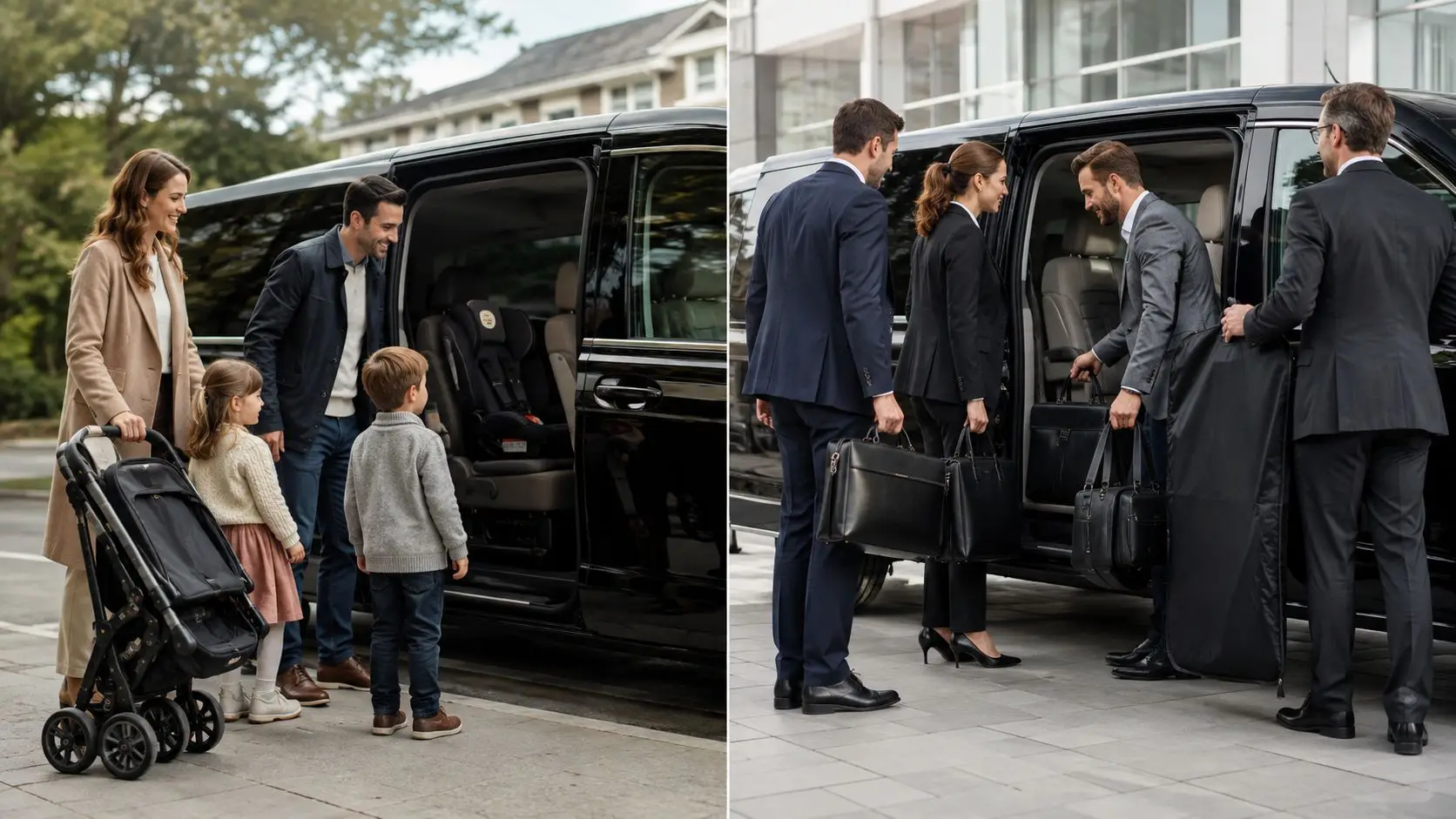
A family arriving at JFK may include grandparents, children, strollers, car seats, and several types of luggage. The organizer should list children's ages or seating needs, the number of strollers, and any item that is unusually large. Those details help the operator match the group with a vehicle configuration that can carry people and equipment together.
Arrival timing can also shift. European flight arrival data recorded 72.4% of flights arriving within 15 minutes of schedule in 2024, so a significant minority arrived outside that window (European flight arrival data). Flight details and a working contact number support arrival coordination. The family should keep phones charged and follow the confirmed meeting instructions once they are available.
Corporate teams and visiting clients
A corporate organizer may be moving executives, visiting clients, or a team to a hotel, office, or offsite. Separate vehicles can create separate receipts, arrival times, and driver communications. One quote and one confirmed transfer can simplify the handoff, as long as the organizer provides accurate passenger and luggage information.
The request should name the destination, the responsible contact, and any timing requirement connected to a meeting or event. If travelers arrive on different flights, the organizer should state whether one vehicle should wait for the later party or whether separate transfers are needed. That decision affects the operating plan before a reservation can be confirmed.
Weddings, conferences, and tours
An event planner may coordinate a wedding party, conference guests, or a tour group arriving on several itineraries. The group's travel details need to align with the shared hotel block or venue schedule, while every guest receives clear meeting instructions.
A group transfer works best when the organizer treats passenger details, luggage, flights, and meeting instructions as one plan.
The event type determines which information deserves priority. Families should lead with children and equipment. Corporate teams should lead with timing and destination control. Event planners should lead with flight coordination, guest communication, and the shared arrival schedule. Clear inputs give the operator something workable to review, rather than a passenger total that leaves the main logistics unresolved.
Pickup Logistics at JFK, LGA, and EWR
A group can finish baggage collection and still lose time at the airport curb. The curb operates as a timed loading point, and airport rules can change by terminal. The operator needs travelers ready for the handoff, with the confirmed meeting instructions in hand.
At JFK, official guidance prohibits parking in front of or beside a terminal. Terminal curbsides support active pickups and drop-offs, and an unattended vehicle may be towed at the owner's expense (JFK pickup and drop-off rules). The group should complete baggage collection, identify the approved meeting point, and be prepared to move when the vehicle arrives. A private van cannot be planned around waiting at the curb.
JFK requires an active handoff
The organizer should tell travelers who will contact the driver and how the group will move from baggage claim to the designated pickup point. One person can gather the passengers while another manages communication. The important part is having that division agreed before anyone leaves the terminal.
JFK access can vary by terminal and time. Current reporting says Terminal 4 allows curbside pickup only during morning hours, while passengers from noon to 2 a.m. use a shuttle to Lot 66. Terminal 5 and Terminal 7 passengers are directed to take AirTrain to Howard Beach for pickup access (JFK rideshare access reporting). Those details explain why a confirmed instruction is more useful than a general message to “meet outside arrivals.”
LGA uses terminal-specific locations
At LaGuardia, general arrivals pickup uses the Car Services Pick Up zone on the outer curb. Terminal B uses Level 2 of the Terminal B Garage between columns E and J, while Terminal C uses the Arrivals area between zones 13A and 13C (LaGuardia pickup guidance).
The terminal belongs in the trip details whenever it is known. “LGA” alone may leave out the information that determines where passengers and vehicle can meet.
EWR changes the curbside assumption
At Newark Liberty, Terminal C pickup procedures have been reworked so app-based pickups no longer use the curb outside the terminal. Travelers are directed to Floor 3 of the Terminal C Garage, following Arrivals Level 1 signs through the pedestrian bridge (Newark Terminal C pickup update).
Private transfer instructions must match the designated commercial pickup location, which may differ from an ordinary curbside meeting point. Airport curb operations depend on short dwell times. A U.S. airport planning guide considers delays up to 30 seconds per vehicle acceptable for new curbside roadways and up to 60 seconds for existing roadways, with longer stops reducing curb capacity and extending queues (airport curbside operations guidance). A van carrying 6–14 passengers with luggage requires more coordinated loading than a sedan, so travelers should be ready before the vehicle reaches the handoff point.
For outbound travel, organizers can review this airport drop-off guidance. Departure procedures also depend on the terminal, meeting point, and time available for loading.
Requesting a Quote and What Happens Next
A well-prepared quote request brings together the three operational questions that determine the trip: who is traveling, what the vehicle must carry, and where the handoff will occur.
Before submitting, the organizer should have these details ready:
- Passenger count: Include children and anyone who needs special seating consideration.
- Luggage description: List checked bags, carry-ons, strollers, car seats, and oversized items.
- Flight information: Provide arrival or departure flight details and the terminal when known.
- Exact addresses: Identify the airport, hotel, residence, office, venue, or connecting airport.
- Timing requirements: Explain event schedules, meetings, hotel check-in needs, or inter-airport connections.
The operator then reviews the request and follows up by phone or email. The response can address the proposed vehicle configuration, route, pickup instructions, quoted price, and any missing information. A quote request is not an instant booking or automatic confirmation. It becomes a reservation only after the operator confirms the arrangement.
Travelers can begin with the Airport Vans NYC quote form. The clearest requests describe the trip as it will happen, including the bags and timing pressures that could affect the handoff.
Airport Vans NYC provides quote-first private Sprinter van transportation operated by IONASprinter for groups traveling through JFK, LGA, and EWR, with routes across Manhattan, Brooklyn, Westchester, New Jersey, and selected inter-airport connections. Groups with children, substantial luggage, corporate schedules, or event deadlines can visit Airport Vans NYC to submit the trip details and request a quote for operator review.