
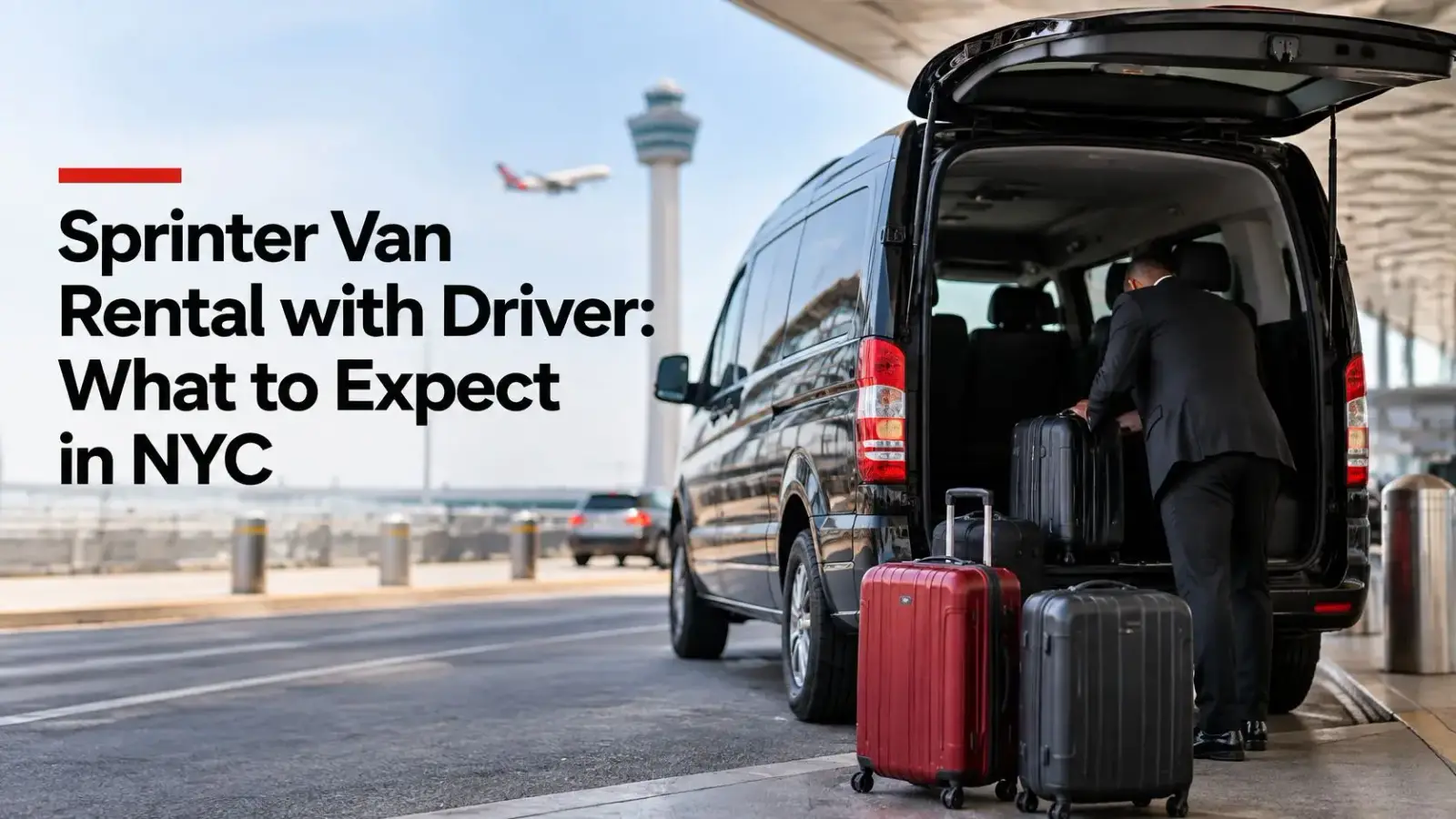
You're third in line at the taxi queue at Terminal 4 with eight people, a folded stroller balanced against a pillar, and eleven checked bags stacked where the queue bends. Two of the party are still at oversize baggage. Nobody has agreed on who rides with whom. Three cars solve the seating problem and create a new one: three drivers circling, three separate curbside negotiations, and a group that splits before it has left the airport.
That's the moment a private van starts to make sense. Not as a luxury, but as one decision that replaces five smaller ones.
Table of Contents
- What a Sprinter Van Rental with Driver Includes
- Matching Passenger Count to Luggage Space
- Which Groups and Trips Suit a Private Sprinter
- How to Request a Quote and Confirm a Reservation
- What Shapes the Price of a Sprinter Transfer
- What to Expect at Airport Pickup
- Book the Van That Fits Your Group
What a Sprinter Van Rental with Driver Includes
A Sprinter van rental with driver reserves one Sprinter and one professional driver for one trip, sized to the party taking it. Nothing is shared with strangers, and there's no looping route through other terminals to fill empty seats. A party of eight landing at JFK with a serious pile of checked bags has a simple choice: one van, or three cars that each carry a fraction of the group and a fraction of the luggage.
A driver who already knows the bag count is the ordinary case here, not the premium one.

The vehicle is a full-size passenger van. Mercedes-Benz introduced the Sprinter in 1995 as cargo vans and five- or nine-seat crewbuses, and the model has grown into a platform offered in different roof heights, wheelbases, seating layouts and cargo arrangements, as Mercedes-Benz's Sprinter model history describes. That variation is the whole point: the configuration gets chosen for the trip rather than assumed from the badge on the back door.
| Element | What it means | What to confirm |
|---|---|---|
| Vehicle | One Sprinter dedicated to your party, not a shared shuttle | Seating layout and cargo space for your group size |
| Driver | A professional driver for the whole trip, including the terminal approach | How and where the driver contacts you on arrival |
| Pickup time | Pre-arranged around your flight details | How a schedule change is handled if the flight moves |
| Baggage | Cargo space allocated from the bag count you supply | Number, size and type of bags, strollers and equipment |
| Price | A quote for this specific trip | What the quote covers, including tolls, waiting time and stops |
The right-hand column does more work than the middle one. A handful of items get assumed and shouldn't be.
- Child seats. A van with 14 seat belts isn't a van with car seats. State the ages and the seats you need, or plan to bring your own.
- Meeting inside the terminal. Curbside handoff and a meet-inside arrangement are different jobs. Ask which one is being sold.
- Waiting time. Late landings and slow baggage belts cost time. Confirm how waiting is handled before the day, not at the curb.
- Extra stops. A second hotel drop or a detour to an office isn't free time or free mileage unless the quote says so.
- Tolls and access charges. Cross the Hudson and the cost structure changes.
- Accessibility equipment. A standard passenger Sprinter isn't automatically accessible. If a lift or ramp is required, that's a question to ask early.
Three decisions carry the rest of this guide: how many people and how many bags, which trip, and how a quote becomes a reservation.
Matching Passenger Count to Luggage Space
Sprinter vans carry up to 14 passengers. That's a ceiling on people, not a promise about people plus luggage. A van laid out for 14 travelers has to seat 14, and every suitcase those travelers brought has to land somewhere that isn't the aisle. That's why the useful first move is to describe the whole load instead of the headcount.
If a page answered the seating question with a single number, the seating and luggage breakdown for 12-passenger vans is the more honest version of that answer.
The Four-Step Luggage Count
- Count the people. Adults and children both take a seat. Infants in arms still take space once a car seat is involved.
- Count the bags in two groups. Checked bags and carry-ons behave differently. A carry-on rides at your feet or overhead; a 28-inch case needs cargo floor.
- List everything that isn't a suitcase. Folded strollers, car seats, golf bags, ski tubes, garment bags, display boards, boxes of samples. Give folded dimensions for strollers. The Sprinter layout takes folded strollers alongside suitcases, but only if the count is known in advance.
- Say whether anyone needs step-free access. This changes the vehicle, not just the seat map.
Group Profiles and What Each One Needs
| Party and bags | Planning consideration | What to send |
|---|---|---|
| 6–8 passengers, one bag each | Comfortable fit in a standard passenger layout | Passenger count, bag count and bag sizes |
| 10–12 passengers, carry-ons only | Near the top of the passenger range with little cargo used | Confirm seat count and rear cargo volume together |
| 12–14 passengers with checked bags | Passenger capacity can outrun usable luggage space | Ask for a luggage-first configuration or a second vehicle |
| Family group with folded strollers | Strollers share the cargo area with suitcases | Stroller count and folded dimensions |
| International arrival with oversized cases | Bag volume, not headcount, decides the vehicle | Number of large cases and total pieces |
| Party with mobility equipment | A standard passenger Sprinter is not automatically accessible | Ask specifically about lift or ramp availability |
| Event or wedding group with equipment | Boxes, garments and displays compete with luggage | List every item and its size |
Vehicle capacity and usable capacity diverge the moment bags enter the conversation. Private ground transportation is mainstream, not niche: the Port Authority's 2025 airport traffic report records private or company cars at 13.9% of ground access across the region and 16.1% at Newark Liberty. A large share of those trunks open onto more than one suitcase.
Practical rule: booking the largest nominal capacity can produce a worse ride than booking fewer passengers in a roomier configuration. Twelve people in a 14-seat layout with 20 checked bags is tighter than ten people with room to spread out.
Accessibility deserves its own line. U.S. Department of Transportation rules require airlines to provide prompt assistance and accessible terminal services, but those obligations attach to carriers and airport facilities, not to a privately arranged van. If someone will travel seated in a wheelchair, ask about a lift or ramp directly.
The single most useful thing to send is the total piece count written out plainly: nine people, eleven checked bags, four carry-ons, one folded stroller.
Which Groups and Trips Suit a Private Sprinter
The core trips are well defined. JFK, LaGuardia and Newark Liberty to and from Manhattan, Brooklyn, Westchester and New Jersey. Newark Liberty sits in New Jersey, not inside New York City, which matters for drive time and for anyone treating a cross-Hudson run like a city transfer. Selected inter-airport connections, including JFK to LaGuardia and JFK to Newark, run as their own trips subject to operator confirmation rather than on-demand availability.
Volume explains why this is a logistics problem before it's a price problem. The Port Authority of New York and New Jersey reported a record 145.9 million passengers across its four commercial airports in 2024, with JFK handling 63.3 million, including 35.3 million international passengers, and LaGuardia 33.5 million, according to the Port Authority's 2024 annual airport traffic report. Newark's total appears as approximately 49.1 million in that report and 48.9 million in New Jersey Business Magazine's coverage of the Port Authority figures. Either way, roughly 49 million people a year pass through one airport's terminals.
| Group type | What one van solves | What to send |
|---|---|---|
| Family with young children | Strollers, car seats and bags stay with the group instead of splitting across cars | Ages, stroller count, child seat needs |
| Corporate team or visiting executives | Colleagues arrive at the same door at the same time | Flight numbers, destination address, traveler count |
| Hotel guests landing on one flight | One pickup for the party instead of several separate arrangements | Arrival time, guest count, bell desk contact |
| Wedding party or event group | The group travels together with dresses, gifts and equipment | Bag and equipment count, event timing |
| Tour group or agency booking | A single confirmed vehicle plan per arrival | Group size, itinerary, number of pickups |
| Inter-airport connection | One vehicle covers the transfer between airports, subject to operator confirmation | Both airports, connection time, bag count |
The argument for one vehicle is simpler than the feature list. Teams and wedding parties ride together on JFK transfers, which means a group arrives at the same door rather than converging from three directions. A hotel lobby to the Newark terminal run doesn't need splitting into separate fares and separate vehicles. Families stay intact through customs, baggage claim and the walk to the curb.
How to Request a Quote and Confirm a Reservation
Most of the work happens before a van is dispatched. The request either contains enough detail to size the vehicle correctly or it doesn't, and that detail is hard to reconstruct on arrival day.
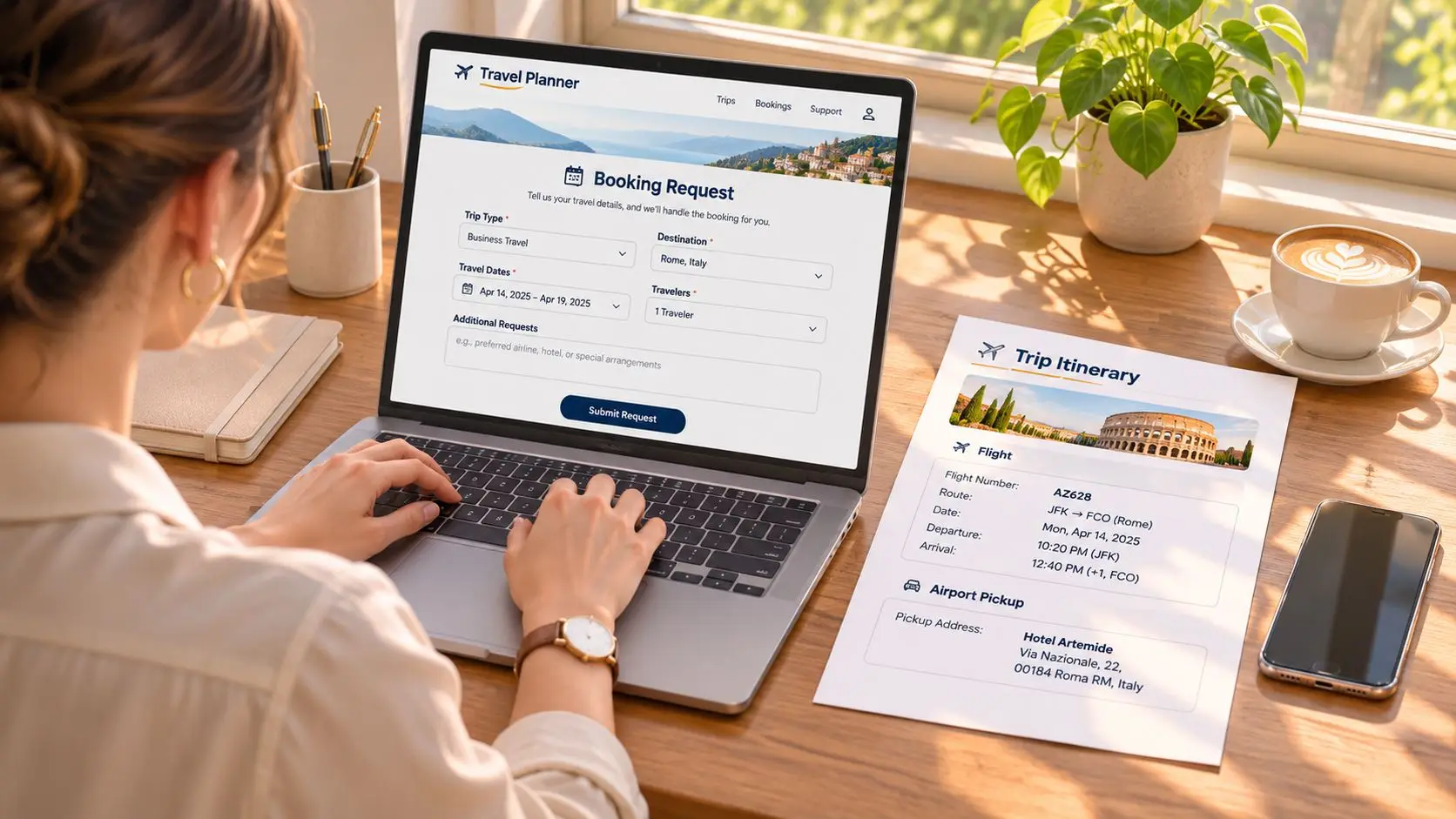
- Assemble the trip facts. Date, flight number and scheduled arrival, exact pickup and drop-off addresses, passenger count, checked bags and carry-ons, strollers or equipment, and whether the trip is one-way or return.
- Send the request through the quote form. The airport transfer quote request collects pickup and drop-off addresses, travel dates, passenger counts and luggage details.
- Read the reply properly. Airport Vans NYC confirms timing, terminal or door instructions and the right van size for the group, and may come back with follow-up questions about bags. Answer them precisely rather than approximately.
- Accept the quote. A quote request becomes a reservation only after the operator confirms it. Nothing is booked instantly and nothing is confirmed automatically.
- Receive pickup instructions. Terminal, door and meeting point for that specific airport, as confirmed by the operator for your trip.
- Update before the trip. Pass on any flight change and ask for the revised plan to be confirmed back to you.
A quote request is not a booking. It becomes one when a person confirms the vehicle, the timing and the pickup point, and that confirmation is in your hands.
Timing matters more than most travelers expect. New York City airports received more than 3.4 million travelers between November 25 and December 2, 2024, according to 6sqft's report of Port Authority data. Airport Vans NYC recommends booking JFK van service at least 24 hours ahead, and earlier for peak holiday travel or large groups.
A return leg or an inter-airport connection needs its own line on the request. Each one changes the vehicle plan, the timing and the bag count, and bundling it into a casual sentence at the bottom of a message is how gaps appear. Manhattan customers should give the exact pickup address, since neighborhood details affect routing and pickup windows.
What Shapes the Price of a Sprinter Transfer
There's no honest rate card for this service, because a quote is specific to one trip. A Manhattan drop, a Westchester run, a cross-Hudson trip to Newark and an inter-airport connection are four different jobs. The variables that move the number:
- Route and distance. City streets, highway miles and terminal loops all cost time, and time is what a private van sells.
- Date and time of day. A Tuesday 4pm arrival and a Sunday 6am arrival are not the same assignment.
- Vehicle configuration. A luggage-first layout for a smaller party can cost more than a dense 14-seat layout, because the space is doing different work.
- Waiting time. A flight that lands late, or a baggage belt that stalls, converts scheduled time into standing time.
- Tolls and airport access charges. These are real costs on a cross-Hudson trip and on airport entry, and they should appear in the quote rather than the final bill.
- Extra stops. A second drop in Brooklyn is a second route decision, not a rounding error.
- One way or round trip. A return leg is a separate assignment with its own timing and its own vehicle commitment.
- Lead time. Late requests during peak periods narrow the options.
Reading Two Quotes Side by Side
Ask whether the price is per vehicle or per person. A per-person figure for a party of nine costs more than a vehicle price, and it's the first thing to check when one quote looks unusually low.
Then run through the inclusions. Are tolls inside the number? Is waiting time included, and for how long before it starts accruing? Does the price cover a meet-inside-terminal service or curbside only? Are child seats part of it? What happens to the price if the arrival time moves by two hours?
Before accepting: ask what the quote covers and what would change it. An operator who answers both questions in specifics is telling you the trip has been planned, not just priced.
The comparison that matters isn't quote against quote. It's quote against the actual cost of the alternative, which is three cars, three uncertain pickups and a group arriving in pieces.
What to Expect at Airport Pickup
Arrival day runs on coordination, not on hope. Three moments decide how it goes.
Before Travel
Confirm the pickup time, terminal, door and meeting point in writing, and save a contact number somewhere that doesn't depend on airport wifi. Send the flight number so timing can be planned around it. That's coordination the operator confirms with you, not automatic monitoring you should assume exists.
Terminal and door details get confirmed rather than guessed. Newark pickups follow the same principle in reverse: the van goes directly to the Manhattan address with no train transfers and no stairs with suitcases, and the party meets the driver at the airport. For departures from Manhattan to LaGuardia, a reserved pickup time is confirmed in advance, and early-flight requests can go in the notes field.
At the Airport
Collect every bag before anyone goes looking for the driver. A group that splits between baggage claim and the curb will lose twenty minutes and one passenger. Agree one meeting point for the whole party, keep the group together at the curb, and load in an order that puts the oversized cases at the back of the cargo area.
More detail on terminal-level logistics sits in this guide to JFK airport pickup coordination.
When the Flight Moves
Message as soon as the arrival time shifts. Waiting time and driver duty limits both react to a late landing, and a chauffeur-driven van is a regulated passenger-carrier service rather than an on-demand car. FMCSA rules for passenger carriers prohibit driving past set on-duty limits, including 60 hours in seven consecutive days for carriers that don't operate every day, alongside a 14-consecutive-hour on-duty window after required off-duty time, as the FMCSA hours-of-service rules for passenger carriers set out.
A late international arrival followed by an inter-airport run needs a realistic window. The operator may need to adjust the plan rather than add a stop, and asking early is what makes that adjustment possible.
Screenshot checklist: flight number, bag count and sizes, exact pickup and drop-off addresses, driver contact, terminal and door as confirmed by the operator.
Book the Van That Fits Your Group
For a party of roughly six to fourteen people whose luggage roughly matches the headcount, a private Sprinter with driver replaces a convoy of cars and several separate arrangements. That's the verdict, and it holds for airport runs, hotel moves, corporate arrivals and event transfers. The exception is the party that doesn't fit the pattern: fewer people with unusually heavy luggage, or anyone traveling with mobility equipment. Say so in the request, in plain numbers, so the vehicle gets chosen for the actual load instead of the seat count.
Airport Vans NYC is the dedicated channel for airport van quotes and bookings, with transportation services operated by IONASprinter. Send passenger count, bag count, flight details and exact pickup and drop-off addresses, and treat the trip as reserved only after the operator confirms. Groups still weighing one van against two cars can describe the full load in the same request and let the operator review the configuration before anyone commits. A quote request is free of obligation, and the phone line, (718) 439-1650, works for anyone who would rather talk through the bag math than type it.
Airport Vans NYC runs private Sprinter van transfers for up to 14 passengers to and from JFK, LaGuardia and Newark Liberty, with selected inter-airport routes, operated by IONASprinter. If your group is landing with more luggage than seats can comfortably account for, describe the whole load and let the vehicle be sized around it. Start at Airport Vans NYC to request a quote for your next arrival.