
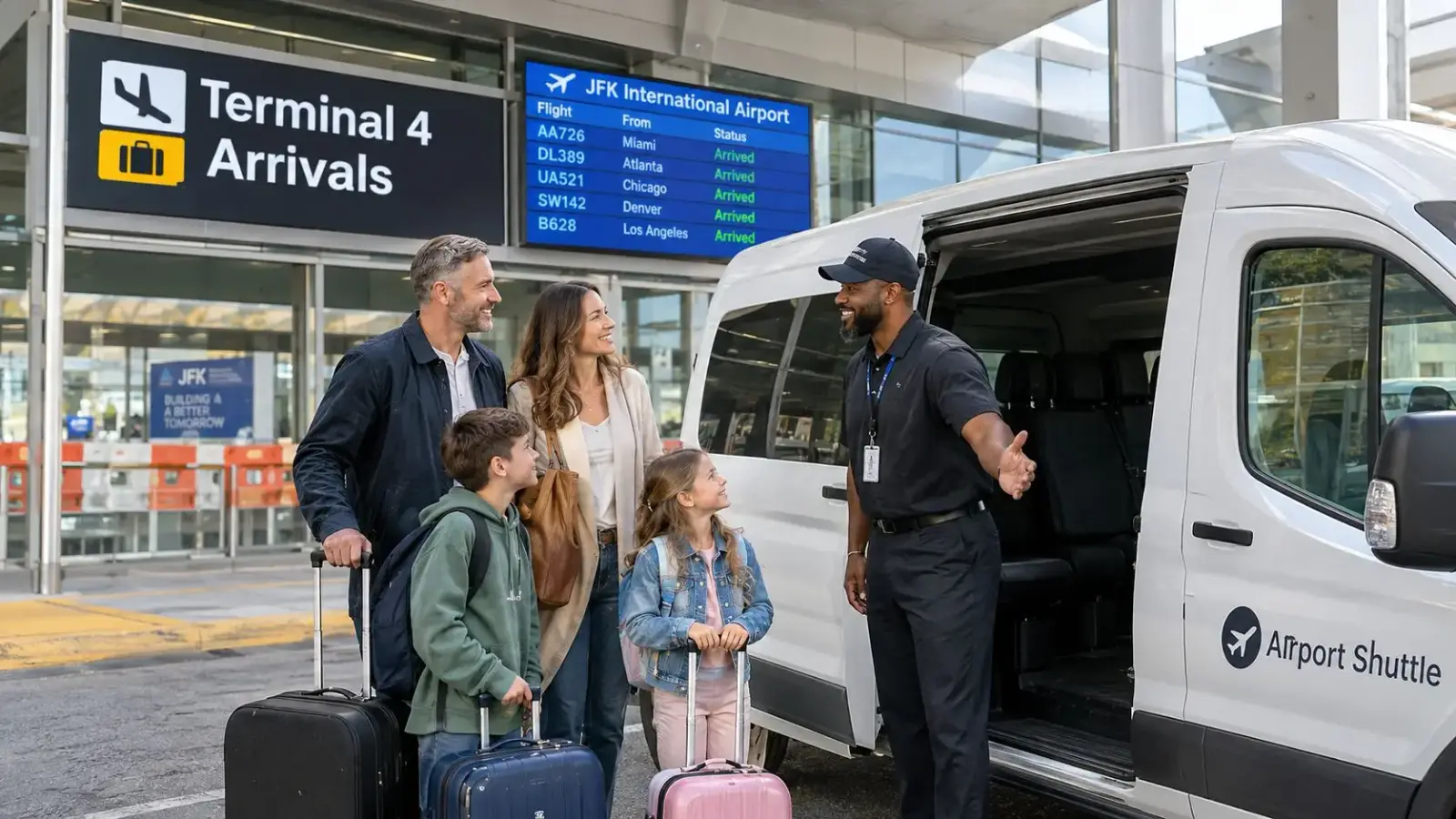
A family of ten has just landed at JFK on a red-eye. They're leaving Terminal 4 with eight suitcases and a stroller, while the driver is trying to text from the Arrivals level and the curb keeps moving around construction barriers. The flight landed on time, but baggage claim didn't, and a simple “meet outside” instruction has already become a split-party problem.
That's the practical reality of airport pickup at JFK in 2026. JFK handled 62,629,455 passengers in 2025, after 63,265,972 in 2024 and 62,464,331 in 2023, according to the Airport Council International traffic rankings. At that scale, even a small annual shift can affect curb congestion, wait times, and how carefully a private group transfer must be coordinated.
Table of Contents
- The Reality of Airport Pickup at JFK Today
- Understanding JFK's Terminals and Curbside Layout
- Official Pickup Rules and Why Dwell Time Matters
- Arrival Coordination With a Private Van
- How JFK Pickup Differs From LGA and EWR
- Booking a Private Sprinter Van for Your Group
- Practical Checklist and How to Request a Quote
The Reality of Airport Pickup at JFK Today
A JFK pickup can change while the van is already on the way. The correct plan depends on the arriving terminal, the passenger's exact exit point, active construction routing, and whether the group has cleared baggage claim. A fixed curbside instruction is not a reliable operating plan.
For a private van operator, “Terminal 4” is only the starting point. The dispatcher needs the flight number, airline, passenger contact, luggage expectations, and a specific door-level meeting instruction. If bags are delayed, the van cannot sit at the terminal frontage. JFK curbs are active loading areas, not parking spaces, and unattended vehicles may be towed under the airport rules in JFK's pickup and drop-off guidance.
Construction adds another variable. Pickup and drop-off can take longer than usual, and instructions can differ by terminal. Some arrivals can still use curbside pickup, while others must use a free shuttle to a pickup lot or take the AirTrain to Howard Beach, based on the terminal's current operating instructions. Groups should review the shuttle-to-JFK arrangements guide before giving passengers a meeting point. The airport's official driver information and construction guidance takes priority over saved directions, old screenshots, and generic travel advice.
Practical rule: The flight number sets the arrival window. The terminal and door determine where passengers can meet the van.
JFK's traffic volume also affects the approach. Port Authority data show 454,573 total aircraft operations in 2025, compared with 458,975 in 2024 and 468,070 in 2023, as reported by JFK airport information. Those figures help explain why the driver needs current knowledge of the Van Wyck approach and terminal traffic flow, not a memorized curb location.
A workable pickup plan therefore has several parts: confirm the terminal's current access pattern, set a door-level meeting point, respect curb rules, track the actual flight and baggage progress, and give the operator enough information to quote and confirm the appropriate van. The plan must remain adjustable until the group is ready to leave the terminal.
Understanding JFK's Terminals and Curbside Layout
JFK has multiple terminal buildings, and airline information is only the starting point. A group should confirm the terminal shown in the airline's arrival details, then confirm the Arrivals door where passengers will wait. Terminal names alone are too broad for a large family, corporate team, or luggage-heavy tour group.
The airport's current pickup pattern can change by terminal. Terminal 4 commonly uses the Arrivals level for ground transportation, while Terminal 5 has an outer-curb arrangement. Other terminals, including Terminals 1, 2, 7, and 8, may direct passengers toward parking-lot shuttle arrangements or designated commercial areas rather than a simple curbside pull-up. Terminal 1's redevelopment has further affected direct curbside access, so passengers shouldn't assume an old meeting point remains active.
Identify the building, level, and door
The inner and outer curbs don't serve the same purpose. Commercial vehicles, pre-arranged vans, taxis, and app-based services may be directed into different lanes, and construction barriers can move passengers away from the frontage that appears obvious on a map. Some pickup points have shifted significantly from older curbside locations, so a driver needs the specific door, not just the terminal number.
Terminal 4 has its own pre-arranged service rules. The operator should be able to identify the reservation using the passenger name, airline, and flight number, as required by Terminal 4's rules and regulations. That information also helps the driver match the right group to the right vehicle when several parties are leaving the same arrivals area.
For a family or event group, the simplest instruction is specific: passengers collect bags, remain together, exit at the assigned door, and contact the driver when they're physically outside. The operator then follows the current signs and pulls up only when the group is ready. General airport drop-off and pickup principles are also summarized in this JFK airport drop-off guide.
Official Pickup Rules and Why Dwell Time Matters
The curb is for movement, not waiting. JFK's official pickup guidance states that terminal curbsides are reserved for active pickups and drop-offs, so a private vehicle can't park at Arrivals while passengers search for bags, gather a group, or walk from another terminal area. The Port Authority pickup and drop-off rules make the operating principle clear: vehicle staging has to happen away from the terminal curb.
That rule changes how a private Sprinter van should be dispatched. The driver shouldn't arrive early and hope the group appears. The vehicle needs to remain in an approved holding or staging area until the dispatcher can align the van's approach with the passenger's actual readiness.
The flight time isn't the pickup time
A scheduled landing time only tells the operator when the aircraft is expected to arrive. It doesn't tell the dispatcher when passengers will clear the aircraft, collect checked bags, pass through any arrival process, and reach the assigned exit. Flight status gives the operator a better basis for deciding when to leave the holding area.
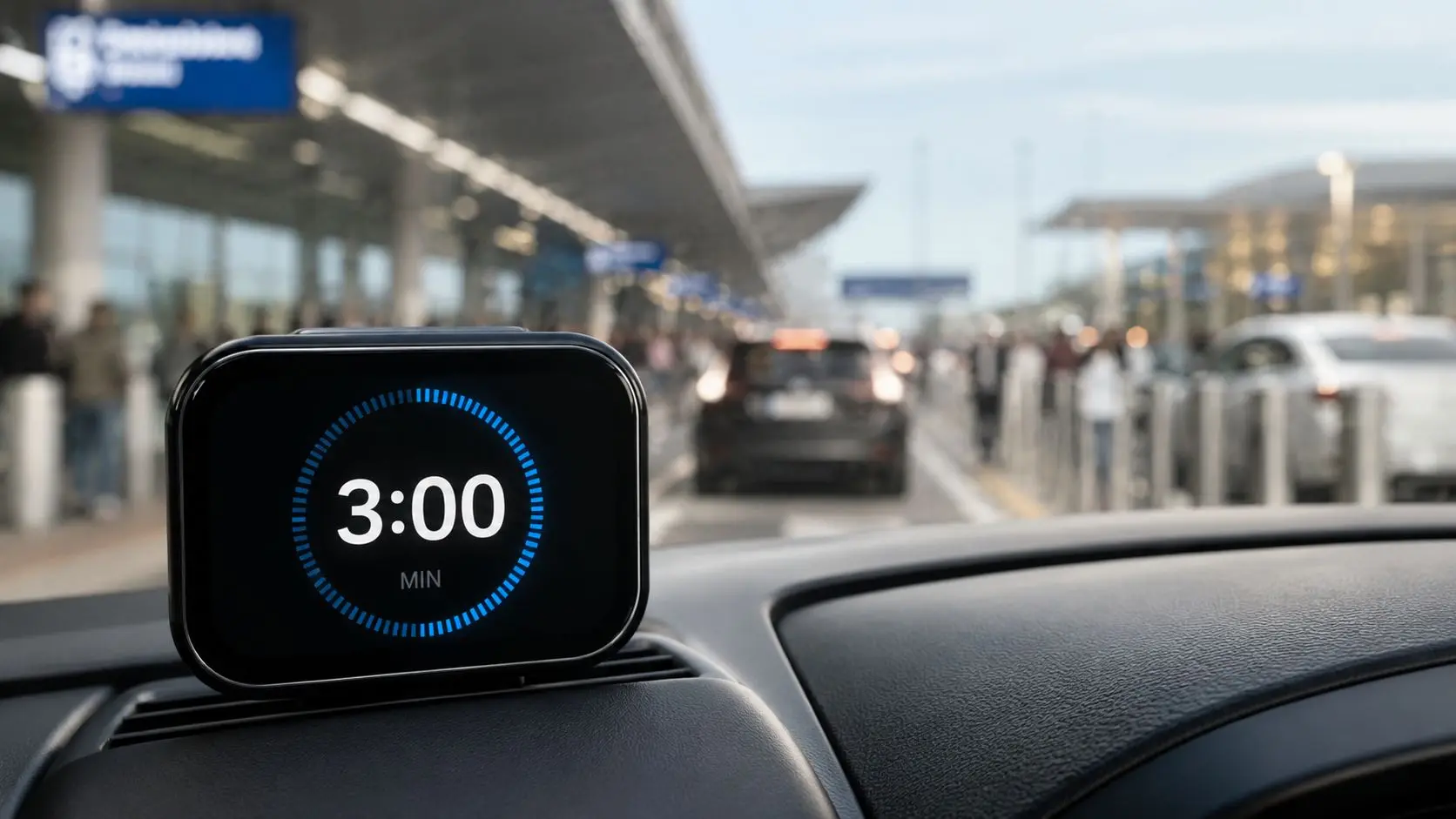
The curbside clock matters because the van has limited time to load and depart. Airport rules describe the curb as an active loading zone, and unattended vehicles can be towed. Construction staging and emergency access add further pressure to keep the lane moving. The driver's job is therefore not to wait at the front of the terminal, but to arrive when the group can load efficiently.
Dispatch principle: A van that reaches the curb too early creates a problem. A van that reaches the correct door when the group is ready solves one.
For group arrivals, one person should act as the point of contact. That person confirms that bags are collected, children and strollers are together, and everyone knows the assigned door. The driver then has a clear signal to make the terminal approach rather than circling while the group is still inside.
Arrival Coordination With a Private Van
Good JFK coordination starts before the aircraft leaves. The dispatcher needs the flight number, origin, airline, passenger count, luggage count, and destination. Those details support a live arrival plan instead of a fixed appointment based only on the scheduled landing time.
The group should also provide one working mobile number. A driver can use that contact for a short warning message when the van is approaching, but the message only helps if the passenger is already outside or moving toward the assigned door. A text exchange from baggage claim isn't a substitute for a clear meeting point.
The operating sequence
- The dispatcher monitors the flight. Early arrivals, delays, diversions, and terminal changes can alter when the van should leave its staging location.
- The passengers stay together. One lead passenger confirms baggage collection and sends the group toward the assigned exit. Families should keep the stroller and smaller bags consolidated rather than sending different people to different doors.
- The driver follows current airport signs. Construction has redirected some JFK pickup lanes, so a driver should follow posted instructions rather than rely on a previously saved route. Airport updates specifically warn that pickup and drop-off may take longer than usual and that terminal procedures can differ.
- The van pulls up after contact. The driver should use the active pickup area, load promptly, and leave the curb. If the terminal requires a lot shuttle or AirTrain connection, the passengers need that instruction before they walk outside.
Flight details also help when an aircraft lands at a different terminal or a planned curb becomes unavailable. The dispatcher can adjust the approach, but the passenger still needs to confirm where the group is standing. A precise message such as “Terminal 4 Arrivals, Door 4, outside with all luggage” is more useful than “outside Terminal 4.”
How JFK Pickup Differs From LGA and EWR
Airport pickup plans shouldn't be copied from one New York area airport to another. JFK, LaGuardia, and Newark Liberty each use different terminal layouts, curb arrangements, and commercial pickup instructions.
At JFK, terminal specificity is the main challenge. The airport's terminals have separate arrivals areas and changing pickup routes, with construction affecting how passengers reach a van. At LGA, the pickup process is more consolidated in several areas, but the correct level and zone still matter. At EWR, Terminal A has a defined lower-arrivals pickup arrangement for app-based drivers, with pickup zones 9, 10, 11, and 12 on the second curb outside arrivals, according to the Terminal A driver pickup information.
| Airport | Terminal Layout | Commercial Pickup Zone | Group Coordination Complexity |
|---|---|---|---|
| JFK | Multiple terminal buildings with separate arrival flows | Terminal-specific curb, lot, shuttle, AirTrain, or commercial arrangements | Highest, because the terminal and current construction routing both matter |
| LGA | More consolidated arrival areas, with terminal-specific rules | Car-service areas or designated parking-garage pickup points | Moderate, because the level and zone must still be confirmed |
| EWR | Terminal-specific arrival levels and marked pickup areas | Defined commercial or app-based zones by terminal | Moderate, with exact terminal instructions still required |
LaGuardia also changes the meeting point by terminal. Driver guidance directs car-service pickups to an outer- curb zone, while public guidance for Terminal B directs car-service passengers to Parking Garage Level 2, Rows E and F. The LaGuardia pickup guidance should be checked for the relevant terminal rather than generalized across the airport.
For private groups, JFK deserves the most detailed pre-arrival message. EWR and LGA may allow simpler instructions in some situations, but a group still needs the terminal, level, zone, and driver contact before leaving baggage claim.
Booking a Private Sprinter Van for Your Group
A quote-first booking begins with facts, not a vehicle guess. The group should provide the number of passengers, luggage volume, stroller or special-item needs, exact flight number, pickup terminal, destination, and requested route. A Sprinter configured for a smaller group may not suit a larger party with substantial checked baggage, so passenger count alone isn't enough.
Airport Vans NYC is a quote and reservation service for private airport van transfers operated by IONASprinter. Its private Sprinter vans serve JFK, LGA, and EWR, with capacity for up to 14 passengers, subject to luggage requirements. The JFK airport van service page is the appropriate starting point for a group that needs a dedicated vehicle rather than several separate cars.
What the quote should settle
The quote request should answer practical questions before the arrival date:
- Vehicle fit: Can the selected van accommodate the passengers, checked bags, carry-ons, stroller, and any child-seat requirements?
- Route: Is the destination in Manhattan, Brooklyn, Westchester, New Jersey, or another supported greater NYC location?
- Airport details: Which JFK terminal is listed, and what arrival instructions apply to that terminal?
- Coordination: Who receives the driver's contact information, and which passenger will confirm readiness?
- Commercial terms: Which tolls, parking arrangements, waiting terms, and other trip details are included in the quoted fare?
The operator should confirm the details before the request becomes a reservation. A quote request isn't an automatic booking, and it shouldn't be treated as confirmed until the operator follows up by phone or email.
For corporate teams and hotel concierges, one point of contact keeps the process orderly. The coordinator can distribute the confirmed terminal instructions to every traveler, while the dispatcher retains the flight and passenger details needed for arrival monitoring. That approach also keeps the group together when construction changes the path from baggage claim to the active pickup point.
Practical Checklist and How to Request a Quote
A reliable JFK pickup plan fits on one page. It should identify the flight, terminal, passenger lead, luggage situation, destination, and exact communication method. The plan must also acknowledge that the curb is active loading space, so the group needs to be ready before the van approaches.
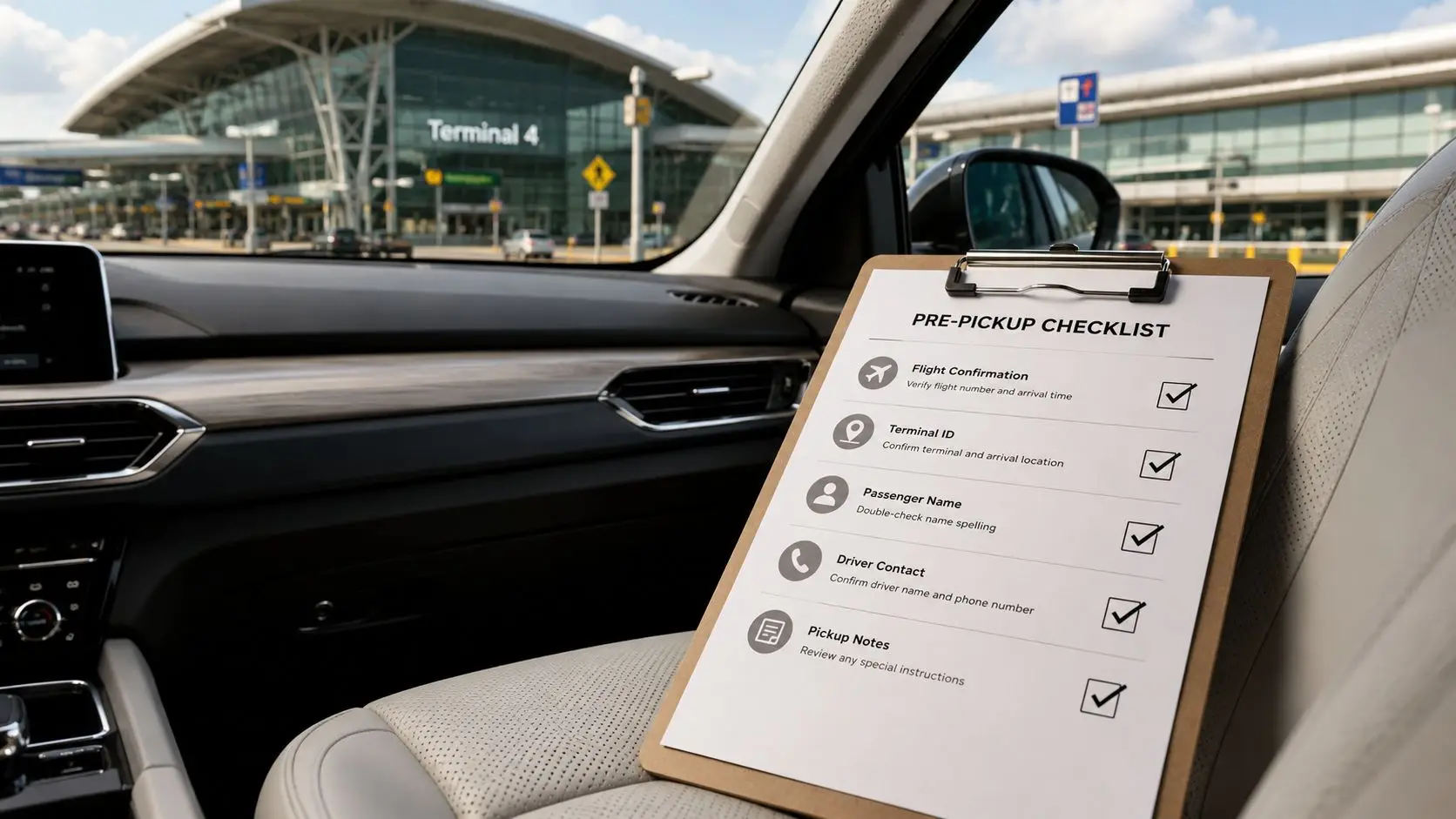
Pre-pickup checklist
- Flight confirmation: Provide the airline, flight number, origin, and arrival date.
- Terminal identification: Verify the terminal in the current airline information and confirm the arrival level.
- Door instructions: Wait for the operator's current meeting-point details instead of using an old curbside location.
- Passenger count: Include adults, children, and anyone requiring extra assistance.
- Luggage count: List checked bags, carry-ons, strollers, equipment, or unusually large items.
- Lead contact: Give the dispatcher one passenger's working mobile number.
- Readiness message: Contact the driver only after the group has collected bags and reached the assigned exit.
- Destination details: Include the hotel, residence, office, event venue, or onward airport.
- Reservation status: Treat the trip as pending until the operator confirms it.
The quote-first process should collect the passenger count, flight number, pickup time, destination, and luggage details. The operator can then identify a suitable vehicle configuration for a group of up to 14 passengers, subject to available luggage space and the specific trip requirements.

What happens after the request
The operator reviews the route and passenger information, sends the quote, and follows up for confirmation. The final dispatch details should identify the vehicle arrangement, driver contact process, and terminal meeting instructions. A group coordinator can then circulate one message so nobody walks to a different curb or lot.
Airport Vans NYC handles private Sprinter transfers for groups traveling between JFK, LGA, EWR, Manhattan, Brooklyn, Westchester, New Jersey, and selected inter-airport routes. The practical next step is to submit the actual flight and luggage information, let the operator determine the appropriate van configuration, and wait for human confirmation before treating the ride as reserved.
Airport Vans NYC offers quote-first private Sprinter van transportation operated by IONASprinter for groups of up to 14 passengers, subject to luggage requirements, with terminal-specific coordination for JFK and other NYC-area airports. Travelers, hotel concierges, corporate coordinators, and event planners can request a quote from Airport Vans NYC with the flight number, passenger count, luggage details, and destination so the operator can plan the correct pickup.