

A family lands at JFK after a long flight, the kids are tired, two checked bags are still somewhere on the carousel, and a grandparent doesn't want to keep walking between terminals trying to figure out where the driver is. That's usually the moment when airport car service stops being a vague category and becomes a coordination problem. For groups in the NYC area, the question isn't whether the ride is fancy, it's whether everyone, and every bag, gets from the terminal to the vehicle without a scramble.
A private airport van exists to solve that handoff. It keeps a group together, gives the organizer one vehicle to manage, and turns arrival-day confusion into a planned pickup with a specific terminal, door, and curbside meeting point. In a market where broader airport transfer bookings are estimated at 460 million to 555 million versus 65 million to 80 million on-airport car rental bookings, transfers are about 7 times higher in volume, which shows how central this kind of ground movement has become around airports CarTrawler airport mobility report.
Table of Contents
- What an Airport Car Service Does
- Private Van, Sedan, and Shared Shuttle Compared
- What Drives the Price of an Airport Car Service
- How the Booking and Confirmation Workflow Works
- Pickup Logistics at JFK, LGA, and EWR
- When a Private Van Is the Right Choice
- Practical Tips for a Smoother Airport Transfer
- Requesting a Quote and Planning Your Trip
What an Airport Car Service Does
A flight from Europe lands at JFK, and a family of nine is already juggling strollers, a booster seat, carry-ons, and two oversized suitcases that never seem to fit where anyone expects. If that group tries to sort out ground transportation one traveler at a time, the pickup turns messy fast. One person is ready, one child needs a bathroom stop, and the oldest passenger just wants to sit down and wait in the same place as everyone else.
Private transportation, not a street hail
An airport car service is prearranged transportation that's booked before the trip and coordinated around the flight, the terminal, and the size of the party. For group travel, that matters because the vehicle is assigned for the whole party, not one rider at a time.
At JFK, LaGuardia, or Newark, curbside pickup is not just a question of finding any available car. Terminal rules, door assignments, and the timing of baggage claim all affect how long the group waits at the curb and where the driver should meet them. A private reservation gives the organizer a named plan instead of a last-minute search, and that plan has to account for the airport's pickup flow from the start.
Practical rule: if the group can't comfortably fit in one standard car, the pickup should be planned as logistics, not treated like a casual ride request.
Why groups book it
Families, business teams, wedding guests, and tour groups usually book private airport transportation for three reasons. They want the whole party together, they need room for luggage, and they need a pickup that doesn't force everyone to improvise at the curb.
The National Academies airport access review shows that airport travel depends on more than one mode, and rental cars cover only part of the picture. At selected airports, originating and terminating passengers using rental cars typically ranged from 9% to 15%, with 21% at Denver International in 2022, while peer-to-peer carsharing stayed below 0.3% at most of those airports and reached only about 1.0% at Denver National Academies airport access review. The point for a first-time organizer is simple. Ground transport is part of the airport plan, and the right format depends on whether the group needs one vehicle, one pickup point, and one clear curbside instruction set.
The same logic shows up in private van service. A vehicle that can hold the party, the bags, and the timing changes from a delayed flight is less about comfort features and more about keeping everyone together when the terminal gets crowded.
Private Van, Sedan, and Shared Shuttle Compared
A sedan works well for one or two travelers with light bags. A shared shuttle can fit a trip where timing matters less than a lower-cost seat and the group does not mind other passengers joining the route. A private van fills the middle ground and usually becomes the better fit once the party grows, the luggage gets heavier, or the pickup has to stay organized from the first curbside handoff.
How the three formats differ
| Service Format Comparison for NYC Group Travel | Best Party Size | Luggage Capacity | Stops | Group Stays Together |
|---|---|---|---|---|
| Sedan | 1 to 3 travelers | Light to moderate | Direct, usually one stop | Yes, but only for small parties |
| Shared shuttle | Varies by route | Limited by shared loading | Multiple pickups or drop-offs | No, passengers are split by schedule |
| Private van | 6 to 14 passengers, subject to luggage requirements | Designed for group bags, strollers, and checked luggage | Direct for the booked party | Yes |
Why the private van usually fits group airport travel
A wedding party arriving at EWR for a Brooklyn hotel often lands with different flight times, different baggage counts, and one shared destination. A youth sports team coming into LGA for Westchester faces a similar problem, because bats, duffels, and carry-ons do not sort themselves cleanly across several sedans at a crowded curb.
A private van gives the organizer one vehicle to account for, one pickup point to confirm, and one set of instructions to pass to the group. That matters in New York airport travel, where a bad handoff can start with someone waiting by the wrong door, someone else stepping into the wrong lane, and the rest of the party trying to interpret the curb from across terminal traffic.
The airport mobility market helps explain why this kind of planning gets so much attention. As noted in the CarTrawler airport mobility report cited above, broader airport transfers were estimated at $19 billion to $23 billion within a total airport mobility opportunity of $60 billion to $70 billion as of 2021. That figure does not tell a traveler which vehicle to choose, but it does show how much airport movement depends on ground transport that matches the size of the group, the luggage, and the curbside setup.
What Drives the Price of an Airport Car Service
A quote for a Manhattan pickup isn't built the same way as one for Westchester or New Jersey. The vehicle, the number of passengers, the amount of luggage, and the route all affect how the trip has to be staged. A quote that looks different from another one usually reflects a different operational load, not just a different mood from the provider.
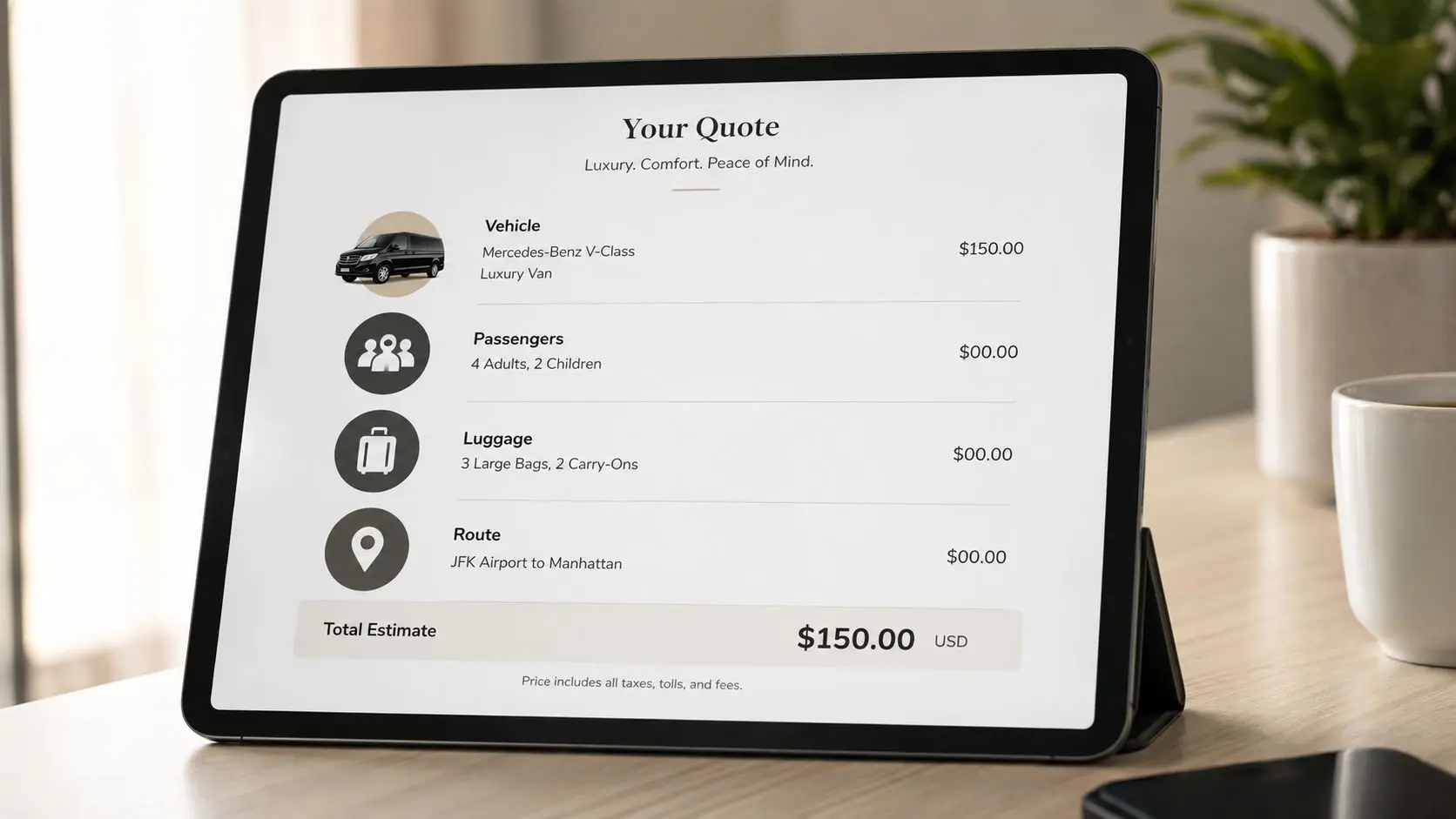
The main variables that move a quote
The first factor is vehicle configuration. A van sized for a family with strollers and checked bags isn't priced the same way as a small sedan, because the operator is assigning a different class of vehicle and managing more loading space.
The second factor is the route itself. A transfer into Manhattan, Brooklyn, Westchester, or New Jersey doesn't create the same drive pattern, curb timing, or dispatch commitment. Inter-airport routes add another layer because the driver has to treat the trip as a timed connection, not just a point-to-point ride.
A third factor is pickup logistics. If the flight lands at a crowded curb or the terminal has exact meeting instructions, the driver has to stage accordingly. Airport ground-transportation policy often includes permit, privilege, concession, per-trip, and curbside dwell-time fees, and the National Academies notes that airports commonly charge commercial ground-transport providers on a per-trip basis in addition to other access fees National Academies airport policy review. That's one reason airport quotes can't be treated like simple street-fare estimates.
A good quote should answer who's riding, how much luggage is coming, where the pickup happens, and whether the route needs special timing.
What a careful organizer should ask
- Vehicle fit: Ask whether the assigned van can handle the actual bag count, not just the headcount.
- Pickup point: Confirm the terminal, level, or door.
- Trip type: Clarify whether it's airport-to-city, city-to-airport, or an inter-airport transfer.
- Flight details: Provide the flight number so arrival changes can be considered in planning.
- Reservation status: Treat the quote as a request until the operator confirms it.
How the Booking and Confirmation Workflow Works
A quote-first process can feel slower than tapping a button, but for airport van travel it reduces the risk of last-minute confusion. The operator needs enough information to assign the right vehicle and the right pickup plan before the reservation is locked in. If those details are vague, the organizer ends up correcting them later, and airport pickups are usually less orderly once the trip is already in motion.
What the organizer sends first
A solid request usually begins with passenger count, luggage count, pickup airport, drop-off address, and flight number. Child seats, strollers, oversized bags, and any mobility concerns should be included in the same message so the vehicle can be matched correctly the first time.
That detail matters more for a group than for a single rider. A van may look open on paper, but it can still be the wrong fit if the bags are large, awkward, or more numerous than expected.
What happens before the ride is confirmed
After the request goes out, the operator follows up by phone or email with the trip details. That is the point where timing, vehicle fit, and pickup instructions get checked against the itinerary. A quote becomes a reservation only after that confirmation.
For travelers who want a place to start, the reservation flow on Airport Vans NYC's quote page follows that same logic, quote first, then operator follow-up, then confirmation. The purpose is practical. Airport transport has to be matched to baggage, terminal access, and the curb plan at the airport.
A clean reservation also helps the dispatcher plan for the parts first-time organizers often miss. If the flight is delayed, the terminal changes, or the pickup needs to happen at a specific door or level, those instructions should already be in the file before the driver is sent. That is the same reason a careful organizer should treat the quote as a working draft until the operator confirms it.
The fastest booking is usually the one with the cleanest details at the start.
Pickup Logistics at JFK, LGA, and EWR
At JFK, LGA, and EWR, the hardest part of the trip is often not the ride itself, it's the meeting point. Families think in terms of “arrivals,” but airports think in terms of terminals, levels, doors, and curb access. That's why a private pickup plan has to be more specific than a street address.
Why exact curb instructions matter
Atlanta's airport guidance gives a clear example of how precise these instructions can be. Its terminal-to-terminal shuttle pickups are directed to the Arrivals level between doors A1 and A2, and the connector shuttle runs between the International Terminal and the Rental Car Center and between the Domestic Terminal and the International Terminal Atlanta airport ground transportation guidance. That kind of specificity shows why “just meet at arrivals” is often too loose for a group with children and luggage.
New York airports work the same way in practice. The organizer needs to know which terminal the flight arrives into, which exit the driver should use, and where the group should wait if the flight lands early or the baggage claim takes longer than expected.
NYC routes that need cleaner coordination
For JFK to Manhattan, the challenge is usually curb discipline and keeping the group together while bags are loaded. For LGA to Brooklyn, the issue is often timing and making sure the driver reaches the right terminal exit. For EWR to Westchester or New Jersey, the pickup plan often matters as much as the drive itself because the group may be connecting to hotels, homes, or offices right after landing.
One practical model comes from Dayton International, where the airport states that prearranged van and car services may be scheduled to and from the airport for destinations including downtown Dayton, hotels, attractions, businesses, personal residences, shopping destinations, universities, Wright-Patterson Air Force Base, and other locations throughout the region Dayton International ground transportation. The useful lesson for NYC is simple. A private van works best when the pickup is framed as a scheduled regional transfer, not a vague curbside guess.
Airport drop-off guidance matters for the same reason. A party that knows the terminal, the level, and the curbside meeting point arrives calmer and leaves the baggage area faster.
When a Private Van Is the Right Choice
A private van fits best when the pickup itself needs structure. One traveler with a roller bag can usually keep things simple in a sedan. A couple with light luggage may not need the extra space at all. The choice changes once the group grows, the bags pile up, or the curbside plan has to hold together under airport pressure.
Group situations where the van makes sense
A multigenerational family arriving at JFK with a stroller, a car seat, and checked luggage is easier to handle in one vehicle. Nobody has to split into separate cars, and nobody has to repeat instructions at the curb while bags are being sorted. A corporate team landing at EWR with rolling cases can also move faster when everyone loads once instead of getting spread across multiple pickups.
Event arrivals show the same pattern. When guests land at LGA on different flights, the organizer needs a pickup plan that can absorb schedule changes without turning into a series of separate rides. A tour group heading to a Westchester hotel has a similar problem, because the baggage load is often awkward for a standard car and the group still needs to stay together.
When another format is smarter
A sedan still works when the party is small and the luggage stays light. A shared shuttle can fit a rider who cares more about a lower-commitment transfer than about keeping the group in one vehicle. Those options make sense when the trip does not require tight curbside coordination.
For groups in the 6 to 14 passenger range, the van becomes less about comfort and more about control. It lowers the chance that someone gets separated at baggage claim, waits at the wrong door, or learns too late that the vehicle cannot take the load. A practical fleet example is a 10 to 14 passenger airport shuttle specification that calls for a heavy-duty chassis, a minimum overall width of 81.3 inches, overall height of 107.7 inches, interior height of 75 inches, and a V-6 gasoline or diesel engine up to 4.0 liters technical shuttle specifications. That kind of sizing shows why van planning has to account for luggage volume and boardability, not just seat count.
Airport Vans NYC is one quote-first private Sprinter van option operated by IONASprinter for groups of up to 14 passengers, subject to luggage requirements. For specific vehicle configurations, see our guide to 12-passenger van rental in NYC.
Practical Tips for a Smoother Airport Transfer
The easiest pickups usually come from small details handled early. A flight number shared in advance helps with delay planning. Oversized luggage shared late creates loading problems at the curb. Children and seniors who are already tired don't need extra wandering while someone searches for the driver.
Small details that prevent curbside friction
Share the flight details early. That gives the operator a chance to plan around delays, gate changes, and arrival timing instead of guessing after landing.
List the bags. A few extra suitcases or a folded stroller can change which vehicle gets assigned.
Give one organizer the main contact role. Airport pickup goes smoother when the driver gets one point of contact instead of three people answering with different instructions.
Prepare the group for one meeting place. At busy airports, the party should know whether the driver is meeting at a specific terminal exit, door, or level.
A useful planning habit is to brief hotel concierges and event planners the same way. The more consistent the pickup information, the less time the group wastes trying to reconcile different directions at the curb.
Requesting a Quote and Planning Your Trip
A group airport pickup works best when the quote request comes before anyone starts guessing about vehicle size. For trips between JFK, LGA, or EWR and Manhattan, Brooklyn, Westchester, New Jersey, or other parts of the greater NYC area, that first step helps the operator match the van to the actual job. It matters even more when the party has several passengers, mixed luggage, or an itinerary that has to line up with another airport arrival. The request should spell out the passenger count, flight details, luggage notes, and destination, so the operator can confirm whether the vehicle fit makes sense from the start.
The quote is the first checkpoint, not the finish line. A route page or photo gallery can help the organizer understand how the trip may work, but the reservation still depends on operator confirmation after the details are reviewed. That distinction matters at busy airports, where curb access, terminal doors, and flight timing can change the pickup plan faster than a casual booking form suggests.
For a direct next step, the Airport Vans NYC quote form is the place to begin if the goal is a private van pickup that keeps the group together and fits the load. It is a practical way to start when the trip calls for terminal-specific coordination, not just another ride waiting somewhere at the curb.
Airport Vans NYC arranges private Sprinter van transfers for airport and group travel across the NYC area, with planning centered on the terminal, the luggage, and the pickup point. For families, corporate teams, and event groups that need one coordinated vehicle, visit Airport Vans NYC to request a quote and start the confirmation process.