
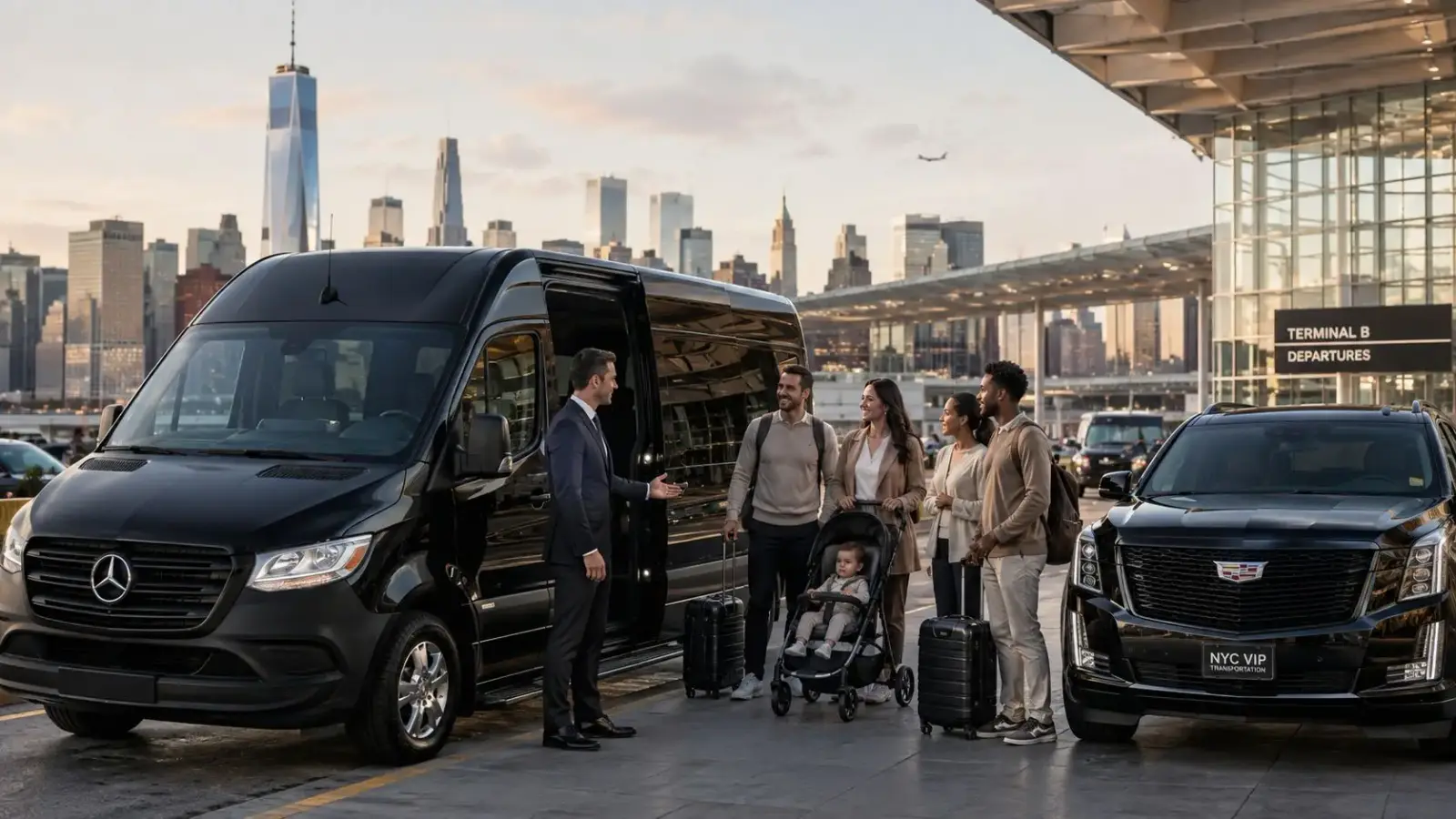
A party of eight lands at JFK after a long flight, one child is asleep in a stroller, and the hotel is in Manhattan. The question is not whether the ride should feel comfortable. The primary question is whether the group can stay together, keep the bags under control, and make it to the curb without splitting into a mess of separate cars.
That's where luxury car service stops being a status buy and becomes a logistics decision. For airport groups in New York, the right vehicle is the one that protects timing, baggage, and coordination. A single private van often solves problems that multiple sedans create.
Table of Contents
- The Group Airport Arrival Problem
- What Luxury Car Service Actually Means for Airport Transfers
- When One Van Beats Multiple Sedans
- Navigating Airport Pickups at JFK LGA and EWR
- How the Quote and Confirmation Process Works
- Which Travelers Benefit Most from Private Van Service
- Deciding If Luxury Service Is Right for Your Group
The Group Airport Arrival Problem
A family lands at JFK with two grandparents, three children, four checked bags, a stroller, and the kind of carry-ons that multiply during a long flight. Two app rides might seem easier on paper. On the curb, it usually turns into a split-party problem, with one car loading first, another stuck waiting, and someone juggling a stroller while watching the luggage pile.
That's the point where luxury car service makes more sense than a generic ride. The value is not the badge on the vehicle. The value is that the entire group gets one plan, one pickup, and one dispatch point instead of trying to coordinate multiple arrivals under airport pressure.
For families and corporate teams, the hidden cost of splitting up is rarely the fare. It's the time lost at baggage claim, the risk that one car leaves before the rest of the party is ready, and the confusion that starts when flight delays hit. Airport travel in New York rewards the group that has already decided how many people, how many bags, and how much terminal patience the ride needs.
That's why many travelers start with a vehicle question instead of a destination question. They already know where they're going. What they need to solve is how to move six, eight, or twelve people through a crowded airport without creating avoidable friction. A private van is often the cleanest answer, especially when the trip starts or ends at a busy terminal.
For a practical look at how larger vehicles are used in the city, the 12 passenger van rental guide in NYC is a useful reference point.
What Luxury Car Service Actually Means for Airport Transfers
In NYC airport transportation, luxury car service should mean a dedicated vehicle, a trained driver, and a reservation process that accounts for people and bags before the ride is confirmed. It should not mean a vague promise of a nicer seat. For airport work, the difference is operational.
The vehicle mix matters more than the label
Sedans work for solo travelers and some couples. SUVs help when luggage is heavier or passengers want more space. Sprinter-class vans are the serious option when the party is larger, because they keep the group in one vehicle and reduce the chance that bags and people get separated.
Practical rule: If the group's luggage creates doubt, the vehicle should be chosen for the bags first and the seating second.
Airport transit also depends on how the vehicle is dispatched. A private transfer is planned around the actual party, not around whichever car happens to be available in an app queue. That matters for terminal timing, baggage handling, and the small delays that happen when one passenger is still at the carousel while another is already outside.
Airport Vans NYC operates as a quote-first private Sprinter van service for groups of up to 14 passengers, subject to luggage requirements. That model fits airport travel better than app-based matching because the vehicle is assigned to the trip after the operator checks the details, not before.
The market context supports that direction. The global chauffeur services market was estimated at $52.4 billion in 2025 and is projected to reach $98.7 billion by 2034, with airport transfers at 34.2% of service-type demand, luxury vehicles at 38.6% of vehicle-type revenue, online booking at 63.5% of bookings, and business end-users at 58.4% of demand, according to Market Intelo. In other words, airport mobility and corporate travel are driving the category.
That pattern matches how travelers book. They want the trip handled before they land, not improvised after they land.
When One Van Beats Multiple Sedans
The cleaner the group, the easier the ride. That's why a single private van often beats two or three sedans for groups of 6 to 14. The main advantage is not luxury. It is control.
Use luggage as the first filter
A family of seven with four checked bags and a stroller should lean toward one van. Two sedans can technically move the people, but they usually turn the airport pickup into a split operation. Someone has to decide which bags go where, who rides with which child, and which car leaves first.
A corporate team of ten with carry-ons only is different. If the group is moving together from the terminal to a Manhattan hotel, one Sprinter still makes sense because it keeps everyone on one schedule. The point is not to maximize seating. It is to avoid the coordination burden that comes from booking multiple vehicles.
The airport transfer market has fragmented service delivery, which makes consistency vary widely by operator. The U.S. limousine and town car services industry was valued at $11.6 billion in 2026, and IBISWorld estimates there were 196,000 businesses operating in the segment, reflecting a 9.7% CAGR from 2021 to 2026, according to IBISWorld. That fragmentation matters because the group that books one vehicle needs reliability more than novelty.
One van reduces the number of decisions the group has to make at the airport. That alone is often worth more than the difference in fare.
Compare the likely setups
| Group Size | Luggage Scenario | Recommended Configuration |
|---|---|---|
| 6 passengers | Light carry-ons only | One SUV may work, but a van is cleaner if the group wants to stay together |
| 7 to 8 passengers | Mixed checked bags and carry-ons | One private Sprinter van |
| 9 to 10 passengers | Multiple checked bags | One private Sprinter van |
| 11 to 14 passengers | Heavy luggage or children's gear | One private Sprinter van, with luggage counted before booking |
| Any group split across terminals | Bags and people arriving at different times | One coordinated dispatch plan, not separate casual rides |
For airport groups, the right question is simple. Can the luggage fit without forcing the party to split? If the answer is uncertain, the van wins.
Navigating Airport Pickups at JFK LGA and EWR
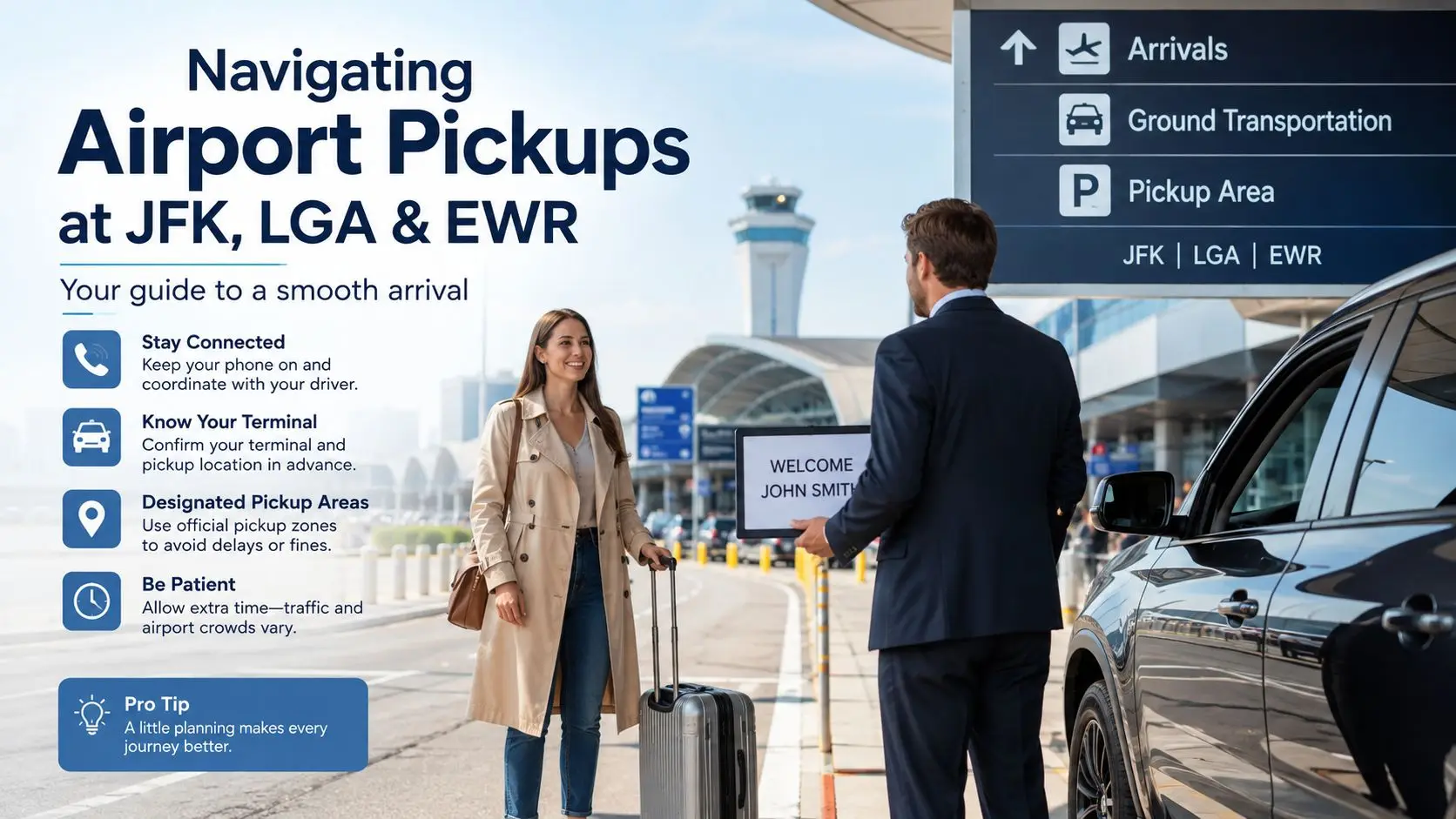
JFK, LGA, and EWR all reward preparation, but they do not reward vague instructions. The driver needs the terminal, the airline, the flight number, the number of passengers, and enough baggage detail to understand whether the curbside handoff will be simple or messy. Without that information, pickup planning becomes guesswork.
Terminal movement is the real challenge
JFK and LaGuardia are busy, but Newark Liberty adds another layer because EWR is in New Jersey, not New York City. That distinction matters for routing, timing, and how a driver plans the approach to the terminal. Inter-airport transfers also matter here, since some travelers are connecting between JFK, LGA, and EWR rather than going straight to a hotel or home.
Curbside rules are never the same as curbside expectations. Flights run late, people stop for bags, and the group that lands together may not exit together. A private van helps because one driver can absorb small changes without forcing the party to renegotiate the ride on the sidewalk.
The best pickup is the one that does not need a second conversation.
The most common failure is not the route. It's incomplete information. If the quote request includes flight details, the dispatch plan can account for delays and keep the pickup organized. That is especially useful for families, hotel concierges, and event planners who need the group moved without fielding a dozen text messages from the terminal.
For travelers who also need departure planning, the airport drop-off guidance is worth reading before the return trip is scheduled.
What pickup coordination should look like
- Terminal detail first. The driver needs the exact arrival point so the meeting plan matches the airport layout.
- Baggage reality second. Strollers, oversized suitcases, and extra bags change loading time.
- Flight info third. Delays are common enough that the pickup plan should anticipate them.
- Group contact last. One point person prevents mixed instructions from reaching the driver.
That's how good airport coordination works. It removes uncertainty before the car even arrives.
How the Quote and Confirmation Process Works
A quote-first model is the right way to handle private airport van service because the vehicle has to match the trip, not the other way around. A reservation should not be treated as final until the operator confirms it by phone or email. That extra step protects the traveler from a bad vehicle match.
What to send with the request
The operator needs the passenger count, luggage details, flight information, and destination. Those four items tell the dispatcher whether a sedan, SUV, or Sprinter-class van is the right fit. If the group includes children, strollers, or extra checked bags, that should be stated clearly instead of assumed.
The practical reason is simple. A van that looks big enough can still be the wrong vehicle if the luggage is heavy or awkwardly shaped. The quote process exists to prevent that mistake before pickup day, not after the driver has already arrived at the terminal.
Airport Vans NYC uses this human review to turn a quote into a confirmed reservation only after the operator checks the details. That avoids the false confidence that sometimes comes with instant booking systems. When the group is moving through JFK, LGA, or EWR, accuracy matters more than speed at checkout.
The quote request page is the right place to start when the group size, route, and luggage volume are already known.
What confirmation should settle
- Vehicle fit. The party should know the vehicle can hold everyone and everything.
- Timing. The pickup should reflect the arrival window, not a generic slot.
- Route logic. Inter-airport routes or Manhattan, Brooklyn, Westchester, and New Jersey drop-offs should be clearly stated.
- Contact method. Phone or email follow-up keeps the handoff clean.
That process is not a delay. It's the safety check that keeps the ride from breaking at the curb.
Which Travelers Benefit Most from Private Van Service
Private van service pays off when one group needs one pickup plan, one luggage count, and one vehicle that can handle the curb without forcing extra decisions. Families, corporate teams, hotel concierges, and event planners all run into the same problem from different angles.
Families and groups with children
Families are the clearest fit. A stroller changes loading time, checked bags change vehicle choice, and tired children make the curbside process harder to manage. A van keeps the whole family together instead of splitting adults across separate cars while someone is still dealing with bags.
That matters most after landing. Once a flight is over, the group needs one handoff, not a string of small decisions at the terminal curb.
Corporate teams and guest arrivals
Corporate travel has a different set of pressures. Executives, clients, and visiting colleagues are easier to manage when one vehicle is assigned to the whole party. That keeps the group from splitting up, with half the riders already at the hotel while the rest are still working through baggage claim.
The same logic applies to hotel concierges and event planners. When an arrival includes several passengers, multiple bags, and a tight agenda, one van keeps the plan organized and easier to control. It also gives dispatch one booking to manage when a flight changes, instead of several disconnected cars.
That deliberate approach matters most for the traveler types listed above, where a wrong vehicle match creates immediate friction at the curb.
Best-use test: If the group would need two conversations to explain who rides with whom, a van is probably the better choice.
For groups of 6 to 14, the primary question is simple. Is the trip about moving people efficiently, or is it about making separate rides feel easier? For airport logistics, efficiency usually wins.
Deciding If Luxury Service Is Right for Your Group
The decision is straightforward. If the group is large, the luggage is substantial, or the airport pickup needs to stay organized under pressure, a private van is the better move. If the party is small and the bags are light, a sedan or SUV may be enough.
Use four checks before requesting a vehicle. Group size. Luggage volume. Coordination complexity. Need to keep everyone together. If all four point in the same direction, private van service is the right answer.
That is especially true in the greater NYC area, where JFK, LGA, EWR, Manhattan, Brooklyn, Westchester, New Jersey, and inter-airport routes all create different pickup realities. The trip works best when the vehicle is chosen around the airport and the baggage, not just the destination.
For travelers who already know their group needs one coordinated transfer, the next step is to request a quote with the passenger count, luggage details, and flight information ready. That is the cleanest way to get the right vehicle the first time.
Airport Vans NYC handles private Sprinter van transfers for airport groups that need one vehicle, one pickup plan, and no baggage guesswork. If your family, team, or event group is moving through JFK, LGA, or EWR, visit Airport Vans NYC and request a quote with your flight and luggage details so the reservation can be confirmed properly.