
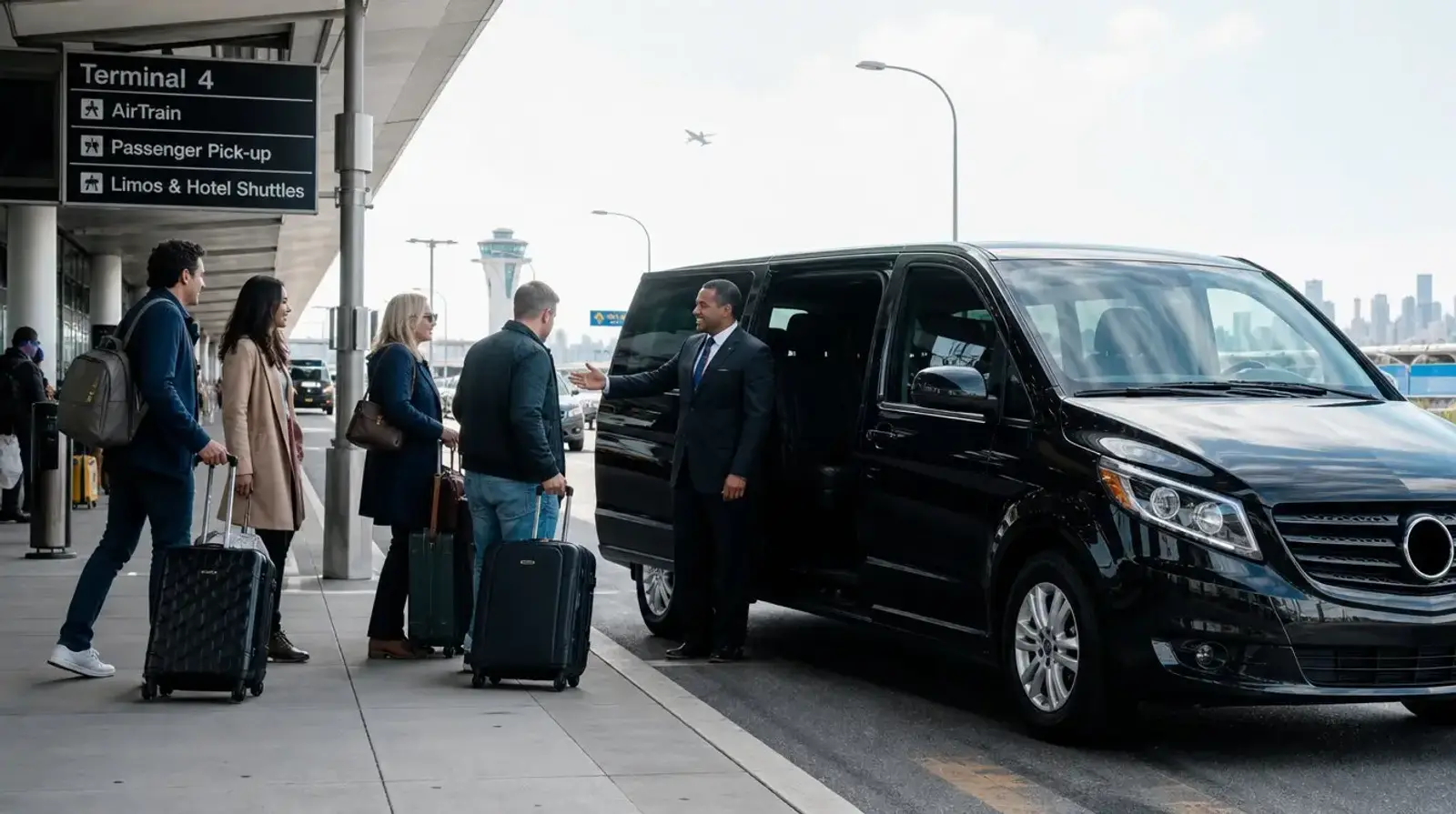
A group of eight to twelve people lands at JFK, LGA, or EWR with carry-ons, checked bags, maybe a stroller, maybe a guitar case, and everyone expects a clean pickup outside the terminal. That's where most plans break down. The issue isn't just finding a van, it's matching the right vehicle to the luggage, getting the timing right at the curb, and making sure the reservation is confirmed before anyone starts waiting outside baggage claim.
Transportation van services solve that problem only when the planner treats them like an operational move, not a generic ride. The right call is usually one private vehicle, one pickup plan, and one clear set of flight details. Split parties, vague instructions, or a sedan-sized quote for a van-sized load only create delays.
Table of Contents
- Coordinating Group Airport Transfers in the NYC Area
- What Private Sprinter Van Service Covers
- Matching Vehicle Capacity to Passengers and Luggage
- Popular Routes from JFK, LGA, and EWR
- How the Quote-First Booking Workflow Works
- Terminal Pickup Coordination at Each NYC Airport
- Use Cases for Families, Corporates, and Event Groups
- Locking In the Details Before You Request a Quote
Coordinating Group Airport Transfers in the NYC Area
The coordination problem starts when the group lands and everyone wants to move at once. One traveler is still at baggage claim, another is waiting on a stroller, someone else has a checked instrument case, and the driver is stuck deciding whether the curb can handle the load. That's the moment a planner needs to think less about “a ride” and more about terminal flow, luggage volume, and where the group is going to meet.
A private group transfer works best when the vehicle choice matches the party's actual footprint, not just the headcount. Eight passengers in one van is simple on paper, but not if six of them checked large bags and two children need car seats. In those cases, a single vehicle is usually cleaner than two sedans because it keeps the group together and removes the risk of staggered arrivals.
Practical rule: if the bags take up the cabin, the seat count stops mattering as much.
That's why planners should think in terms of three trade-offs. First, one Sprinter versus two sedans. Second, curbside meet-and-greet versus driver-call coordination after landing. Third, whether luggage forces a larger van even when the passenger count looks manageable. The best early move is to map those choices before anyone assumes the terminal pickup will sort itself out.
For a planning reference on group movement from the airport side, see the group airport transfer overview.
What Private Sprinter Van Service Covers
A private Sprinter van service in NYC terms means one dedicated van reserved for one party, not a shared shuttle and not an on-demand vehicle that may arrive with a different layout than expected. Airport Vans NYC presents that as a quote-first private Sprinter van service operated by IONASprinter, with capacity for up to 14 passengers, subject to luggage requirements. That capacity matters less than the actual setup inside the vehicle, because luggage, child seats, and oversized items can change how many people fit comfortably.
What the service is actually built to do
The point of a private van is controlled routing. One pickup, one destination plan, and one driver who knows the terminal or curbside instructions before the group exits the building. For a practical service description, review the Sprinter van airport transfer page.
Typical private service is built around a scheduled pickup window, luggage loading by the driver, and direct routing from curb to destination. That setup is better for airport transfers than a standard ride call because the operator can plan for bag volume and terminal access instead of hoping the vehicle that arrives is the right one. Waiting time policies, tolls, gratuity, and extra stops still need to be clarified in the quote, because those items are not something a planner should assume.
Shared shuttles work on a different logic. They optimize for pooled demand, which means more stops and less control. Rideshare XL can work for small loads, but it doesn't give the same accountability around vehicle assignment, pickup instructions, or group timing. For planners who need everyone to arrive together, that distinction is the whole ballgame.
A quote that leaves out luggage, child seats, or terminal details is not ready yet.
Matching Vehicle Capacity to Passengers and Luggage
The wrong vehicle choice usually happens when a planner counts seats and ignores bags. A 14-passenger van sounds roomy until several travelers each bring large checked luggage, a stroller, and a folded wheelchair. In real airport work, seat count and cargo capacity are not the same thing, and the bags usually win.
Use the load, not just the headcount
A group of 8 passengers with 12 large suitcases often needs a Sprinter even though the van is nowhere near full on paper. A 10-person light-travel party may fit comfortably in one van if everyone has modest luggage. The reverse also happens. A smaller group of 6 can still justify a Sprinter if the load includes three car seats, four checked bags, and a folded wheelchair. In other words, the bag plan can push the group into a larger vehicle before the seat count does.
Typical Sprinter luggage allowances often land in the 10 to 14 large bag range depending on the seating layout, but the usable space drops fast once a group adds child gear or oversize items. That's why planners should request a quote with both passenger count and bag count, not one or the other. A vehicle that looks oversized for the headcount may be the only clean fit.
| Passenger and Luggage Sizing Scenarios for Sprinter Vans | Group Size | Luggage Volume | Strollers or Car Seats | Recommended Vehicle |
|---|---|---|---|---|
| Light airport party | 10 | Modest | None | One Sprinter van |
| Family arrival | 6 | Mixed checked bags | Three car seats and a folded wheelchair | One Sprinter van |
| Oversized luggage load | 8 | 12 large suitcases | None | Larger Sprinter configuration |
| Full group, light bags | 12 | Limited | None | One Sprinter van, if confirmed by operator |
The planner's job is to protect cabin space before the booking is locked in. Once the luggage profile is clear, the vehicle decision gets easier and the pickup plan becomes more reliable.
Popular Routes from JFK, LGA, and EWR
Route planning in the NYC area is never just about mileage. A van leaving JFK for Midtown has different pressure points than one leaving LGA for Brooklyn, and a transfer that connects JFK with Newark depends on whether the group is making a clean handoff or chasing a tight connection. The driver's job is to move the group, but the planner's job is to reduce friction at the curb.
JFK to Manhattan, LGA to Brooklyn, and JFK to EWR
JFK to Midtown Manhattan usually runs through the Van Wyck and the Long Island Expressway. The curbside challenge is luggage, because loading large bags takes longer than loading a couple of carry-ons, and that delay matters when terminal traffic is building. LGA to Brooklyn often pushes through the Grand Central Parkway and BQE, where traffic can stack near major approach points and make a clean exit from the terminal more valuable than a fast-start sedan dispatch. JFK to EWR is more sensitive to timing, because connecting passengers need the driver to handle handoff timing without wasting the group's runway at the curb.
A Sprinter is often faster end to end than two sedans even on shorter hops because the group loads once, departs once, and reaches the destination together. Two cars split luggage, split coordination, and increase the chance that one vehicle gets delayed by terminal flow while the other is already on the road. That's a bad trade for planners who care about arrival cohesion.
| Route Comparison: JFK, LGA, and EWR Transfers | Route | Typical Drive Time (Off-Peak) | Traffic Pressure Points | Luggage Loading Note |
|---|---|---|---|---|
| JFK to Midtown Manhattan | JFK to Manhattan | Varies by traffic conditions | Van Wyck and LIE approaches | Larger bags slow curb departure |
| LGA to Brooklyn | LGA to Brooklyn | Varies by traffic conditions | Grand Central Parkway and BQE access points | Keep carts close for fast loading |
| JFK to EWR | JFK to EWR | Varies by traffic conditions | Inter-airport access and terminal exits | Best handled with pre-confirmed bag count |
For route-specific planning, the operator's dispatch desk should know the flight, the terminal, and the destination before the party lands. That's what keeps the curbside move from turning into a guess.
How the Quote-First Booking Workflow Works
A quote-first workflow is the right way to buy airport van service because it forces the operator to confirm fit before anyone treats the trip as booked. The initial inquiry is just that, an inquiry. A request becomes a reservation only after the operator reviews the details and confirms it in writing.
The five steps that matter
- Submit the load. The planner sends passenger count, luggage count, child seats, and pickup details. Without those fields, the operator can't size the van correctly.
- Operator reviews fit. The provider checks whether the requested vehicle works for the headcount and baggage mix, then confirms availability.
- Price is quoted clearly. The quote should spell out inclusions and exclusions so there's no confusion later.
- Client approves. The planner reviews the quote and signs off.
- Reservation is confirmed. Only after written approval does the trip become a real booking.
That workflow protects both sides when flight times shift, which is common in airport work. It also prevents the classic mistake of approving a price before the actual vehicle fit is settled. A complete quote confirmation should include pickup terminal, flight number, party size, luggage profile, and the point of contact for day-of coordination.
A planner who already has the fields ready saves time. Missing flight details or vague bag counts slow the quote down and make the response less useful. The operator needs enough information to assign the right van the first time, not guess and correct later.
Terminal Pickup Coordination at Each NYC Airport
Airport curbside rules matter because a van carrying eight to twelve people can't behave like a sedan. It needs space to stop, room to load bags, and a pickup instruction that keeps the driver from circling while the group hunts for the curb. The operator should dispatch the chauffeur after the flight lands, then direct the party to a defined meeting point instead of relying on a vague “outside arrivals” plan.
At JFK, curbside pickup is tightly controlled. The airport says terminal curbsides are for active pick-ups and drop-offs only, unattended vehicles can be towed at the owner's expense, and there's no parking allowed in front of or next to any terminals, so the driver needs exact instructions, not improvisation. For planners who want a terminal-level mindset, the airport drop-off guidance is a useful model for how disciplined the curb process has to be.
Why terminal-specific instructions matter
At Terminal 4, pre-arranged ground transportation is required, and the terminal's rules say service must be provided only by NYC-TLC licensed taxis, Port Authority permitted operators, or pre-arranged service. The vehicle also needs an announcement card showing the provider name, passenger name, and the airline and flight number for the arriving passenger. At LaGuardia Terminal B, pickup for for-hire vehicles is routed away from the curb to the parking garage level, with travelers directed to Level 2 and designated garage pickup rows, which is exactly why one universal pickup instruction doesn't work across the city.
Practical rule: the terminal decides the handoff, not the passenger's assumption.
For EWR, the planner should expect the same discipline, clear pickup instructions, no wandering curbside, and a pre-arranged meeting point that avoids confusion as the group exits with carts. The best day-of message to passengers is simple. Tell them which terminal they're using, where to walk, what name the chauffeur will use, and whether the pickup is curbside or in a designated lot or garage level.
Use Cases for Families, Corporates, and Event Groups
A family of six flying into JFK Terminal 4 with three checked bags, two car seats, and a stroller needs more than a vehicle. It needs a driver who can load quickly and a pickup plan that doesn't force parents to manage children at the same time. The operator should confirm the terminal, the baggage mix, and the child-seat requirement before the vehicle is dispatched.
A corporate team of ten landing at LGA after a red-eye has a different priority. The cabin needs to be quiet enough for laptop work, the receipt details need to be clean, and the group wants one vehicle so nobody has to coordinate two separate arrivals into Midtown. The planner should confirm the meeting time, the drop-off address, and any baggage that will slow the handoff.

Hotel concierges often book a 14-passenger Sprinter for wedding guests arriving at EWR Terminal B on overlapping flights. In that case, the job is to keep the group together without making the driver wait so long that the curb becomes a bottleneck. Event planners face a similar challenge with a 12-person speaker panel headed from JFK to a Manhattan venue with instrument cases. The operator needs the flight details, the terminal, and the baggage profile before pickup so the car can match the load.
That's the common thread. Families need hands-on loading, corporate teams need timing discipline, hotel staff need coordination, and event planners need cargo space. The vehicle is the same category, but the service shape changes with the job.
Locking In the Details Before You Request a Quote
The quote is only as accurate as the information behind it. A planner who sends incomplete details forces the operator to guess, and guessing is how airport pickups go sideways. The cleanest workflow is to lock in the basics first, then request the quote once the trip profile is fixed.
The six details that need to be set
- Flight information: Each arriving flight number and arrival time should be ready before the request goes out.
- Exact passenger count: Children count too, especially if seats or boosters are needed.
- Luggage breakdown: Carry-ons, checked bags, and oversize items should be listed separately.
- Pickup point: The terminal and airline need to be identified clearly.
- Drop-off specifics: The destination address should include any loading zone or curbside notes.
- Timing constraints: Hotel check-in, meeting start, or event call time should be stated up front.
Those details tell the operator whether the vehicle fits, when it should be staged, and what kind of handoff is realistic. They also make the confirmation cleaner because the quote can be written around the actual trip, not a placeholder version of it. A planner who wants a dependable pickup should submit the quote request only after the party size and bag load are settled.
Airport Vans NYC offers private airport van transfers for JFK, LGA, EWR, Manhattan, Brooklyn, Westchester, New Jersey, and selected inter-airport routes, with quote-first confirmation by phone or email through its operator. For planners who need the group to stay together and the pickup to make sense at the terminal, Airport Vans NYC is the place to start the quote process and turn the trip into a confirmed reservation once the details are reviewed.