
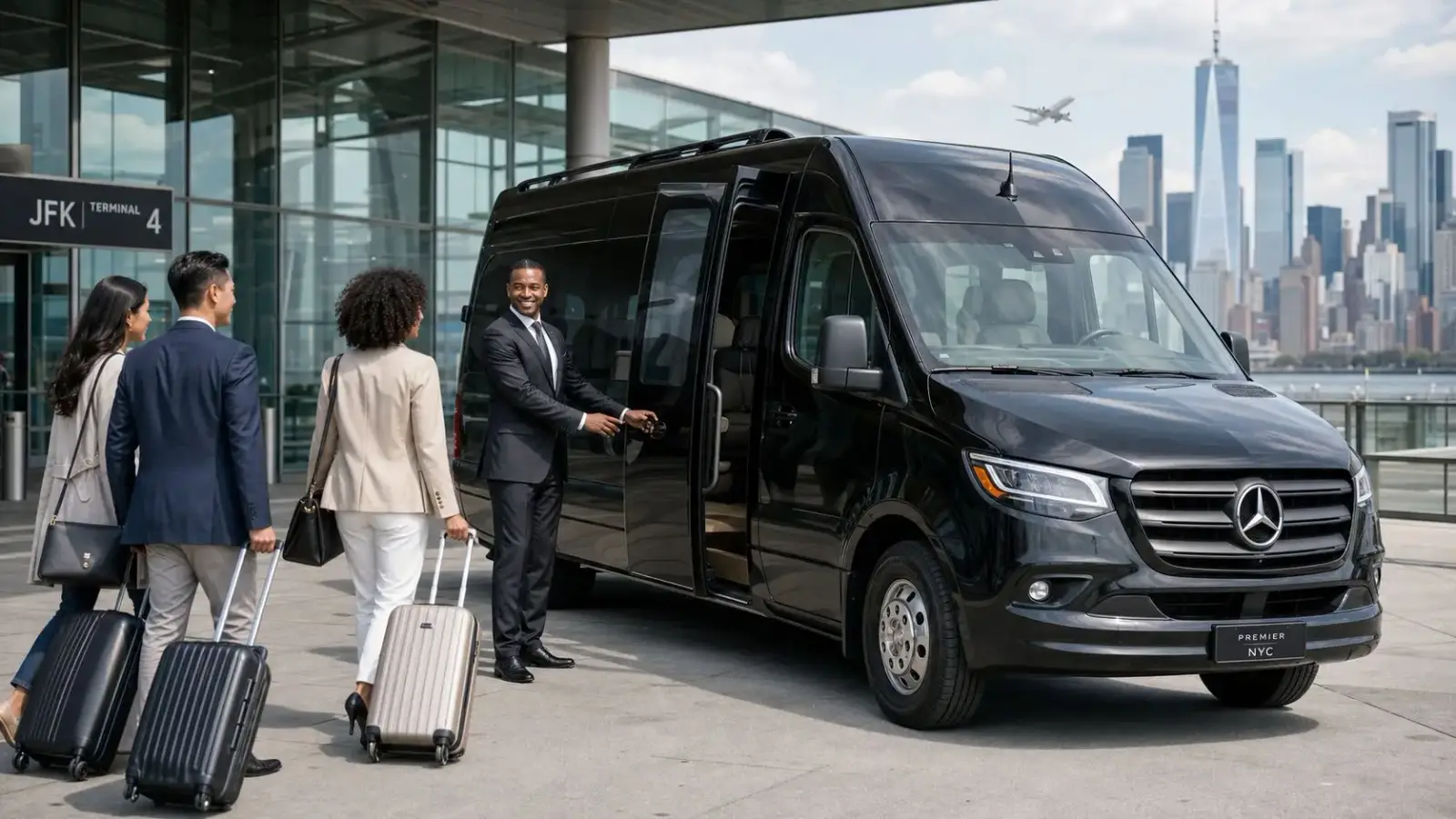
A family lands at JFK with six roller bags, two carry-ons, a stroller, and one person who's already asking where the chauffeur is. The first car gets assigned, then the second, then someone realizes the group is split between two terminal pickup points and nobody wants to stand on a curb trying to reconnect a party of eight. That is the problem with luxury car service in NYC for group airport travel, not whether the seat leather looks expensive.
For corporate teams, hotel concierges, and event planners, the job is simple. Keep the party together, keep the pickup orderly, and avoid turning one arrival into two separate logistics problems. In New York, that usually means thinking in terms of capacity, luggage, and confirmed dispatch, not prestige language.
Table of Contents
- The Real Problem With Group Airport Arrivals in New York
- What Counts as a Luxury Car Service in New York Today
- Why Quote-First Booking Is the Industry Default for Groups
- The Three Airport Environments, JFK, LGA, and EWR
- Capacity Planning When Luggage Is the Real Constraint
- Private Vans Versus Multiple Sedans or SUVs
- Pickup Coordination That Actually Works at NYC Terminals
- Preparing a Quote Request and Confirming the Reservation
The Real Problem With Group Airport Arrivals in New York
A group of eight doesn't fail at the airport because the vehicle was too plain. It fails because the party gets split before anyone has a clean handoff plan.
At JFK or Newark Liberty, the default split often happens fast. Two sedans look convenient on paper, then the family loses visual contact, one driver waits at the wrong door, and luggage ends up divided between vehicles that don't arrive together. That's not a luxury problem, it's a coordination problem.
The first failure is usually the curb, not the booking
Airports don't reward loose planning. A group that has not agreed on one meeting point creates delay for the driver, confusion for passengers, and more calls between the organizer and everyone on arrival. The right question is not whether the cars are premium enough, it's whether the full party can move as one unit from terminal to destination.
That matters in New York because airport demand is structurally heavy. The New York City metro area has long been one of the densest chauffeured-transport markets in the world, with over 60% of North America's passenger car service industry and over 30% worldwide in the 2017 TLC Magazine baseline, alongside more than 60,000 licensed vehicles across TLC-regulated categories (TLC Magazine). A market that concentrated does not reward sloppy pickup planning.
Practical rule: If the group needs to stay together, the first decision is vehicle sizing, not brand image.
For a corporate manager or concierge, the operational questions are always the same. How many passengers are traveling, how much luggage is coming, and who is responsible if the flight arrives late? Once those answers are clear, the transfer stops being a scramble and becomes a controlled handoff.
What Counts as a Luxury Car Service in New York Today
In New York, luxury car service is not a vague promise about comfort. It sits inside the TLC-regulated for-hire system, which means the provider needs a Luxury Limo Base license and dispatch has to flow through a radio or other communications system to TLC-licensed luxury limos (NYC Business). That structure matters because it separates reserved, licensed operation from casual on-demand behavior.
The product is dispatch discipline, not just a nicer cabin
A private van service is bought for reliability. The vehicle is pre-arranged, the pickup is coordinated, and the group isn't left improvising at the curb. That's a very different product from street-hail behavior or a last-minute app ride, where the vehicle appears one at a time and the organizer still has to manage who fits where.
The market also has a real safety baseline. NYC TLC's July through December 2015 base report for luxury limo services recorded 0 fatal crashes, 0.06 injury crashes per vehicle, 0.00 vehicle safety violations per vehicle, 0.01 base safety violations per vehicle, 36 affiliated vehicles, and an average vehicle age of 3.8 years (NYC TLC PDF). A separate 2022 analysis summarized in Yahoo Finance reported 27.3 crashes per one million miles for luxury limousines and 3.8 injury crashes, while other for-hire services ran from 29.1 to 66.1 crashes and 6.1 to 15.7 injury crashes. Those figures support the point that the luxury-chauffeur segment has historically been tightly regulated and safety-focused (NYC TLC PDF).
For groups, “luxury” means one reservation that holds together
That distinction changes the airport experience. One vehicle means one pickup thread, one luggage load, one destination handoff, and one arrival timeline. Multiple smaller vehicles turn the same trip into a sequence of separate arrivals, which is exactly what families and business teams are trying to avoid.
A sedate sedan can be the right choice for one executive. For a party of six to fourteen, the premium move is usually the vehicle that keeps everyone together and fits the bags.
Why Quote-First Booking Is the Industry Default for Groups
Licensed luxury transportation in New York does not work like instant checkout. A quote request does not become a reservation until the operator confirms it, and that's the right model for airport transfers where passenger count and luggage can change the whole vehicle assignment.
The request is a sizing exercise first
The quote form should capture the facts that matter: how many passengers are traveling, how many bags are coming, which airport is involved, and where the trip ends. Only then can the operator decide whether the requested vehicle works. If the luggage load is heavy, the same passenger count may no longer fit the same configuration.
That is why New York's regulated luxury-basis model matters. A Luxury Limo Base is built around dispatch, licensing, and pre-arranged service, not casual street assignment (NYC Business). For a travel manager, that means the booking is a planning conversation, not a button click.
A proper quote is a capacity check, a timing check, and a pickup check rolled into one.
What the organizer should expect next
After the quote request, the operator follows up by phone or email to confirm whether the trip can be reserved as requested. That is the point where the vehicle, the pickup timing, and the route are locked in. If the request is underspecified, the operator can't responsibly confirm it.
For groups, that process is a benefit, not a delay. It prevents the common mistake of booking the wrong vehicle class, then trying to force a split-party workaround at the airport. In practice, the quote-first model protects the traveler from oversubscription and protects the operator from dispatching a vehicle that can't handle the bags.
The Three Airport Environments, JFK, LGA, and EWR
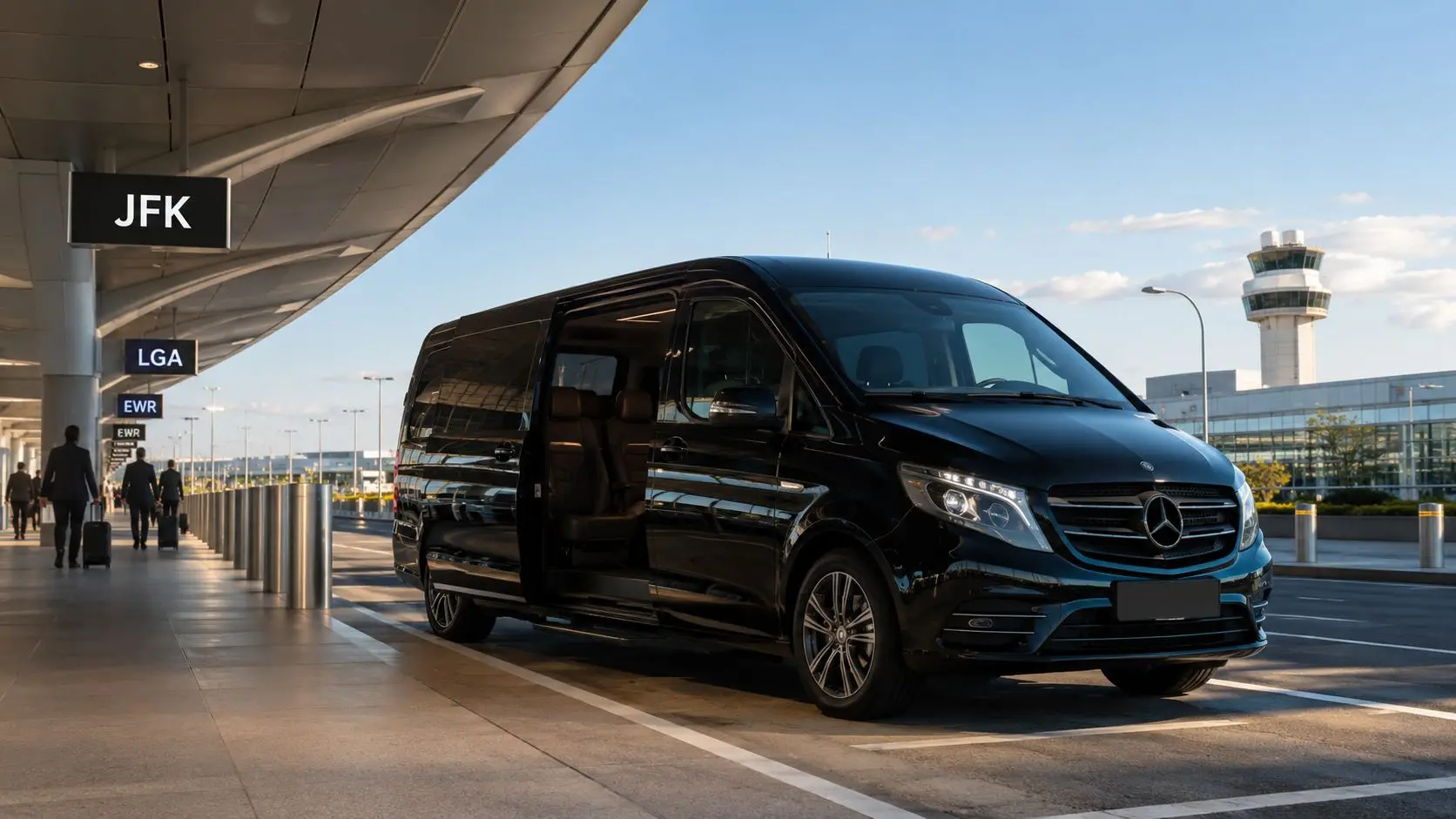
JFK, LaGuardia, and Newark Liberty are all airport pickups, but they are not the same pickup problem. Each has its own terminal layout, curbside rhythm, and passenger flow, which is why airport-specific instructions matter.
JFK and LGA need terminal-level coordination
At JFK and LGA, the useful instruction is not just “meet at the airport.” It's which terminal, which door, and which curbside point the passengers should use. That level of specificity keeps a family from wandering between doors while a driver waits on the wrong side of the terminal loop.
For hotel concierges and corporate coordinators, the cleanest practice is to send the full pickup note to the arriving party before landing. The driver should know the terminal, the flight, and the curbside plan, while the travelers should know exactly where to stand when they come out. The fewer assumptions on arrival, the better the handoff.
EWR serves the metro area from New Jersey
Newark Liberty is in New Jersey, not inside New York City. It still serves the New York metropolitan area, and that matters for route naming and traveler expectations. EWR-to-Manhattan, EWR-to-Brooklyn, and EWR-to-Westchester are normal metropolitan transfers, just not NYC-internal airport moves.
Route naming should reflect that reality. If a coordinator treats EWR like a Manhattan airport, the pickup plan gets sloppy before the car even moves. If the route is named correctly from the start, the operator can plan the pickup rhythm and the destination handoff without confusion.
For a deeper example of route framing, see the practical airport transfer guidance on Airport Vans NYC's transportation from airport page. One clear pickup note saves more time than three follow-up calls.
Capacity Planning When Luggage Is the Real Constraint
The headline number on a Sprinter-class van is useful, but it isn't the whole story. For private airport transportation in the greater NYC area, the working rule is simple, up to 14 passengers only if luggage requirements allow. Bag volume is usually the binding constraint before the seats run out.
Count bags before you count heads
A family with strollers and checked luggage can eat up space faster than expected. A corporate team with roller bags and garment carriers can do the same thing. Event groups carrying cases, samples, or equipment should think about cargo layout first, because bulky items change usable seating faster than people expect.
That's why the quote request needs passenger count and luggage count together. A seat chart alone doesn't tell the operator whether the rear space will hold the bags without forcing a split. Real airport planning happens at the intersection of passenger-to-baggage ratio and vehicle configuration.
Brief the organizer with the details that matter
The cleanest handoff is a short factual note. List the number of travelers, the number of checked bags, the number of carry-ons that need space, and whether any item is bulky. If children are traveling, include strollers in the count. If the group is coming from a conference or event, mention the cases up front.
Operational standard: One party, one vehicle, one luggage plan.
That is also why the quote form should be used as a planning tool rather than a formality. It lets the operator size the van against the combined load before anything is confirmed. For groups, that's the difference between a smooth arrival and an awkward roadside reshuffle.
For travelers who want the route details in a private transfer context, the service description on Airport Vans NYC's Sprinter van airport transfer page is the right place to start.
Private Vans Versus Multiple Sedans or SUVs
A single private van is usually the cleaner choice for a group, but not because it looks more impressive. It works because it reduces coordination failure.
The comparison is about unity, not status
Multiple sedans or SUVs can work for very small parties with light luggage. The problem is that every extra car creates another pickup point, another driver to brief, and another chance that one vehicle arrives before the other. A group traveling together should not have to split into fragments just to get from the airport to the hotel or office.
| Option | Passenger Capacity | Luggage Handling | Coordination Required |
|---|---|---|---|
| Private Sprinter van | Up to 14 passengers, subject to luggage requirements | Best when one baggage plan needs to stay together | Lowest. One vehicle, one driver, one pickup note |
| Multiple sedans | Smaller parties only | Luggage gets split across cars | High. Two or more drivers, two arrival points |
| Multiple SUVs | Useful for mixed small groups | Better than sedans, but still split across vehicles | High. The organizer still manages several moving parts |
The table makes the tradeoff obvious. The van keeps the party united and reduces the chance of a bag ending up with the wrong car. Split bookings only make sense when the headcount is small and the luggage load is light enough to tolerate division.
The real cost is organizational friction
Hotel desks and corporate travel teams feel this immediately. A single car means one confirmation thread, one arrival update, and one terminal plan. Two cars mean one message can be missed, one driver can be delayed, and the group starts chasing itself at the curb.
If a party is too small for a van, a smaller vehicle can be more efficient. But once the travelers and bags start pushing the limit, a private van becomes the right operational call. For one reference route and service setup, Airport Vans NYC's private Sprinter transfer page shows the kind of booking structure that keeps group arrivals intact.
Pickup Coordination That Actually Works at NYC Terminals

The curbside handoff is where good planning pays off. If the terminal note is weak, the whole transfer gets noisy fast.
Give the driver a clean arrival picture
The organizer should send terminal, door, and curbside meeting information before the passenger lands. That matters because the driver is not guessing where the traveler will appear, and the passenger is not wandering around the wrong exit. For families and corporate groups, one shared contact thread cuts the odds of someone standing at the wrong door.
Flight details matter too. If the flight moves, the operator can use that information during arrival planning and adjust the pickup timing around the actual schedule. That keeps the group from being penalized for a delay it didn't cause.
Keep EWR separate in the pickup note
EWR deserves its own line in the instructions because it sits in New Jersey and behaves differently from a NYC terminal pickup. JFK, LGA, and EWR all need exact meeting points, but the routing and pickup rhythm are not interchangeable. A good note tells the operator where the party is arriving, where the driver should wait, and who is responsible for the handoff.
The best airport pickup instructions are boring. They name the terminal, the door, and the curb.
That is the standard worth using for hotel concierges, event planners, and corporate travel managers. If the pickup note is short, specific, and shared once with everyone involved, the transfer tends to stay calm. If it's vague, the curb becomes the problem.
Preparing a Quote Request and Confirming the Reservation
A strong quote request should include the passenger count, luggage count, flight details, and the pickup and drop-off addresses, including airport terminal and destination borough or county. If the trip involves Manhattan, Brooklyn, Westchester, New Jersey, or supported inter-airport routes, spell that out clearly. EWR should be treated as a New Jersey airport serving the metro area, not as a New York City airport.
The reservation is only final after the operator confirms it. That's the part many travelers miss, and it's why the request should be treated as a planning step, not a finished booking. For a straightforward quote workflow, visit Airport Vans NYC's quote page and send the trip details in one pass.
Airport Vans NYC handles private Sprinter van transfers for airport arrivals and departures across the greater NYC area, with quote-first reservations for groups, families, and corporate travelers. For a one-vehicle group transfer that keeps the party together from terminal to destination, visit Airport Vans NYC and request a quote for the next trip.