

Fourteen people, seventeen suitcases, two strollers and a flight that lands at 6:40 on a Friday evening. Counting seats is the easy part. Whether that group leaves the airport in one vehicle comes down to weight, floor space, a curb that allows a few minutes of standing time, and an arrival window that shifts when the plane does.
Most searches for a sprinter van rental nyc start with price and end with a vehicle that is technically big enough but practically wrong. The seat count fits and the luggage doesn't, or both fit and the van can't legally wait where the group is standing. Working through capacity, driving rules, cost drivers and airport timing in that order usually produces a request that holds up under confirmation.
One point worth stating plainly before anything else. A private van keeps a party together and takes the driving, parking and curb decisions off the group's plate. It does not remove traffic on the Van Wyck, a slow baggage belt, or a terminal road that closes without notice.
Table of Contents
- Sprinter Van Size and Capacity at a Glance
- How Many Passengers and Bags Fit in One Van
- Self-Drive Requirements and NYC Street Rules
- What Drives the Price of a Sprinter Quote
- Airport Demand and Pickup Timing in NYC
- Renting Yourself or Booking a Private Transfer
- Request a Quote Before You Commit to a Van
Sprinter Van Size and Capacity at a Glance
A Sprinter passenger van can carry up to 14 passengers, but its dimensions shape where it can stop, turn and park in NYC. The figures below describe a representative passenger-van configuration; the Mercedes-Benz Sprinter specifications are the reference for the listed measurements and payload range.
| Specification | Value | Why it matters for your group |
|---|---|---|
| Overall length | 234 inches (about 19.5 feet) | Needs room at crowded curbs and hotel entrances |
| Width including mirrors | 92 inches | Narrow residential streets and tight lanes |
| Turning diameter | 45 to 52 feet, curb to curb | Limits circling and reversing at terminals |
| Passenger-van payload | Roughly 3,109 to 3,307 lb, depending on configuration | Occupants, bags and gear share this limit |
| Passenger capacity | Up to 14 passengers | Confirm against luggage volume, not seat count alone |
Reading the numbers the way a dispatcher does
Length sets the parking problem. At 234 inches, the van takes more curb space than a sedan. A Manhattan hotel entrance or Brooklyn side street may not have a clear space long enough when a group and its bags are ready to board.
The 92-inch width includes mirrors. That matters on narrow residential blocks and when assessing whether a garage entrance is suitable. Turning diameter affects how easily a driver can correct a missed entrance; on a one-way terminal loop, a wrong turn may mean circling again.
Payload is easy to overlook. Passengers, luggage, car seats, strollers and other gear all count toward the vehicle's rated limit. A full passenger load with heavy bags can leave less room for additional equipment.
Where that leaves a group of six to fourteen
For a group of six to fourteen, seat count is only one part of the fit. A van with all 14 seats occupied may not have room for 14 large suitcases as well. Layout varies by configuration, so provide passenger and bag counts when requesting a quote; that information helps assign a vehicle suited to the group.
How Many Passengers and Bags Fit in One Van

A family of eight looks at a 14-passenger Sprinter, counts the belts, and books. They still have eight large checked cases, two folded strollers, and a car seat. The seats work. The cargo bay does not. Ten travelers with twelve large suitcases can be a tighter fit than fourteen travelers with carry-ons, because cargo volume and shared weight decide the fit, not the number of seat belts.
Put passenger and bag counts in the quote request. Airport Vans NYC assigns a private Sprinter from that count, so the van matches the group rather than a bare 14-seat label. No other party's luggage is already in the bay.
A five-step fit test for your group
- List every traveler. Include infants and children who need a car seat or booster. A seat taken by a child restraint cannot hold an adult, and the restraint still needs anchoring space.
- Count checked bags and carry-ons separately. An international arrival often means two large checked cases per person. A domestic weekend may mean one bag for three people. Mixing those assumptions is how the cargo floor fills before the last suitcase is loaded.
- Add the bulky items. Folded strollers, car seats, golf bags, trade-show cases, instruments, and camera kits take floor space out of proportion to their weight. The Sprinter layout can take folded strollers with suitcases, but only if those pieces were in the count and the aisle stays clear.
- Estimate the weight of the heavy bags. Occupants and luggage draw from one payload allowance. A rough total for people plus bags is more useful than a bag count alone, especially when several travelers are adults with full-size cases.
- Check aisle and door access. A van packed to the roofline forces a shuffle at every stop and slows unloading on a busy terminal road. That delay sits on top of traffic. A private van does not make the tunnel or the airport loop any shorter.
What a seat-only booking misses on weight
Payload is the shared limit. Mercedes-Benz's published Sprinter passenger van specifications list roughly 3,109 to 3,307 lb of payload depending on configuration, and that allowance covers occupants, luggage, accessories, and onboard supplies. Adults plus heavy checked bags can approach it on an international arrival, where several large suitcases per traveler is normal.
Practical rule: send exact passenger and bag counts, including strollers and car seats, in the quote request. For a group near the top of the 14-passenger range, ask the operator to confirm the seating layout and luggage volume before the party relies on a single vehicle.
I would not treat a nominally full 14-seat van as settled until that confirmation comes back. Packed to the windows, the same van is uncomfortable for a three-hour ride and unworkable for a multi-stop day. Confirming the load before the quote is locked is the difference between one vehicle and a second one the budget never included.
Self-Drive Requirements and NYC Street Rules
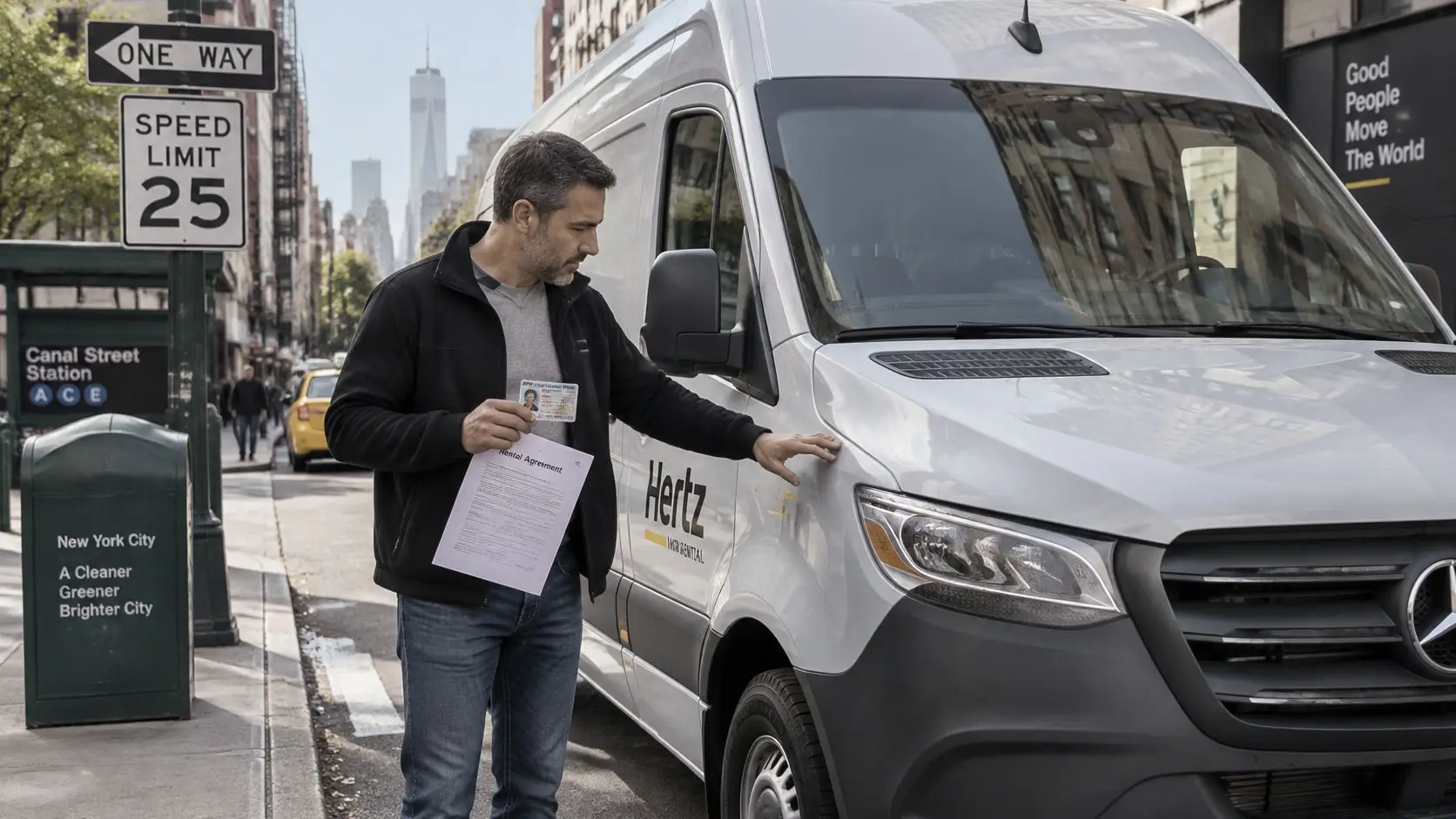
A 19.5-foot Sprinter that looks workable on a rental page still has to fit a Manhattan curb, a garage door, and a return deadline. Driving it yourself is a different product from a chauffeured airport transfer. The difference starts at the counter, then shows up again on the street, where the same traffic sits whether you hold the keys or someone else does.
What the counter will ask for
Rental companies set their own rules. Before the reservation is final, get the age minimum, license requirement, additional-driver terms, insurance options, deposit amount, mileage allowance and fuel policy in writing.
A valid driver's license is the baseline. Some companies impose a minimum age and a surcharge below a second threshold. If the license was issued abroad, ask whether an international driving permit is required.
Anyone else who might take a shift has to be named on the contract. That usually carries a daily fee. Coverage is a separate choice: buy the rental company's protection or rely on a personal policy, and confirm the hold placed on a credit card.
Airport runs and cross-airport transfers can exceed a daily mileage allowance. Check the per-mile charge and the fuel level required at return. Confirm the reservation is a passenger configuration with the seating you counted. A cargo layout will not give the group those seats.
Where a 19.5-foot van gets hard
Manhattan loading zones are short and heavily used. A quick stop to unload is one thing. Leaving a high-roof van parked on a crosstown street overnight is another. One ticket is enough to force a second move: the driver shifts the van from the loading zone to a garage while the group is still sorting bags at the curb.
Many Manhattan garages have clearance limits a tall van will not clear at all. The itinerary needs a garage that accepts the height before anyone drives into the block. Curb length, roof height, bag volume and the clock at the terminal are one planning problem, not four separate ones.
Tolls and charges add up in ways a daily rate does not show. Crossings into New Jersey, the Queens-Midtown tunnel, and a congestion charge for vehicles entering Manhattan's central business district are billed separately from bridge and tunnel tolls. A self-drive renter usually pays them directly. Confirm how each is collected before the trip.
Before relying on any specific curb, loading or no-standing instruction, check current New York City rules and the sign posted on that block. Regulations change from street to street. A rule that applies one avenue over often does not apply where the group is standing.
A prearranged private van does not remove that traffic. It removes the work of holding the vehicle, hunting a legal stop, and getting passengers and bags off the curb in one move.
If the destination is a dense Manhattan address with no loading space, a self-drive van may mean circling the block, paying a garage, or unloading while someone holds the vehicle. That's the test that settles most self-drive decisions.
Questions to bring to the counter
- What's the full total? Ask for base rate, taxes, insurance, additional driver, one-way fee and any cleaning charge in one number.
- What's the mileage cap and the per-mile rate beyond it?
- Will this van clear every garage and loading dock on my itinerary? Ask for the vehicle height and compare it with the clearance of each garage.
- Where does the van go back, at what time, and with what fuel level?
- Who pays if the van is ticketed or towed while loading?
Groups that can answer all five without hesitation are equipped for a self-drive trip. Groups that cannot should weigh a prearranged private transfer before signing anything. The van still waits in the same tunnel queue. What changes is who handles the curb, the garage height, and the return.
What Drives the Price of a Sprinter Quote
A Sprinter quote depends on what the trip requires. Two headline rates may cover different services, so compare them only after confirming the passenger count, luggage, route and included charges.
Check these cost drivers:
- Vehicle size and configuration. A van carrying up to 14 passengers may have less room for luggage than a layout with fewer seats. Passenger weight and bag volume both affect which vehicle fits the group.
- Hours or days booked. An airport transfer may be priced as a single trip. Events, tours and multi-stop itineraries may be quoted by the hour, sometimes with a minimum booking.
- One-way or round trip. A round trip that keeps the vehicle and driver between legs has different costs from two separately booked one-way trips.
- Airport pickup or drop-off. Ask whether pickup coordination, flight monitoring and terminal instructions are included in the quote.
- Mileage, fuel, tolls and parking. A route involving Manhattan or an airport crossing can add tolls or parking charges. Check which costs are included and which are billed separately.
- Waiting time and extra stops. Delays after landing and stops added to the itinerary can extend the vehicle's booked time. Ask how those changes affect the total.
- Timing and demand. If your travel dates fall during a holiday period, request a quote early rather than assuming a van will be available.
Request an itemized quote. Give the provider accurate passenger and bag counts, along with the pickup and drop-off addresses, then compare quotes on the same trip details.
Ask before booking: What happens if a flight is delayed or the itinerary changes on the day? Look for a clear procedure, including how waiting time or added stops affect the booking.
Airport Demand and Pickup Timing in NYC
A Sprinter booked for an arrival still has to stop in one curb lane. Up to 14 passengers, plus the large suitcases that group shares in the quote, do not load like a sedan. On a heavy arrival bank that lane is already full of other parties. The planning problem is passenger load, bag volume, curb space, and the clock together.
A private van does not remove traffic.
JFK, LaGuardia, and Newark are separate airports with separate volume. The counts below are from the Port Authority's 2025 airport traffic report.
| Airport | Approx. 2025 passengers | Planning note |
|---|---|---|
| John F. Kennedy International (JFK) | 62.6 million | Multi-terminal airport; set the meeting point by terminal, not by "JFK" |
| LaGuardia (LGA) | 32.8 million | Separate from JFK; a JFK to LGA connection is a city drive, so add buffer |
| Newark Liberty International (EWR) | 47.0 million | In New Jersey; Manhattan trips typically use the Holland or Lincoln Tunnel, or an alternate if traffic dictates |
Three airports, two states, no shared terminal
A trip between two of these airports runs through city traffic, a tunnel or a bridge, and the time to leave one terminal road and reach another. It is not an internal hop. Size the buffer to that crossing, then treat it as a floor.
EWR changes the math again because it sits in New Jersey. Tolls and travel time differ from a New York City airport. On a private Newark transfer, the customer meets the driver at EWR. Routing into Manhattan typically uses the Holland or Lincoln Tunnel, or another path when traffic is worse. The van goes to the Manhattan address directly, with no train transfer and no stairs with the suitcases.
That volume shows up as curb pressure. A vehicle that arrives early may be waved on. A driver who has already circled is working with less margin. A loaded van needs a real stop to get people and bags in, not a rolling pause.
Turning volume into a pickup window
Start from the scheduled landing time. Add deplaning, a restroom stop, baggage claim, and the walk to the meeting point. Add more for an international arrival with a long customs line. Add more again when the next leg must clear the first terminal before it can reach a second airport.
Flight tracking lets dispatch shift the vehicle's arrival window when the inbound time changes, instead of holding at the curb. It does not clear a tunnel, shorten a customs line, or fix weather. A tracked flight still joins the same terminal roads as an untracked one.
Timing rule: build the pickup from the scheduled landing time plus a realistic airport buffer, not from the time the group hopes to be curbside. Then treat the buffer as a minimum, not a target.
Terminal doors, levels, and curb zones change. General instructions age badly. Confirm the meeting point with the airport's own guidance and with the operator when the pickup is confirmed. Groups flying into JFK can start with this airport pickup guide for JFK, then verify the details that apply on the day of travel.
Renting Yourself or Booking a Private Transfer
Choosing between driving and booking a private transfer is a question of who handles the logistics. With a rental, your group takes responsibility for the vehicle, parking and route decisions. With a transfer, the operator's driver handles those tasks, while your group shares passenger and bag counts for the right vehicle assignment.
| Factor | Self-drive Sprinter rental | Private van transfer |
|---|---|---|
| Who drives | You, under the rental terms | The operator's driver |
| Parking and street decisions | You handle NYC curb and garage rules | Confirm the terms in the quote |
| Keeping the group together | You manage every passenger and bag | One private vehicle for the whole party |
| Flight timing | You track delays and adjust | Share flight details for pickup planning |
| Best fit | Groups comfortable driving a large van in NYC | Groups wanting a prearranged airport pickup or drop-off |
Holiday demand can tighten availability. The period from December 22, 2025 through January 4, 2026 saw 5.8 million passengers, according to the American Journal of Transportation's report on Port Authority facility volumes. For a group choosing between a rental and a transfer, the practical difference is who must adapt when plans change.
Which option fits which group
Seven hours after landing, a family with car seats, folded strollers and heavy luggage may prefer a prearranged private van over installing seats in a rental and driving through the city. A Sprinter can accommodate folded strollers with suitcases; share passenger and bag counts when requesting a quote so the right vehicle can be assigned.
A corporate team arriving together may find one vehicle and one contact channel simpler than coordinating several cars to the same hotel. Airport Vans NYC offers Corporate Transportation and private Sprinter transfers for airport trips. A guide to private airport car service explains how to arrange a pickup.
A hotel concierge arranging several guests can request a private transfer with the passenger and bag counts, giving the front desk one booking to coordinate. Airport Vans NYC provides private transfers to and from JFK, LaGuardia and Newark.
An event or wedding group may ride together in one Sprinter for a JFK transfer. Self-driving can suit a group that wants the vehicle available between stops, but someone must take responsibility for driving and parking in Manhattan.
A solo traveler or a pair on a day trip may find a large van unnecessary. Public transit, a taxi or a sedan can be a more practical choice when the group is small and luggage is light.
A private transfer puts driving and parking in the operator's hands, while your group stays together in one vehicle. The choice comes down to who will drive, how much luggage is coming and how many stops the trip includes. A willing driver, light bags and one destination make self-drive a reasonable option. Without a driver, or with heavy luggage and several stops, a prearranged private transfer can remove work from the trip.
Request a Quote Before You Commit to a Van
A quote is only as good as the details behind it. The request should carry passenger count, the number and size of checked bags, carry-on count, strollers or car seats, the airline and flight number, the airport and terminal, the arrival door or curb area if it's known, the exact pickup or drop-off address, and a mobile number that works on the day.
Those details drive pickup coordination rather than paperwork. The van's published dimensions, set out in Mercedes-Benz's Sprinter passenger van overview, explain why: a long body and a wide turning circle leave little margin to recover from a missed terminal entrance once a driver commits to a one-way loop. Getting the door right the first time is cheaper than a second circuit.
Worth knowing before the request goes in:
- Capacity is subject to luggage. A group of up to 14 passengers can travel in one private, non-shared Sprinter, with the configuration set by the passenger and bag counts supplied.
- A quote is not a reservation. The request becomes a booking only after operator confirmation, so don't build the rest of the itinerary around an unconfirmed number.
- Larger groups may need two vehicles. Parties above 14 passengers, or luggage beyond the van's limits, get that confirmed in the quote rather than discovered at the curb.
- Route coverage and terminal meeting details are confirmed at the same time. They're part of the quote, not assumptions to carry to the airport.
The full sequence is straightforward: submit the request, confirm the details, wait for the operator's confirmation, then treat the pickup as set. Groups that want to see how the request flows can read this guide to requesting an airport transfer quote. Airport Vans NYC is a quote-first private Sprinter service operated by IONASprinter, and quote requests can be made by phone at (718) 439-1650 or through the website.
Airport Vans NYC arranges private, non-shared Sprinter transfers to and from JFK, LaGuardia and Newark, with capacity for up to 14 passengers subject to luggage, and a quote that's built around your passenger count, bag count and flight details. If the group has a flight to meet and luggage that needs planning, Airport Vans NYC will confirm the vehicle, the pickup details and the timing before anything is treated as reserved. Start with a quote, then wait for confirmation before the itinerary depends on it.