
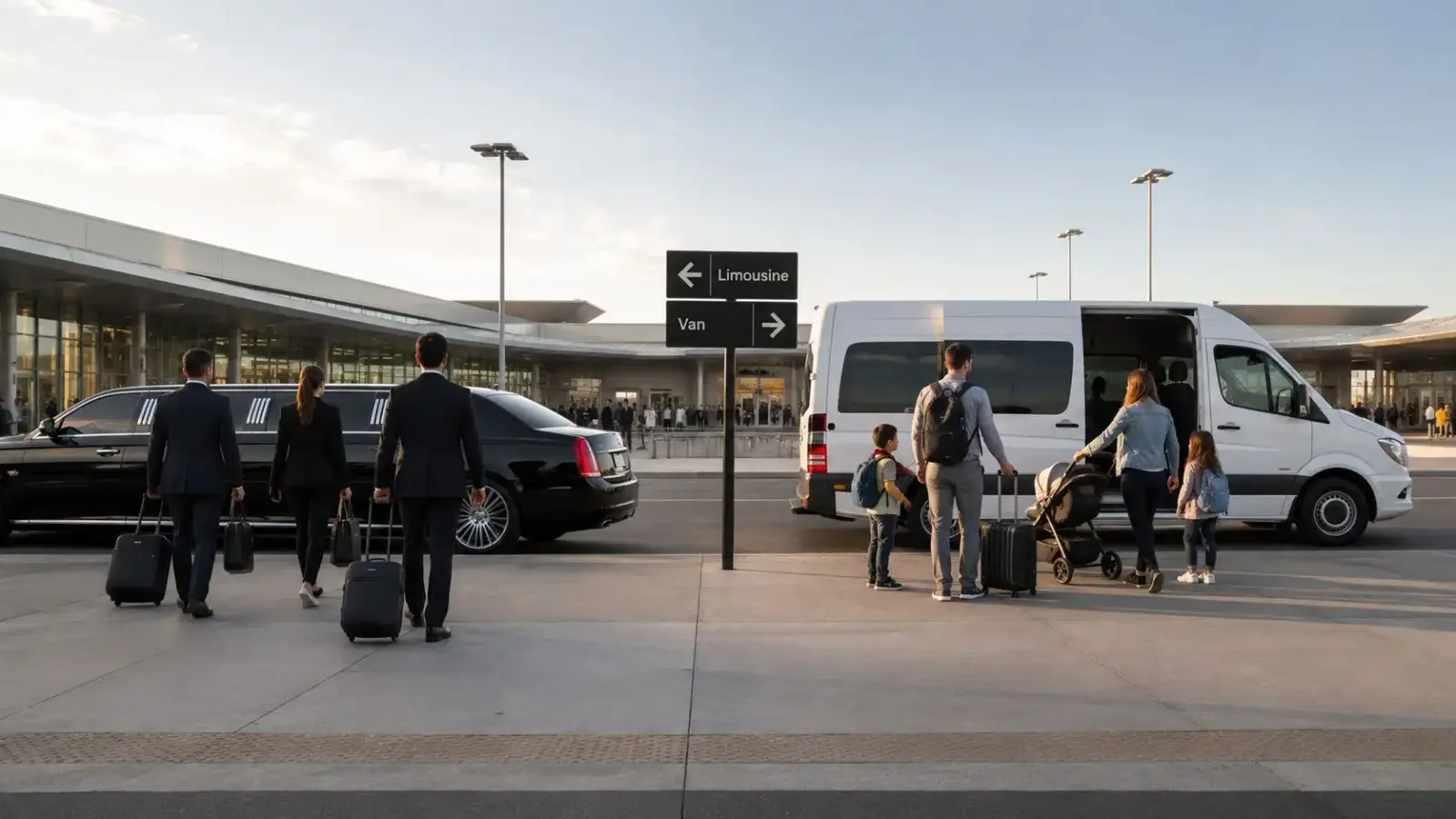
A Queens pickup sounds simple until the baggage carousel spits out three oversized suitcases, a stroller, two carry-ons, and one tired family that just wants to get home. That's when the vehicle choice stops being about image and starts being about whether the whole party gets out of the terminal together, with the luggage, on the first try. For limo service Queens NYC, the question is not which ride looks nicer, it's which ride survives the airport curb, the bags, and the route without turning into a second problem.
| Vehicle | Passenger Capacity | Luggage Capacity | Cost Per Passenger (6–14 pax) | Best Fit |
|---|---|---|---|---|
| Traditional limo | Usually smaller, best for tight groups | Limited trunk space, weaker for strollers and multiple checked bags | Lower for small, luggage-light parties | Couples, executives, short airport runs |
| Sprinter van | Up to 14 passengers, depending on luggage requirements | Rear cargo space is built for full-size bags, strollers, and car seats | Often better for larger groups because one vehicle keeps everyone together | Families, corporate teams, event groups, heavy luggage |
Table of Contents
- Why Group Travelers in Queens Need a Vehicle Built for the Party
- Traditional Limo vs Sprinter Van at a Glance
- How JFK, LGA, and EWR Pickup Rules Shape the Choice
- Matching the Vehicle to the Traveler Profile
- Cost Per Passenger and Coordination Tradeoffs
- Which Option Fits Which Situation
- How to Request a Quote That Becomes a Real Reservation
- Operational Questions Families and Planners Ask First
Why Group Travelers in Queens Need a Vehicle Built for the Party
A Queens pickup gets messy fast once the terminal doors open and the bags start coming out. Families land at JFK, work crews come through LaGuardia, and international groups arrive with luggage, strollers, and car seats that eat up space. A vehicle that works fine for one or two riders can break down the minute the group grows and the curbside loading gets tight.
Queens sits inside a huge citywide for-hire network, which is why airport moves here are routine, not special. The city's regulated market included about 101,000 licensed for-hire vehicles operating through pre-arrangement in 2023, with 1,767 licensed luxury limousines, 3,230 livery vehicles, and 15,012 black cars among the prearranged fleet, plus 177,051 TLC drivers and 294,483 total active licenses as of December 31, 2023 (NYC TLC annual report). That scale matters because Queens is tied into airport runs, cross-borough trips, and group pickups every day.
The curb problem drives the choice
Practical rule: if the whole party cannot fit in one vehicle with the bags, the booking is already too small.
A private Sprinter van often makes more sense than a traditional limo for Queens airport work. One vehicle gives you one driver, one meet point, one set of instructions, and one clean move out of baggage claim. For dispatch, that is simpler. For travelers, it avoids the mess of splitting a group and hoping a second car shows up exactly when it should.
The limo service Queens NYC search should start with the actual load. Six people with carry-ons are one job. Six people with checked bags, a stroller, and a child seat are a different job. The second group needs a vehicle built around baggage reality, not just seat count. That is the split that matters at JFK, LGA, and EWR, where curb access and luggage space decide whether the pickup stays orderly or turns into a delay.
Traditional Limo vs Sprinter Van at a Glance
Some bookings are still perfectly fine in a traditional limo. Others are a bad fit from the moment the headcount goes past the comfort zone. The right move is to compare capacity, luggage, curb access, and the type of trip in one glance, then stop pretending every airport ride needs the same vehicle.
| Vehicle | Passenger Capacity | Luggage Capacity | Cost Per Passenger (6–14 pax) | Best Fit |
|---|---|---|---|---|
| Traditional limo | Smaller groups, typically best for 2 to 6 travelers | Limited, especially once bags, strollers, and car seats enter the picture | Better for smaller parties that travel light | Executive arrivals, date-night transfers, light airport luggage |
| Sprinter van | Up to 14 passengers, subject to luggage requirements | Stronger fit for full-size bags, stroller storage, and mixed baggage | Often more efficient for larger groups because the cost is spread across more riders | Families, corporate teams, wedding guests, event groups |
A quote-first private van service like Airport Vans NYC's Sprinter van airport transfer page fits this kind of booking logic because the vehicle is selected around the group, not around a generic luxury image. That matters at JFK, LGA, and EWR, where the airport rules and baggage load can matter more than the badge on the door.
Use the vehicle that matches the load
A traditional limo can still be the right answer when the party is small and the bags are light. It's a clean choice for a few people with carry-ons, especially when the pickup is straightforward. But once the group expands, or once strollers and checked luggage start competing for space, the van stops being a luxury upgrade and starts being the sensible move.
The point isn't to downgrade the limo. It's to stop forcing airport logistics into a vehicle that was not meant to carry a family reunion. Queens travelers usually don't need more style. They need fewer handoffs, fewer loading problems, and fewer surprises at the curb.
How JFK, LGA, and EWR Pickup Rules Shape the Choice
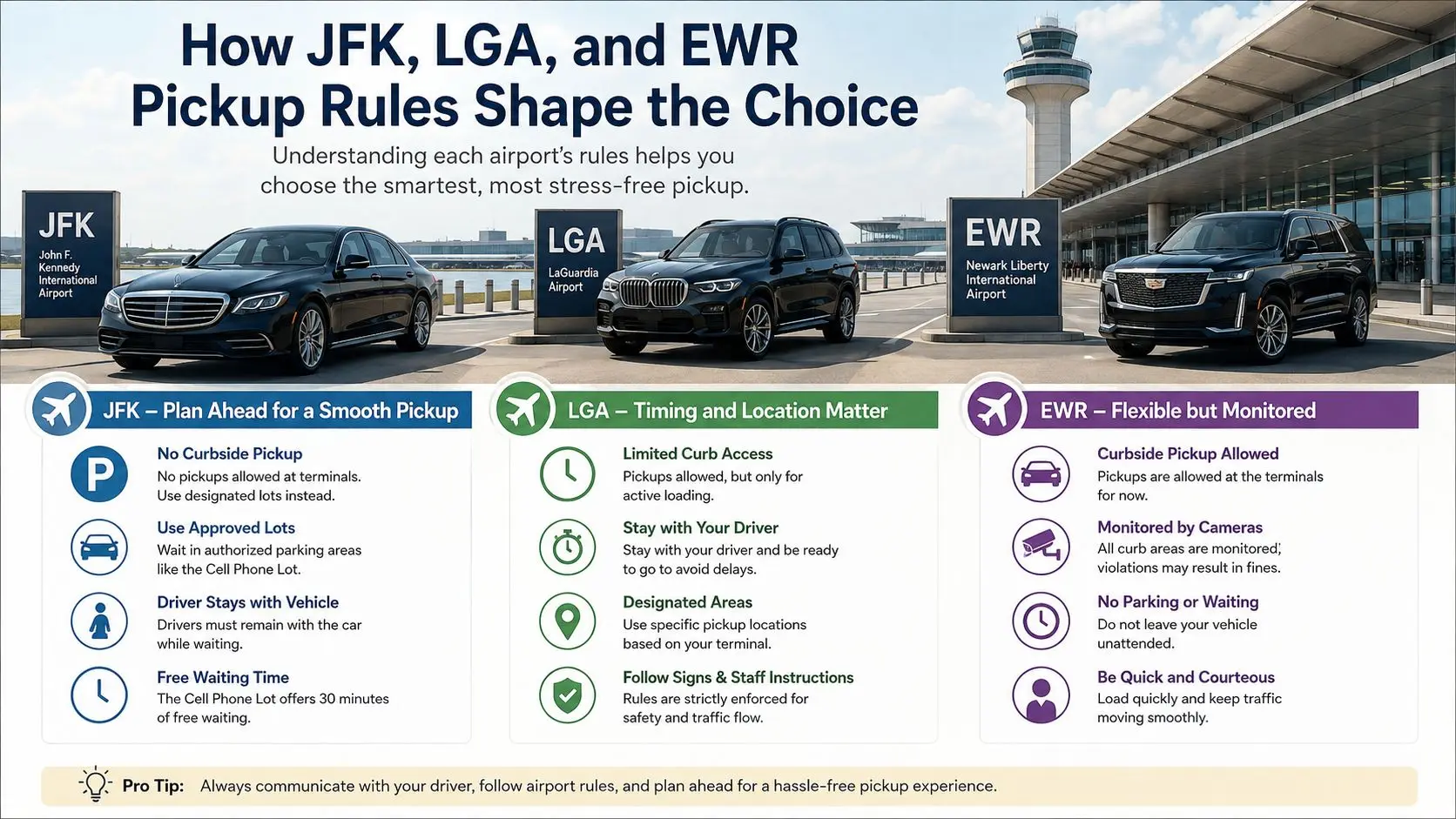
Airport curb rules decide the vehicle before style does. If the pickup point is tight, the terminal is busy, or the luggage count is high, a limo starts to look cramped fast. Queens families and planners need to choose around the handoff, not the badge on the door.
At JFK, official guidance says terminal curbs are for active pick-ups and drop-offs only, so private transfers depend on clear pre-arranged coordination (JFK pickup and drop-off guidance). Our JFK pickup logistics guide explains how that affects timing and meet-up flow. JFK also frames inter-airport travel as a multi-step rail connection, which shows why a direct vehicle helps when the group has luggage and a hard arrival window (JFK inter-airport connections guide).
Terminal layout changes the handoff
LaGuardia pushes the same point even harder. One pickup guide says Terminal B for-hire pickups do not happen at the arrivals curb, they're routed to the parking garage, Level 2, rows E and F, under Ground Transportation and For-Hire Vehicles signage (LaGuardia pickup guide). That setup is fine for a small party. It gets messy when bags are split, kids need help, or people arrive at different speeds.
A single van handles that better than two sedans because one dispatch instruction covers the whole group, one loading point handles the luggage, and nobody gets separated at the curb.
EWR demands the same practical thinking. Newark pickup is its own process, so the dispatcher has to plan for the terminal and the exact meet point, not just the city name. For Queens travelers, the clean answer is direct, the more complex the airport pickup, the more useful a vehicle is that keeps everyone together and gives the luggage one place to go.
Matching the Vehicle to the Traveler Profile
The right vehicle depends on who's traveling, what they're carrying, and how much chaos the terminal is already creating. A family with car seats needs a different setup than a corporate team with roller bags. A mixed-age group returning from an international flight needs something else entirely.
| Profile | Best Vehicle | Key Reason |
|---|---|---|
| Family of six at JFK with car seats, stroller, and checked bags | Sprinter van | One vehicle keeps child gear and luggage together |
| Corporate team of eight at LaGuardia with roller bags only | Traditional limo or Sprinter van, depending on meeting style | The deciding factor is whether the group wants a tighter executive feel or more space |
| Group of twelve arriving at EWR with mixed luggage and older relatives | Sprinter van | Easier boarding, better baggage handling, fewer transfer points |
Family booking
Families should lead with baggage count, not passenger count. A family of six can look manageable on paper and still overwhelm a sedan-style booking once the stroller, child seats, and checked bags are counted. For airport pickups, the dispatcher needs the terminal, airline, flight number, and the actual luggage load, because those details decide whether the ride fits cleanly.
Corporate booking
A corporate team can go either way, but the decision should follow the meeting plan. If the group is coming from a client visit and only has roller bags, a more formal car can make sense for a short transfer. If the team is carrying samples, presentation materials, or split arrivals, the van is the safer choice because it removes the need to coordinate multiple cars after a delay.
Group and international arrival booking
A larger inbound group should default to the vehicle that reduces friction at the curb. That's the clean lesson from airport logistics. If people are older, if luggage is mixed, or if the terminal handoff is already going to take time, the van wins because it reduces the number of moving parts. For some bookings, the issue is not comfort. It's boarding speed and keeping the group intact.
Cost Per Passenger and Coordination Tradeoffs
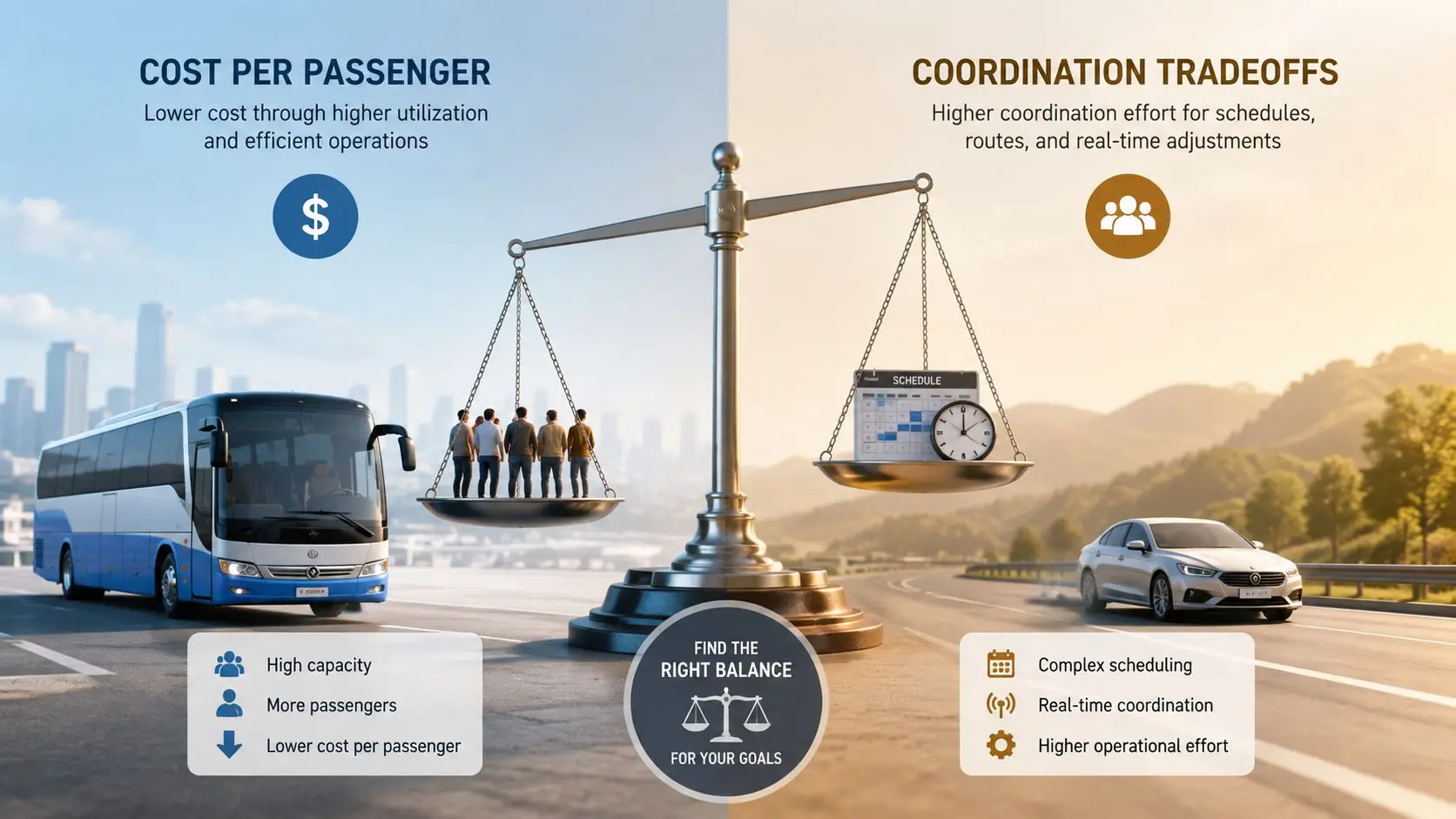
Price conversations go wrong when they focus only on the sticker. A better question is what the ride costs per person once the whole group is accounted for, then what it costs in coordination if the party gets split across multiple cars. That's where a single van often makes sense for Queens airport work, even if the upfront quote is higher than a smaller car.
The math is basic. One vehicle divided by more passengers gives a lower per-head burden. More important, one vehicle removes the hidden cost of managing two pickup points, two drivers, two sets of terminal instructions, and the risk that one car arrives before the other. That's not a luxury issue. That's a logistics issue.
What changes the quote
The final price can move when the booking needs extra support. Car seats, meet-and-greet, additional curbside stops, and waiting time at baggage claim all affect how the dispatch is planned. That doesn't mean every trip needs a premium add-on. It means the dispatcher needs the facts before the quote is locked.
A traditional limo can still win on pure per-passenger cost for a smaller, luggage-light party. But once the group starts approaching the van range, the coordination cost of using two sedans rises fast. One vehicle keeps the ride simpler for the traveler and simpler for the operator.
Best practice: quote the trip using the real luggage count, not the hopeful version. That one detail often decides whether the cheaper vehicle is actually the cheaper booking.
For Queens travelers comparing options, the right decision is often less about style and more about avoiding a second vehicle, a second meet point, and a second delay. That's why a private van can be the smarter buy even when the base quote looks higher.
Which Option Fits Which Situation
A Queens airport pickup gets decided at the curb, not in the brochure. If the group is small, the bags are light, and everyone is landing at one door, a traditional limo does the job. If the terminal run involves bulky luggage, child seats, or a group that needs to stay together from arrival to drop-off, a Sprinter van is the better call.
| Situation | Recommended Vehicle |
|---|---|
| 2 to 4 travelers, light luggage, curbside pickup | Traditional limo |
| 6 or more travelers, strollers, child seats, or multiple checked bags | Sprinter van |
| One group, one terminal, one clean handoff | Sprinter van |
| Small executive transfer with minimal bags | Traditional limo |
| Party approaching 14 passengers, or luggage is the limiting factor | Larger van or shuttle planning |
For bookings near capacity, treat the trip as a luggage and boarding problem. The issue is boarding speed and keeping the group intact. A vehicle that fits the headcount can still fail if the bags do not fit, especially on airport runs where terminal pickup rules leave no room for improvisation.
JFK, LGA, and EWR all punish sloppy planning in different ways. The best choice is the one that lets the dispatcher quote the trip using the actual luggage count, then get everyone into one vehicle without a second stop, a second handoff, or a missed bag at baggage claim.
How to Request a Quote That Becomes a Real Reservation
A quote only works when the dispatcher has enough detail to assign the right vehicle. The booking should include the pickup address or hotel name, the airport terminal and airline for arrivals, the exact headcount, checked and carry-on bag count, child seat needs, and any stops that can't be skipped. When that information is accurate, the operator can match the vehicle to the trip instead of guessing.
A quote request is not the same thing as a reservation. It becomes a reservation only after operator confirmation, so the traveler should expect human follow-up before the trip is locked. That confirmation is where the vehicle class, timing window, and pickup plan get fixed.
What to send with the request
- Exact pickup location: hotel, residence, terminal, or arrival door.
- Flight details: airline, flight number, and terminal for airport arrivals.
- Real passenger count: not the estimated count.
- Baggage count: checked bags, carry-ons, strollers, and car seats.
- Special handling notes: child seats, mobility needs, or time-sensitive stops.
The quote-to-reservation flow is the same whether the trip starts in Queens or ends there. A dispatcher reviews the request, confirms the vehicle, and then shares the live trip details closer to pickup. For travelers comparing private airport transfer logistics, the process used on this private airport transfer guide is the right mindset, details first, confirmation second, no guessing in between.
Operational Questions Families and Planners Ask First
Families and planners usually ask the same set of questions once the vehicle choice is settled. How far ahead should the booking go, whether flight tracking is used, how meet-and-greet affects the price, and what happens when child seats are needed. Those aren't side issues. They're the things that decide whether the pickup feels organized or improvised.
Flight details matter because they let the dispatcher plan around the arrival, not just the scheduled time. Child seats and booster seats should be confirmed during the quote request, along with who is bringing them or whether the operator is sourcing them. If the answer changes after the quote, the reservation should be updated through the same dispatcher line, not handled casually at pickup time.
Inter-airport transfers need even tighter coordination. A party connecting between JFK, LaGuardia, and EWR is not just booking a ride, it's booking a sequence, and the sequence has to respect route timing, curb rules, and the fact that families or corporate groups may converge at one terminal from different directions. That is where a private van is often the cleanest answer, because one vehicle can gather the group without forcing separate arrivals to reconcile at the curb.
| Factor | Traditional Limo | Sprinter Van |
|---|---|---|
| Flight tracking | Useful for arrival timing | Useful for arrival timing |
| Child seats | Possible, but space is tighter | Better fit for families with gear |
| Meet-and-greet | Best when the party is small | Better for larger groups with baggage |
| Advance booking | Should be early for peak travel | Should be early for peak travel |
| Inter-airport transfer | Works for small, light parties | Better for mixed luggage and larger groups |
Airport Vans NYC handles private Sprinter van quotes for JFK, LGA, EWR, Manhattan, Brooklyn, Westchester, New Jersey, and selected inter-airport routes, with each reservation confirmed by the operator after the quote is reviewed. If the trip is a Queens airport pickup, a family transfer, or a group move with real luggage, visit Airport Vans NYC and send the trip details that matter.